


On June 25, we saw one of the bigger upsets of the group stage, as Germany lost to Ecuador 2–1 on a late set piece goal by Gonzalo Plata. Ecuador did not get a result merely on a fluke of finishing but rated as the stronger team by Adjusted xG, 1.3–0.9.1 But nonetheless, this victory comes with an obvious asterisk.
Coming into the match, Germany had clinched first place in Group E and had nothing to play for. Because of the new head-to-head tiebreaker system, it did not matter what the goal difference was in the final group matches: Germany’s victory over Ivory Coast sealed the place for them. Ecuador, by contrast, could only qualify out of the group stage with a victory. The pattern of the game clearly reflected these different priorities.
The second half began 1–1, and typically one would expect the match favorite to exert control and push for a winner. But instead, from the kickoff of the second half through to the Plata winner, it was Ecuador who had the advantage in possession 54 percent to 46 percent and the advantage in field tilt (passes in the final third) 67 to 33 percent. Germany used their periods of possession mostly to slow down the game and Ecuador used theirs to push for a goal, exactly in reverse of what would be expected in a match where both teams had something to play for.
The two other matches in which a team had already clinched their group, Mexico–Czechia and United States–Türkiye, did not tell quite as clear a tactical story. The United States conceded late to lose 3–2, but that Türkiye goal followed a long stretch where the USMNT were playing on the front foot chasing a goal. And Mexico won 3–0 in a match where Czechia created little danger.
In the aggregate, however, these three matches do reflect a more general trend. The United States had by far their worst defensive match of the tournament, conceding three goals on just about 3.0 xG.2 Germany likewise were leaky against an Ecuador side that was projected as a primarily defensive team. Even with Mexico’s solid play, the three teams combined conceded 2.3 more goals and 1.6 more xG than they would be projected to under normal circumstances.
And of course the three teams went a combined 1–0–2, hardly meeting expectations for two tournament hosts and one European powerhouse.
These results were already predicted by the PADDLIN’ model.
Dead Rubbers and “Nothing to Play For” Adjustments
The model obviously did not predict Ecuador to win, but it did drive down Germany’s odds of winning significantly due to the “Nothing to Play For” adjustments. In all of the final round matches with at least one team with nothing to play for, the model shifts the odds of winning slightly to the team with real stakes in the match.
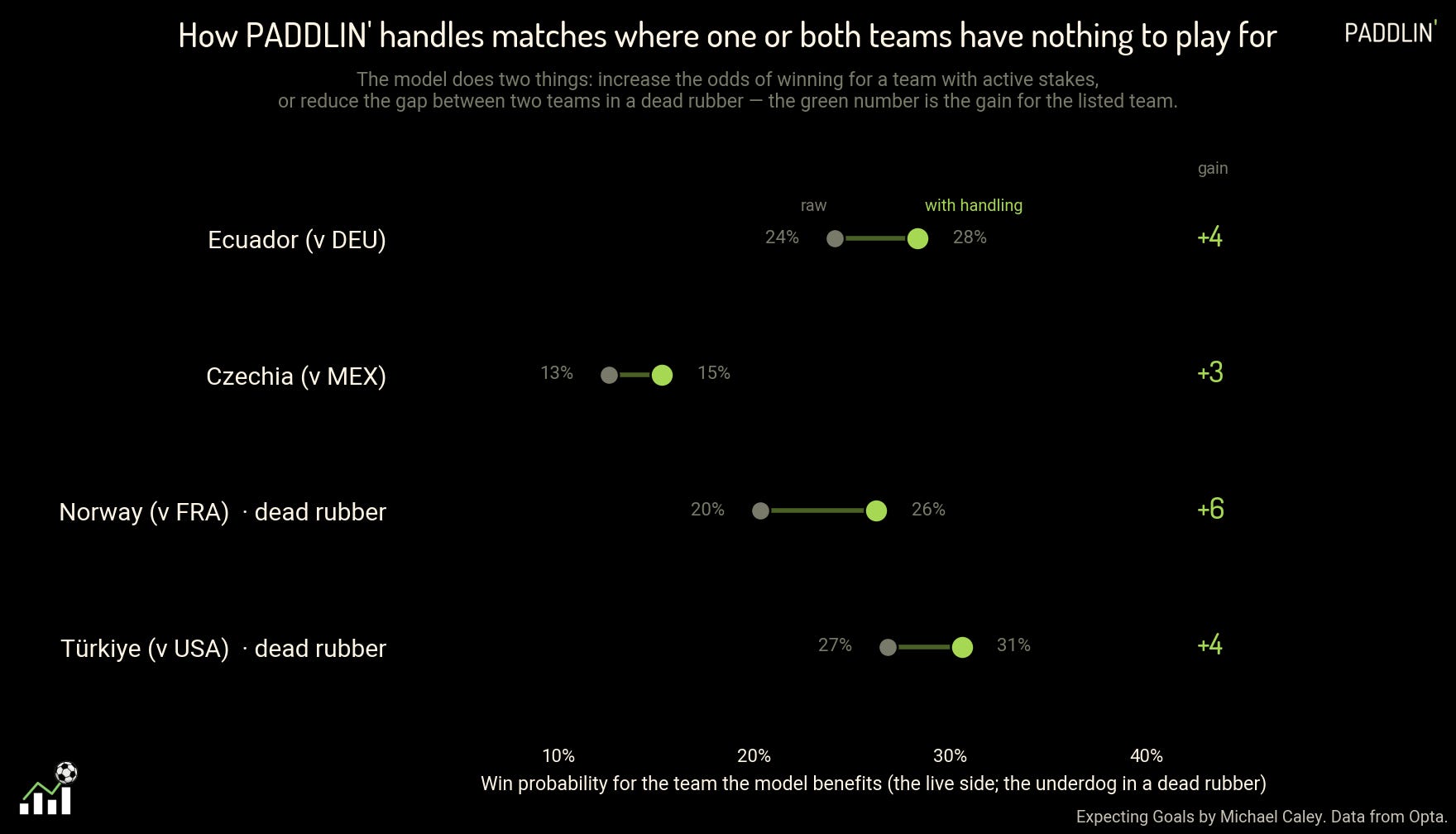
In the development of the PADDLIN’ model, I ran a study to break down tournament and qualifying matches into three separate types:
normal matches, in which both teams have competitive stakes, whether advancement from a group or qualification to a tournament
“nothing to play for” mismatch contests, in which one team has competitive stakes and the other does not
“dead rubbers” in which both teams lack competitive stakes
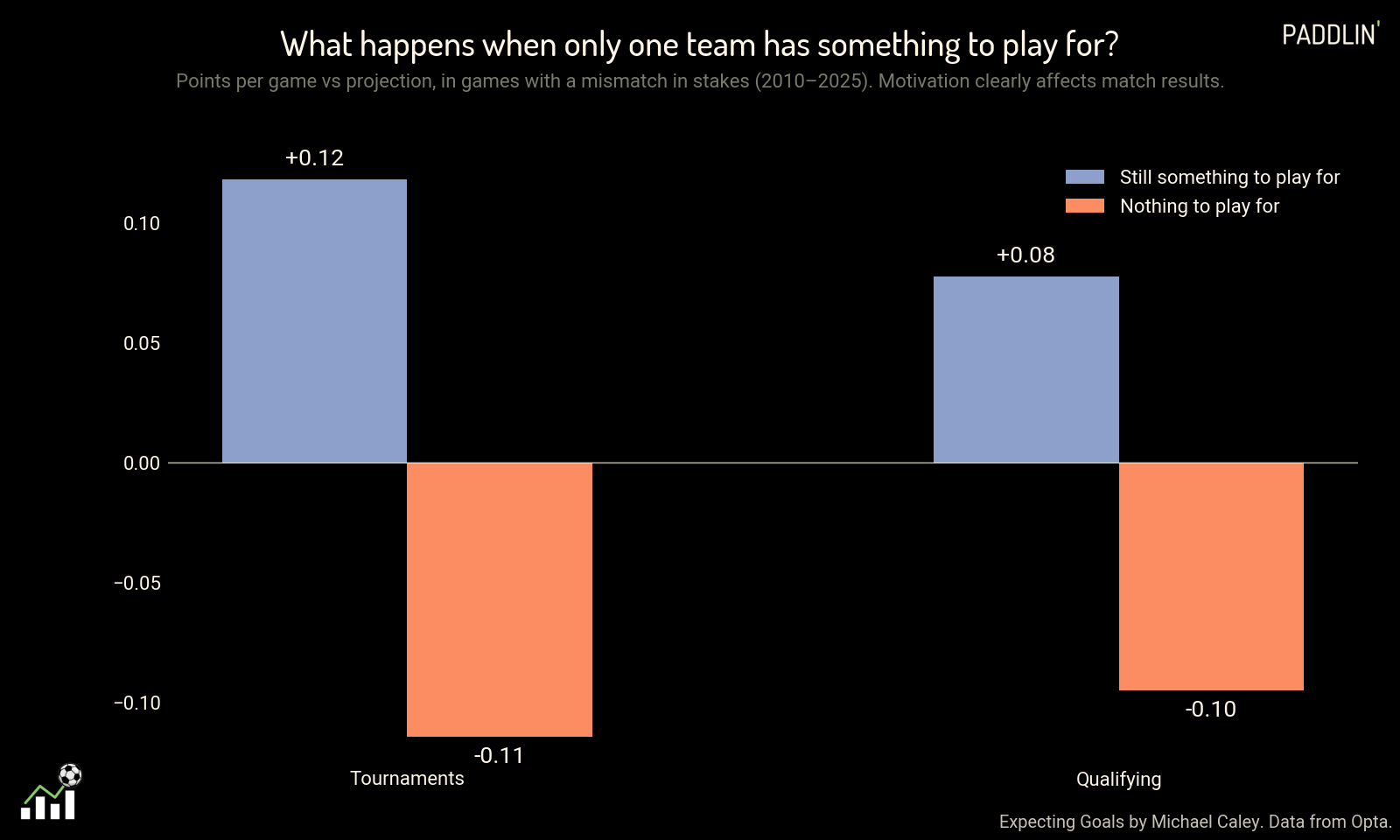
What I found was, first, that when there is a mismatch in stakes there is typically also a mismatch in results and level of play. Exactly as anyone would expect, and as anyone who watched Ecuador–Germany saw demonstrated on the pitch, it matters if a team has something to play for within a tournament structure.
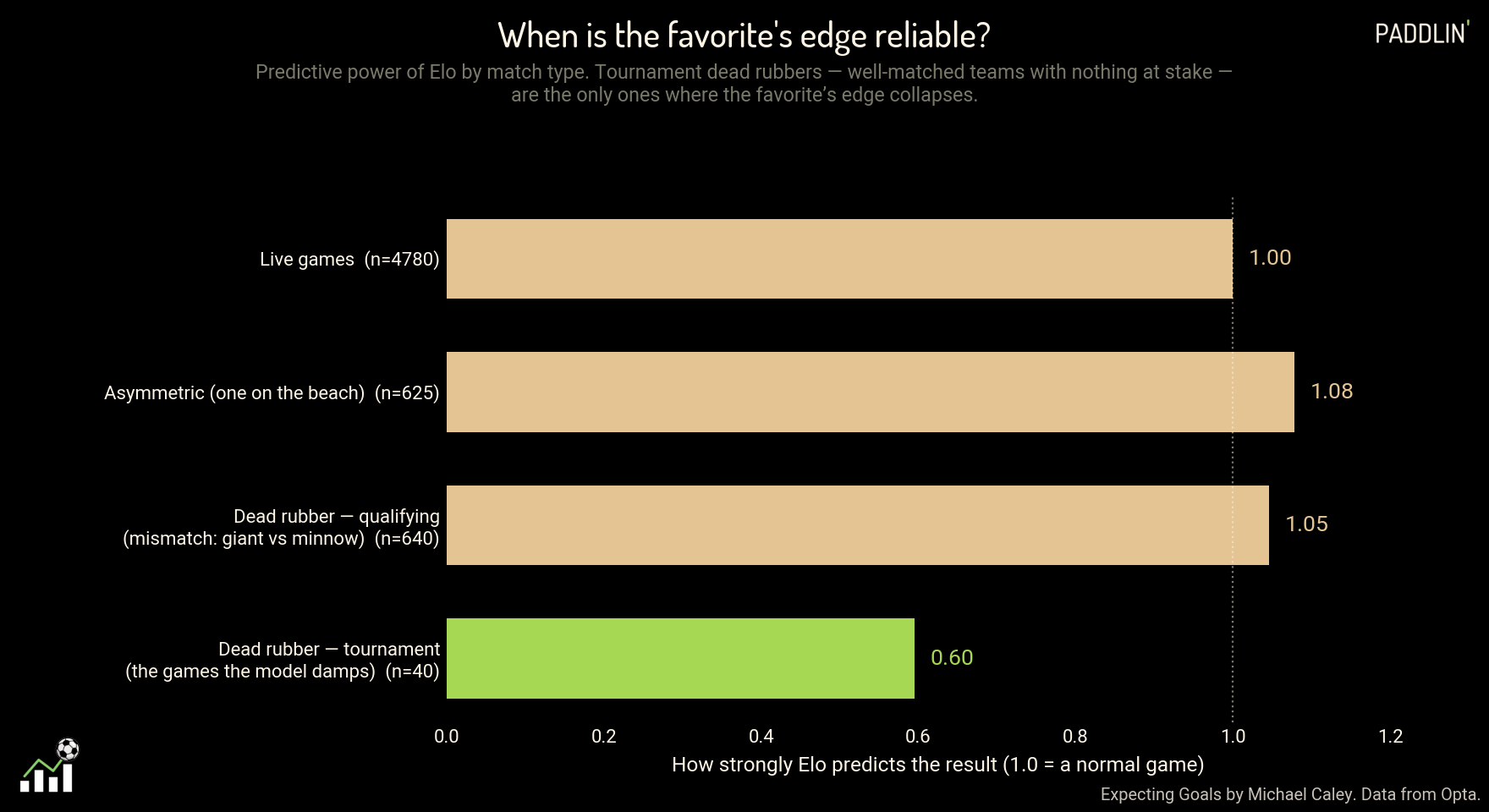
Further, in dead rubbers, I found a significantly greater tendency toward randomness, as favorites were more likely to draw or lose to underdogs.
These results accorded more or less perfectly with an earlier Expecting Goals study of “Nothing to Play For” matches in league competition. In that study, I found that in matches at the end of the league season, teams that have clinched a title or are guaranteed one of the European places but cannot win the title, and teams that are guaranteed to be relegated, all play worse than they did earlier in the season.3
Notably, this pattern of diminished quality of play also has more specific causes, and these causes are just as intuitive as the broader effects. Teams play worse when they have nothing to play for because they defend more poorly. There are only limited, and harder to identify effects on attacking play. Defending is hard, thankless work, and it does appear to be the case that when soccer players have the option, they will often choose to let their defensive intensity lapse. But attacking is fun, and players mostly do keep attacking.
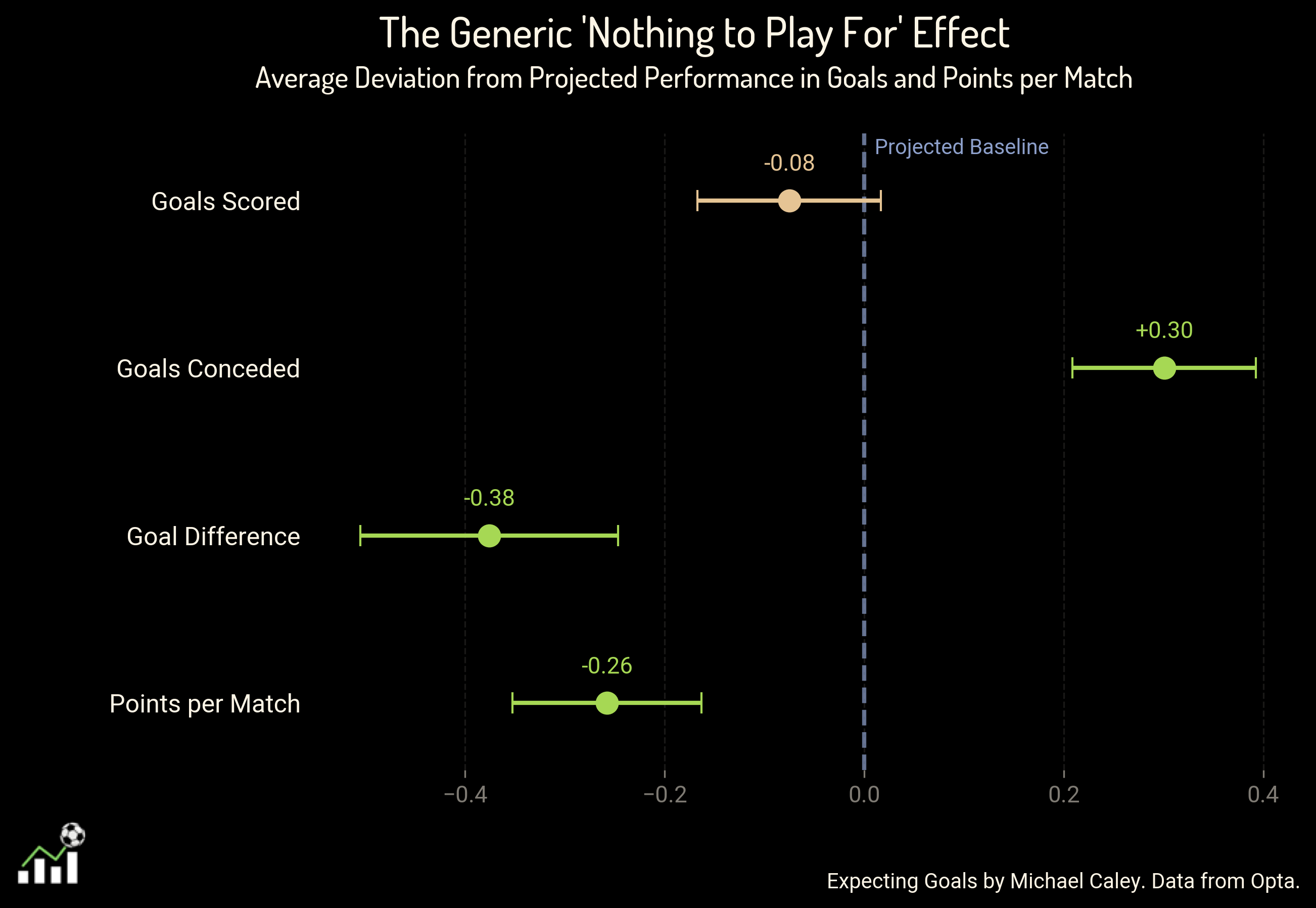
So when I ran the study on the international data, I knew what to expect and I had a clear hypothesis.4 We should expect to see worse performances, and in particular we should expect to see problems primarily in defense.
It might seem right now that the Germany and United States results were exactly in line with my expectations, but the story does get a little more complicated than that. It turns out that tournaments may have different dynamics from both leagues and qualifying competitions, and this history then raises questions about why matches in the 2026 World Cup have not quite followed that pattern.
