


With the expansion of the World Cup to 48 teams and the expansion of the knockout rounds to 32 teams, FIFA had to manage a new qualification structure. They could have instituted a draw system, perhaps. But in their infinite wisdom they decided to create a fixed structure with a degree of complexity that no human mind can fully comprehend in all its specifics.
But its exact dynamics became important following the results on June 23. Ghana’s draw against England puts the Black Stars on four points, which is more or less guaranteed to be enough to qualify for the knockouts.
In the late game on June 23, DR Congo lost to Colombia, putting their qualification from the groups at somewhat more risk.
The combination of these two results, within the bizarre matrix math of FIFA’s new third-place system, meaningfully increased the chances that England will draw Senegal in the round of 32.
It will take a while to get back around to this point, but we will get there. To begin with, here are the very broad strokes of the new knockout qualification system.
Eight third-place teams qualify for the knockouts, from twelve groups. But no one knows in advance which groups will see their third-place side qualify. Arithmetically, there are “12 choose 8” different possible ways that the eight qualifying third-place sides can be distributed among the twelve groups, for a total of 495 different combinations.1 For every single one of these 495 different combinations, FIFA created a distinct way those eight teams would be lined up to face eight different group winners.2 That is, four group winners are pre-assigned to face a specific second-place team from another group, just as the knockouts used to work in the 32-team system, and the other eight face the ludicrous math of the third-place matrix.
So if we are trying to figure out the third-place system, four group winners can be set aside immediately: Groups C, F, H, and J. These are the groups of Brazil, the Netherlands, Spain and Argentina. This structure explains why there was so much discussion of the possibility of a round of 32 tie between Spain and Argentina. If one of Spain or Argentina failed to win their group, the other would be guaranteed to face them, while the winners of other groups get a selection from the third-place pool.
Full PADDLIN’ groups projections are here, for reference.
So, finally, how does FIFA’s new process distribute teams into the knockouts in practice? I fed the entire third-place matrix into my projection system and it gave a few clear answers to start. As applied, there are certain groups whose third-place team is more or less guaranteed to face a specific group winner, should they qualify, and others where that third-place team’s opponent will remain unknown until late in the third round.
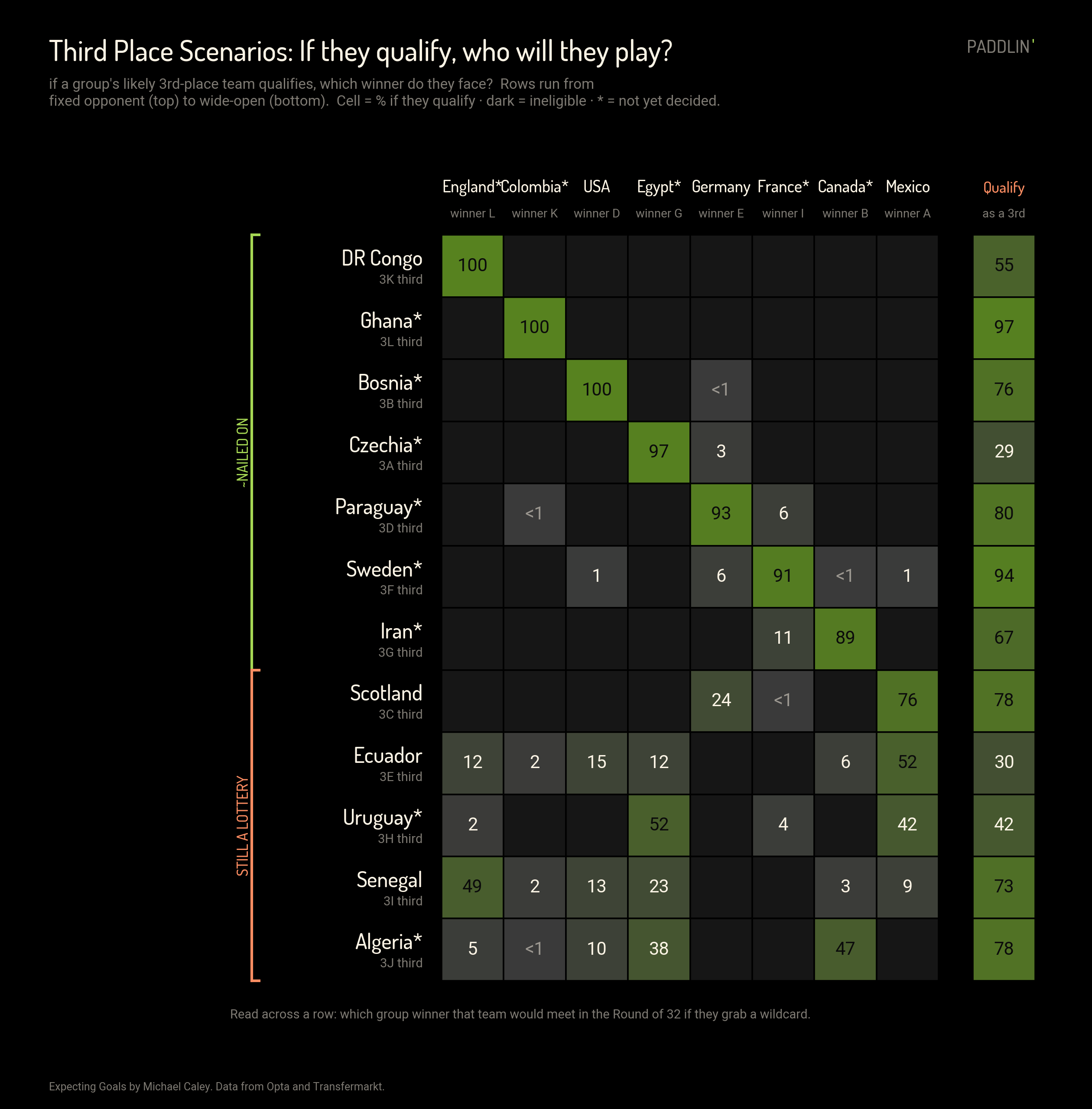
There are four groups whose third-place team is more or less guaranteed to face a specific group winner: Group B (likely Bosnia), Group L (Ghana or Croatia), Group K (likely DR Congo), and Group A (likely Czechia). The above chart shows that these four teams would line up against England, Colombia, the United States, and Egypt, should the favored teams win those groups. But there are also four groups whose third-place team, should they qualify, still has massive uncertainty about their most likely opposition: Group E (likely Ecuador), Group H (Uruguay, Cabo Verde or Saudi Arabia), Group J (likely Algeria) and Group I (Senegal).
Senegal, who are now more likely to face England than any other group winner, offer the most important story here. The Lions of Teranga had perhaps the toughest opening two matches of any team at this World Cup, losing to France and Norway in succession. But Senegal could still qualify for the group stage with a win over Iraq and a little bit of good fortune in the third-place results elsewhere. According to the PADDLIN’ model, Senegal rates as both a roughly 70 percent favorite to make the knockouts, and as the strongest of the likely third-place sides. Their odds of facing England have increased, but it is still highly uncertain where Senegal end up.
And that is what this newsletter was originally intended to explain.
This Will Be a Different Kind of Expecting Goals Newsletter
When I began this project, I thought I would be able to summarize the basics quickly and give fans a simple overview of their teams’ likely paths. But as I began working through the matrix logic, and in particular drafting paragraph after paragraph following the almost impossibly arcane combinations of results that may deliver Senegal to a round of 32 berth, I realized this was a different kind of newsletter. You will follow me into madness, and we may not make it out alive.
Should you choose to continue reading, however, we will gain a better understanding of what factors will be determinative in drawing the round of 32.3
But there are two issues to clarify first. For one, not all of these teams will qualify for the round of 32, and in some groups there may be another team that qualifies in third. In Group B, for instance, Qatar would finish third with a win, and would be more or less guaranteed a place in the knockouts with that win. And if that happened, Qatar would be guaranteed to face the United States, the winners of Group D. PADDLIN’ makes Bosnia big favorites in that match and so they projected as the most likely third-place qualifier, but that has not been fixed yet.
In this newsletter, for ease of reading, I will often refer to the current favorite for a group’s first or third-place spot as the team which will take that place in the knockouts. There is uncertainty on all these projections, but the points apply whether Canada or Switzerland win the group or whether Bosnia or Qatar finish third.
Further, if Bosnia and Qatar draw, then it is very unlikely either team would qualify for the knockouts. Should that happen, the United States would face a different third-place team in the round of 32. Because no team has yet locked up a third-place finish, that means that every one of the eight group winners in the chart faces a reasonable amount of uncertainty about their knockout opposition.
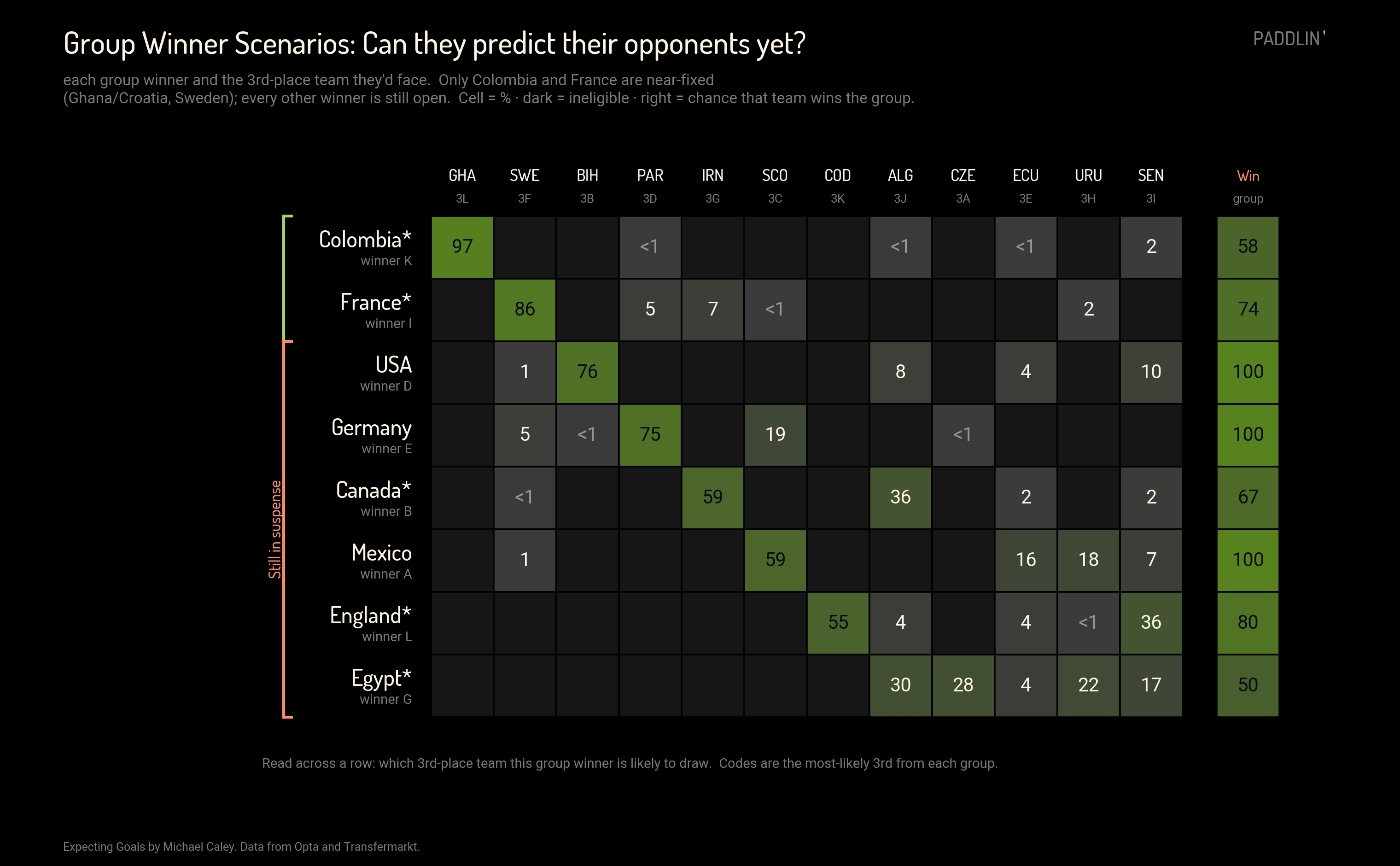
The winner of Group K (Colombia or Portugal) is now more or less guaranteed a match against the third-place team from Group L (Ghana or Croatia).
Along with Colombia, the winners of Group I are highly likely to face the third-place team from Group F. In Group F, both Japan and Sweden have blowout victories over Tunisia on their records, and so whoever finishes third is massively favored to make the knockouts. This gives France (or possibly Norway) an unusual amount of certainty in their likely opposition. It will be Japan or Sweden, unless something highly unexpected occurs.
That more or less does it for group winners who have a straightforward round of 32 opponent. Everyone else faces the question of whether one or two results in other groups might give them a different round of 32 tie, and could even deliver Senegal to one unlucky side.
For the United States, Canada, Mexico,4 Germany, England, and Belgium or Egypt, there are many different combinations of results that could throw off their round of 32 plans. Likewise, Scotland, Senegal, Algeria and a few other likely third-place finishers, will await the results of other matches to see which group winner they are likely to draw.
For each of these teams, the permutations are complicated but fixed. And so I have collected the data on which results will lead to which opponents for each of these teams, and the likelihood of each outcome according to PADDLIN’.
Third-Place Combinatorics, or, the Esoteric Punishments for England 0–0 Ghana
Coming into the day, England stood a 25 percent chance of drawing Senegal as their round of 32 opponent, and this increased to 36 percent with the conclusion of Colombia–DR Congo.
To explain how this occurred requires answering what seem like basic questions, such as “who will face England in the round of 32?” and “where would Senegal be placed in the knockout bracket?” However, the answers to these questions become complex in ways that stretch the capacity of language to properly and coherently draw out.
Take my hand to begin the descent, if you dare.
