


It was a comprehensive defeat for the United States at the hands of Belgium on July 6. The Red Devils had attempted 7 shots for 1.3 xG, including Charles De Ketelaere’s opener, before the USMNT even attempted their first shot on goal. Even in the second half, as the United States came out pushing for a goal, they only managed four attempts and never came particularly close. It was a dispiriting end to the World Cup, and it has raised a variety of questions from fans of the team.
One question is whether the furor around the White House’s intervention in Folarin Balogun’s red card suspension created a more difficult atmosphere for the players. If you want to hear my opinions on and my breakdown of the Balogun situation, I was interviewed on KCRW, a Los Angeles public radio station, by Madeleine Brand before the match. But the question of whether the USSF, FIFA, or the White House were justified in their actions, or followed any kind of fair process, is a separate one from how the larger context affected the game on the field.
And that is an impossible question for analytics to answer. Notably, manager Mauricio Pochettino denied at his press conference that the political situation made any real difference, and he also emphasized that he and his players were responsible for their performance regardless. When you get into questions of human psychology and group dynamics, in a situation none of the players have or likely will experience again, it becomes impossible to test any particular theory. And that is before getting into a discussion of Belgium, who came out with a clear tactical plan and executed at a high level. The number of unknowable potential causal factors should inspire humility among commentators. We will probably never know the answer.
But there are certain baselines that analytics can offer to the discussion. Did the United States play unusually poorly against Belgium, or was this simply what normally happens when a team at the USMNT’s level faces its first top level European test in a tournament? That is an objective question that the PADDLIN’ model can help answer. If the team’s performance was not below par, then there is little need to ask further questions about context. But if it was significantly below par, then at least there is a football outcome that needs explanation.
Likewise, perhaps the question is not one of the team rating based on their performances but the talent level overall. Is a team with talent like the United States’ expected to fall short against Belgium? Is this loss just another in a long line of USMNT losses built on the same problem, a shallow talent pool? Here the Transfermarkt ratings used in the PADDLIN’ system can be useful. These ratings are not foolproof, but they have been shown to predict team quality and results, and given that the ratings are crowd-sourced from a mostly-European set of evaluators, there is little reason to think Americans would be overrated.
In these studies, I found that the United States’ talent has improved significantly over the last decade, and that the performance against Belgium was surprisingly poor. This does not mean that any particular explanation is justified, but it does show that the match and the performance require explanation.
Belgium 4-1 United States: A Paddlin’ Indeed
The United States came into the round of 16 having won three of four contests with only a defeat to Türkiye in a dead rubber match with a mostly-rotated starting lineup as the exception. In normal competitive situations at this World Cup—excluding matches with nothing to play for and periods of time played at a man advantage or disadvantage, the United States was dominant. And then against Belgium, they were dominated.
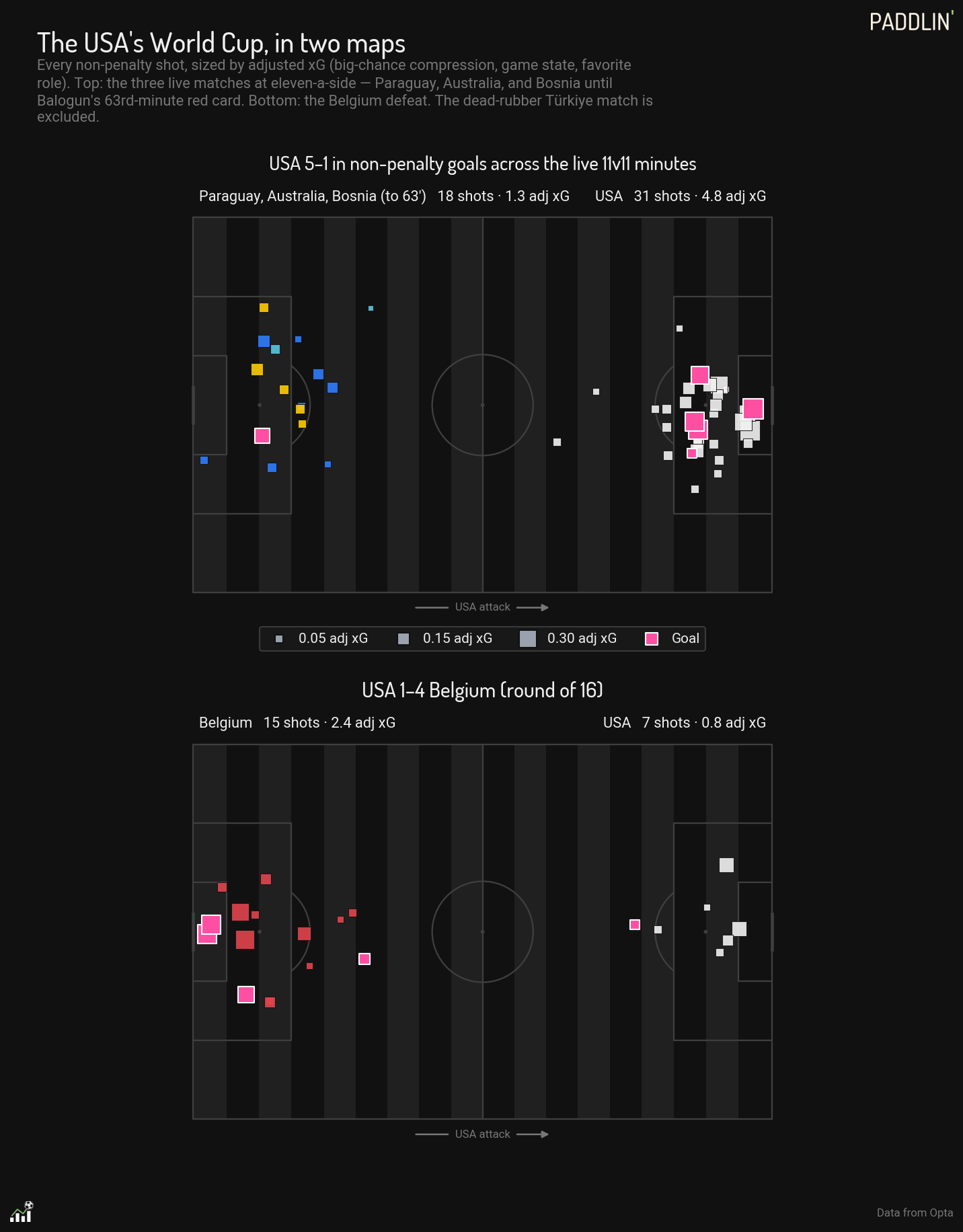
A United States team that had allowed opponents few opportunities within close sight of goal conceded three huge chances to Belgium in the first half (the two Charles De Ketelaere goals and Youri Tielemans’ first-minute miss), all within 12 yards of goal. An attack that had created good chances at high rates fell silent, despite chasing a result for most of the game.
Of course, Belgium are the best team the United States have faced. Even after some disappointing performances, the Red Devils were still on the edge of the tournament top 10 in the PADDLIN’ ratings. No one should have expected the United States to run Belgium off the pitch like they did to Paraguay. But this is a question that a projection system is perfectly set up to answer. What were reasonable expectations for the United States coming into these matches, and did the US exceed or fall short of those expectations?
In both cases, the PADDLIN’ projections reinforce the initial observation. The USMNT played at an unusually high level in their opening matches, and then collapsed well below expectations against Belgium.
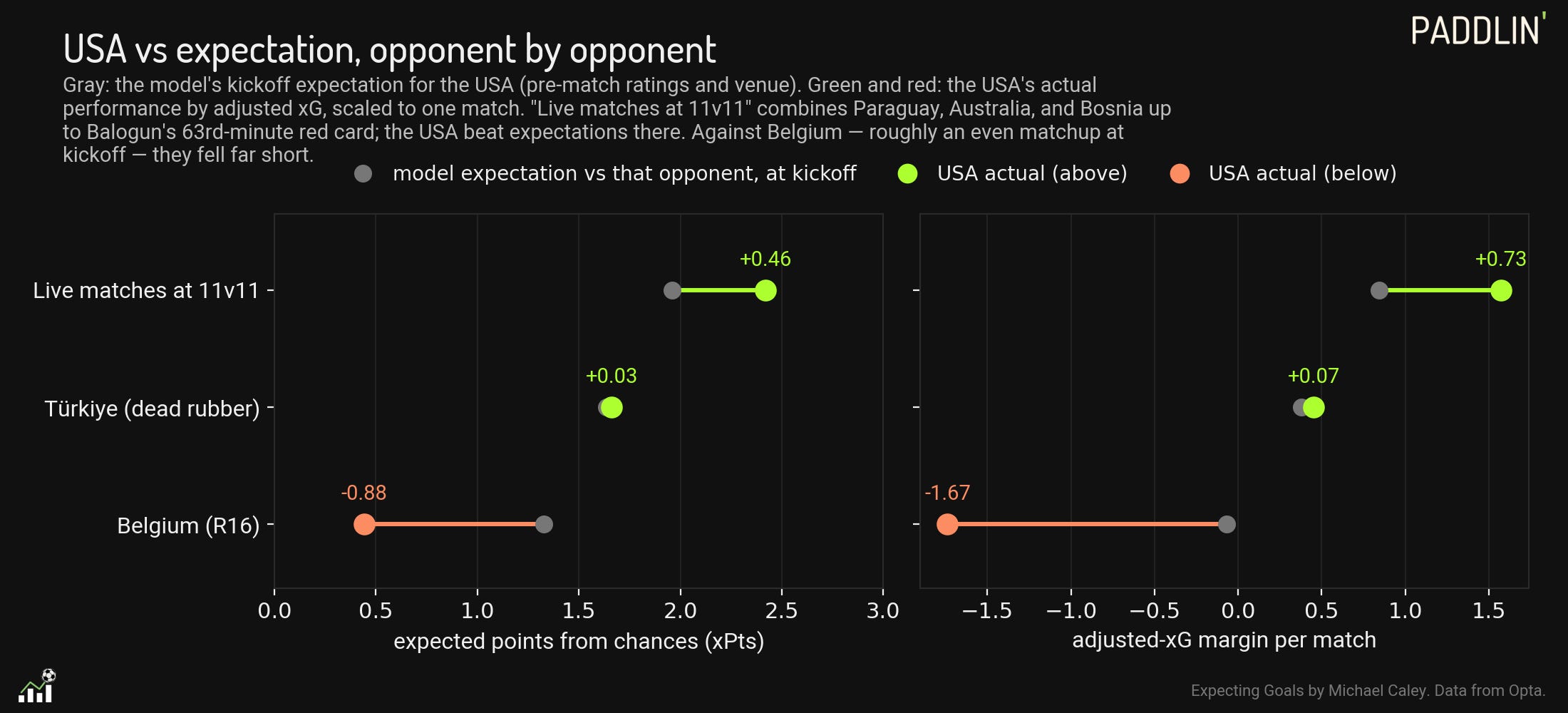
The Red Devils were clearly the best team the United States faced. But with home field advantage and a competitive team rating, the difference between the two teams should have been only fractions of a goal, not the 4-1 result and 2.5-0.8 adjusted xG estimate of the match itself. Likewise, while the United States was rightly favored in their group matches and against Bosnia, the easy victories in live matches all reflected performances well above expectation.
Winning against Paraguay, Australia, and Bosnia, and then losing to Belgium, would not in itself have required any explanation. But the results can mislead here. It is not merely that the United States won the matches they should have won, but they did so comprehensively and rarely faced any risk of defeat. And likewise, Belgium did not merely proceed to the quarterfinals as expected, but dismantled the United States to such a degree that even a fluke deflected goal could not make the match competitive.
The results may have been to expectation but the underlying performances were not.1
When you account for the extent of Belgium’s superiority, it was a surprising result that opens up further questions for analysis.
If we come at the question from a different angle, looking at estimated talent level rather than the team’s rating and projection, we find similar answers. The USMNT has added significant talent over the last decade and clearly progressed up the charts of international teams, and a purely talent-based model would be just as surprised by this result. This data also puts a different spin on the 2014 team that took Belgium to extra time and the 2018 team which failed to qualify for the following World Cup.
