


Editor’s Note: The initial PADDLIN’ projections were published with a key bug in the code, which affected specifically the USA, Mexico and Canada. In each group, one or two matches were projected without incorporating home field advantage or the player value adjustment. This bug did not affect knockout projections, and so the favorites for the tournament remain the same, and it did not affect the team ratings at all. The charts and commentary have been updated to reflect the real pre-tournament projections (with notes if anything notable changed), to correct the effects of this bug
The World Cup kicks off today, when Mexico hosts South Africa at the Azteca. There is nothing like a World Cup. I do not mean that the entire world, to a first approximation, will be watching. I do not mean that the greatest athletes alive will play for teams nothing like their club sides, at stakes no club match can touch. I do not even refer to the exceptional corruption and venality of FIFA, or its warm friendships with the world’s most unsavory leaders.
What I mean is: the World Cup is an analytics problem unlike any other.
What makes it special? Partly that everyone cares, and a model that gets it wrong gets to faceplant in front of all of them.1 But mostly the problem is technical. Take one of the biggest matches of the last World Cup
Morocco upset Portugal 1-0 and became the first African team to reach the semi-finals. In the (nearly) four years since, Morocco has played 53 matches, about 15 per year, and Portugal has played only 40. Of Portugal’s matches, 31 have been competitive fixtures, and every single one has been against a team in UEFA, the (mostly) European confederation. Of their seven friendlies, five were also against UEFA opposition and their two matches in March against the USA and Mexico were the first against non-UEFA competition. When Portugal kicked off a friendly against Nigeria on Wednesday, June 10, it was their first match against an African team since losing to Morocco.
Morocco’s record is slightly richer, but all the more telling for that. By playing in the Arab Cup in December 2025, Morocco did rack up five competitive matches against opponents from AFC, the (mostly) Asian confederation, but only two of those teams, Saudi Arabia and Jordan, will be at this World Cup. Other than a June friendly against Norway, the only matches Morocco has played against UEFA opponents since defeating Portugal were the ensuing World Cup semifinal and third-place match against France and Croatia, respectively.
If Morocco were to face Portugal at the World Cup again, what would you have to go on to predict that match? Both teams have played fewer matches than most club teams play in a single season but spread out over four years. They do not even have a single shared opponent since the World Cup, not even in a non-competitive fixture.
Even within the few truly competitive matches at major tournaments, problems arise. Portugal lost 2-0 in the Euros to Georgia, but that match took place after Portugal had clinched a spot in the knockouts with two straight victories, and manager Roberto Martínez chose to rest key starters because the result did not matter to the team’s advancement.
There are too few matches over too long a time to build a good system. Many of the matches are not competitive fixtures, and the remaining high-stakes matches are held nearly exclusively within fixed groups by confederation. And even some of the few matches left over happen under unusual competitive conditions.
Data coverage makes it all worse. Expected goals are published for every major league match in the world; for internationals the coverage is spotty, and outside Europe it is sparse.
All of that is what makes projecting the World Cup fun.
Introducing: Probabilistic Archetype, Dominance-Driven, Linking Interrelated National teams (PADDLIN’)
The apostrophe, of course, cuts off the final word “teams.”
This model seeks an answer to all the problems that bedevil any objective measurement of international team quality. It uses an Elo rating based on actual results and, where available, an xElo rating based on the projected result of adjusted expected goals, to get a first view of team quality that can be compared among teams around the world. The model does in fact increase the weights of matches in which a team put up a significant margin in goal difference or xG difference, actually incorporating the question of whether one team or another did suffer a paddlin’. It makes use of player values from Transfermarkt.com to adjust these Elo ratings, giving teams credit for having better players available beyond the effects they may have had on results in the past. While these crowd-sourced player ratings are far from definitive, work by Paul Johnson among others has demonstrated their utility for statstical projections. The model makes particular use of these values in situations where two teams do not have opponents in common, like Portugal and Morocco, and where teams have very few matches with expected goals coverage. The idea is, if we have a fair number of matches connecting two teams, and a reasonable amount of advanced stats coverage between them, the Transfermarkt values aren’t as important for distinguishing between the two teams. But if it is hard to say objectively what the relationship between two sides is based on their results and past opponents, the model leans more heavily on estimated player quality. In general, in matches between two teams in the same confederation, the model will lean more heavily on Elo, and in cross-confederation matches the model will lean more heavily on Transfermarkt.
There are a lot more pieces that go into this model, but let’s take a look at the output.
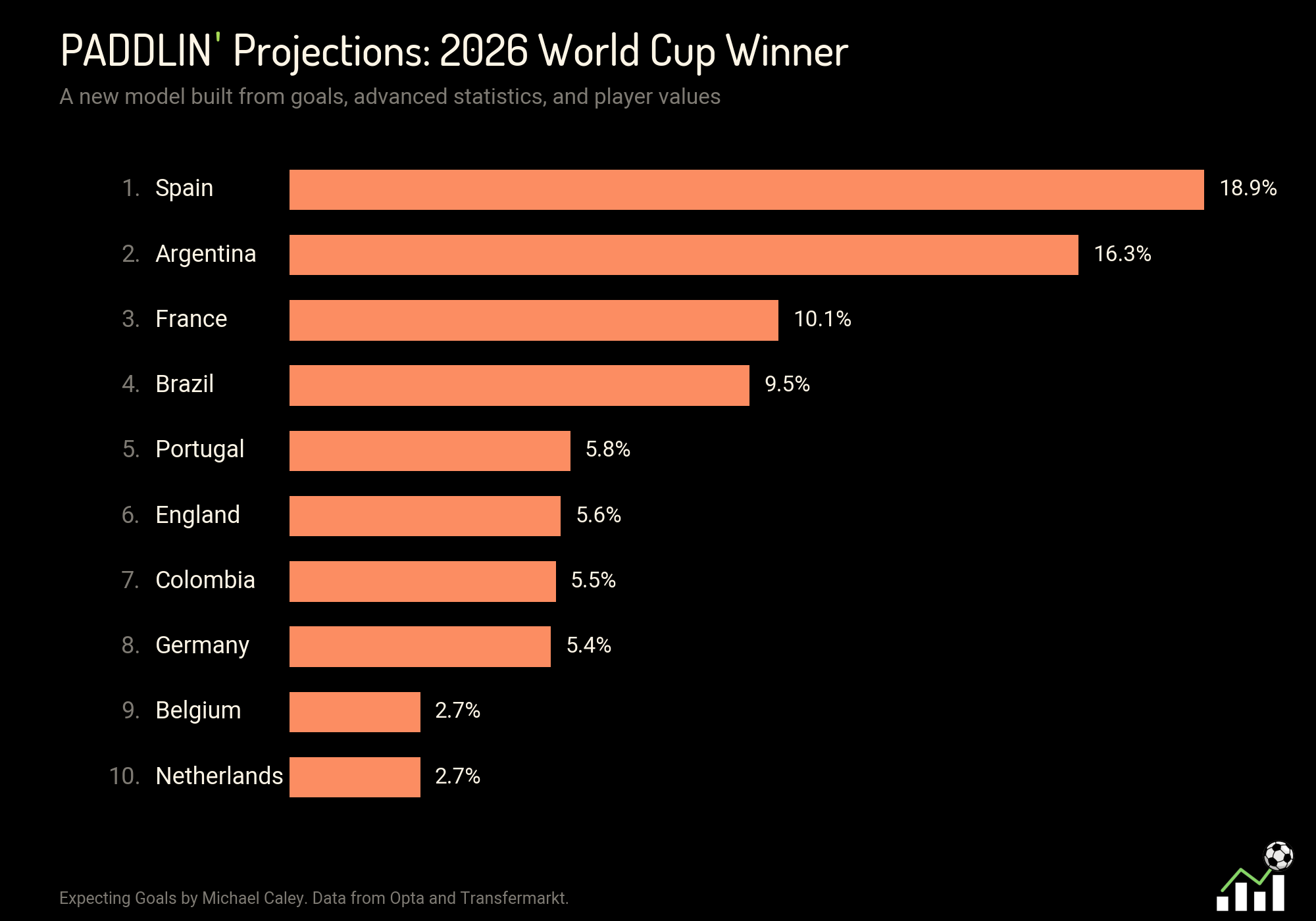
These are the projections for how the tournament will play out, which differ from the general team ratings in a couple important ways. These projections are based on a Monte Carlo simulation which runs the scheduled tournament over and over to find probabilities, so teams with more and less favorable draws will be pushed up or down. Further, this takes into account home field advantage. I will have more to say about international football HFA, the bane of my existence for the last several weeks, but in this model there are three home field effect. First is a general and substantial advantage for hosts, second is an adjustment based on the altitude the match is played at, and third is a smaller projected benefit for teams that traveled across fewer time zones to play at this World Cup. (Colombia is getting a little boost from that third factor, which is enough to slip them ahead of Germany.)
These are the underlying ratings which drive the model, before any specific tournament adjustments. Because the Transfermarkt adjustment is not applied equally to all matches, I do not have a final, single Elo rating for all teams. Instead, this is a “Round Robin Score” based on how many points every team would project to take in a 48-team neutral field round robin tournament between all the World Cup teams.2
