The process of developing an Expecting Goals study rarely runs down a predetermined track without detours or dead ends. A question drives me toward another question which leads into some statistical analysis that ends up not being necessary, or even sufficiently related to the larger argument of the eventual newsletter. But there is often a real finding at the end of those cul-de-sacs. One thing I want to do this year is publish more of these mini-studies.
In the midst of working on last week’s set piece study, I pulled some data together on player shot and goal production from set pieces, and on teams’ primary set piece takers and set piece targets. I found that player set piece goals and assists are best predicted not by open play statistics, but by a combination of that player’s set piece production and by their role on the team’s set plays. These results suggest that set piece production should be understood as a separate aspect of player statistical production, and players should be evaluated and projected in distinct ways on set piece and open play skills. That is an interesting result even if it ended up being extraneous to the argument of last week’s newsletter.
I also did a few media appearances last week including a guest spot on the FML FPL podcast,1 which covers Fantasy Premier League. And I realized that my little set piece study included some actionable findings for fantasy players: measuring set piece targets helps predict goal-scoring. So that will be this week’s mini-study. But, with all respect to Alon’s lovely podcast, that was not the most important newsletter media this week.
I Made “Meat Wall” Happen
Last week I published a piece on the set piece revolution in the English Premier League and we recorded an episode of the Double Pivot Podcast discussing the study as well.
This weekend, Jonathan Northcroft wrote a column for The Times which discusses and builds upon this study, focusing particularly on how corner kick strategies have changed. With more corner kicks being struck on inswinging trajectories toward the goal mouth and more players crowding the goalkeeper to prevent claims, Northcroft suggests that clubs will prioritize bigger and stronger keepers. Perhaps Manchester City’s signing of Gianluigi Donnarumma already reflects a recognition of this tactical change.
Northcroft also picked up on a phrase we used on the podcast, describing how teams form a “meat wall” of bodies to prevent goalkeepers from reaching crosses hit to the six-yard box, which normally they would be able to claim. It was exciting to see this newsletter get picked up in major sports media, and I cannot say enough good things about the image that the Times photo editors selected of the “meat wall” in action for Arsenal against Manchester United.
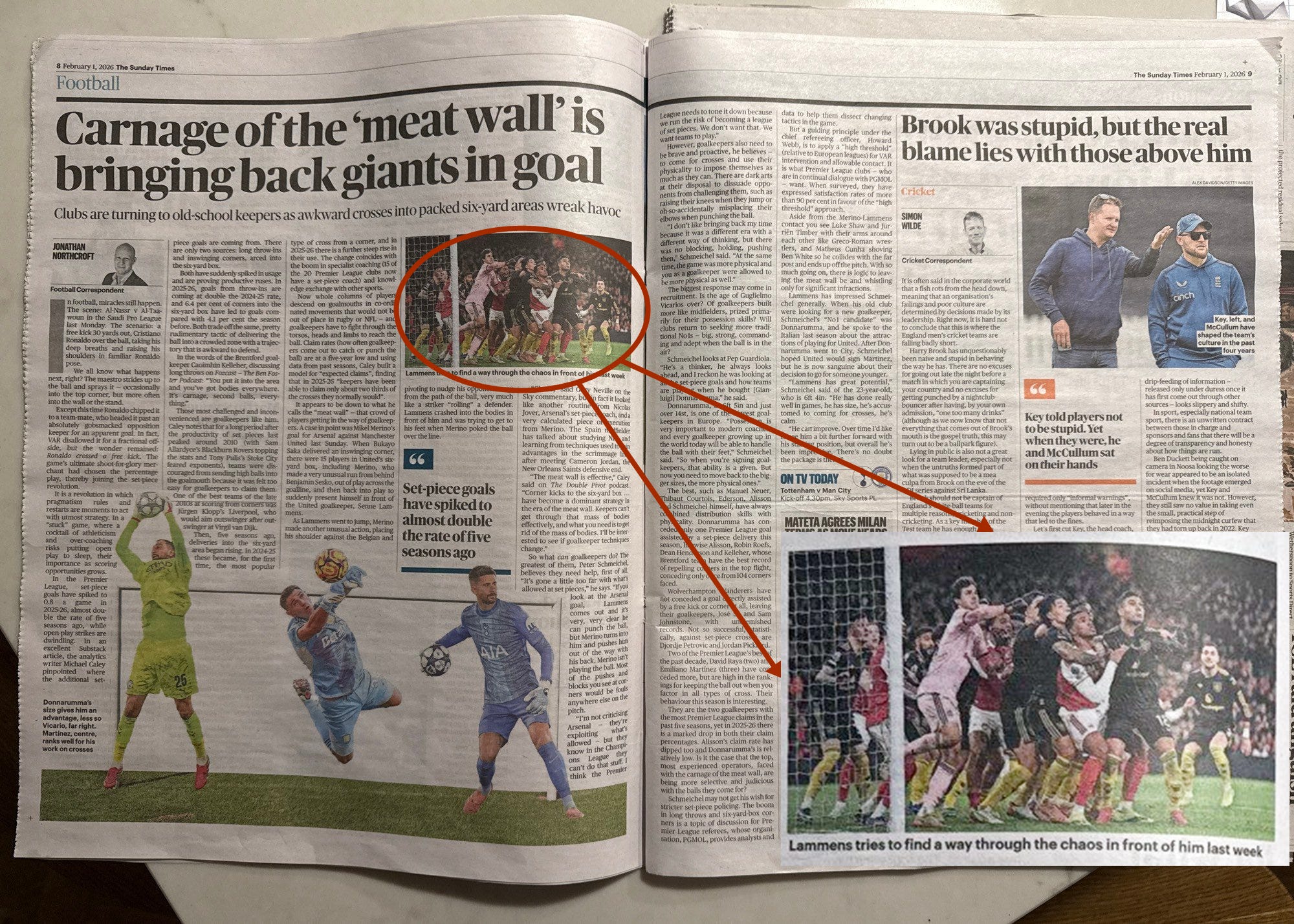
(Thank you to Bluesky user Nick of the Northbank (@nicktheinventor.bsky.social) for alerting me to the article and sharing this image of the physical newspaper.)
We can only hope that “meat wall” gains momentum from here and becomes a football cliche. It has been my dream since I was a little boy that I might introduce a useful and evocative, but vaguely nauseating, term into common sports parlance.
To step back from my own feelings, the fact that this newsletter did reach a wider audience may point back to one of the study’s conclusions. Anyone who has been watching the Premier League this season has seen the set piece explosion and could easily describe the twin tactics of long throws and crowding the keeper which account for most of its revolutionary effects on the game. This study collected the data to confirm more precisely those observations and intuitions, but those observations are widely shared. Public recognition of the set piece revolution is a necessary first step to any experimentation with rule changes to rebalance the game tactically and discourage these simple but seemingly dominant tactics. When and whether such reactions arise will be one of the major stories to follow in football over the next year.
And as long as set pieces remain of elevated importance to the game, it will be even more important to understand their place in the measurement of player production.
The Mini-Study: Predicting Set Piece Statistics
I have written a set of studies for this newsletter on projecting player production using past data, incorporating age curves into projections, and accounting for positional and tactical context. But in those studies, when I looked at shots, goals, assists and shot assists, I did not separate set piece statistics from open play statistics. This appears to have been a mistake.
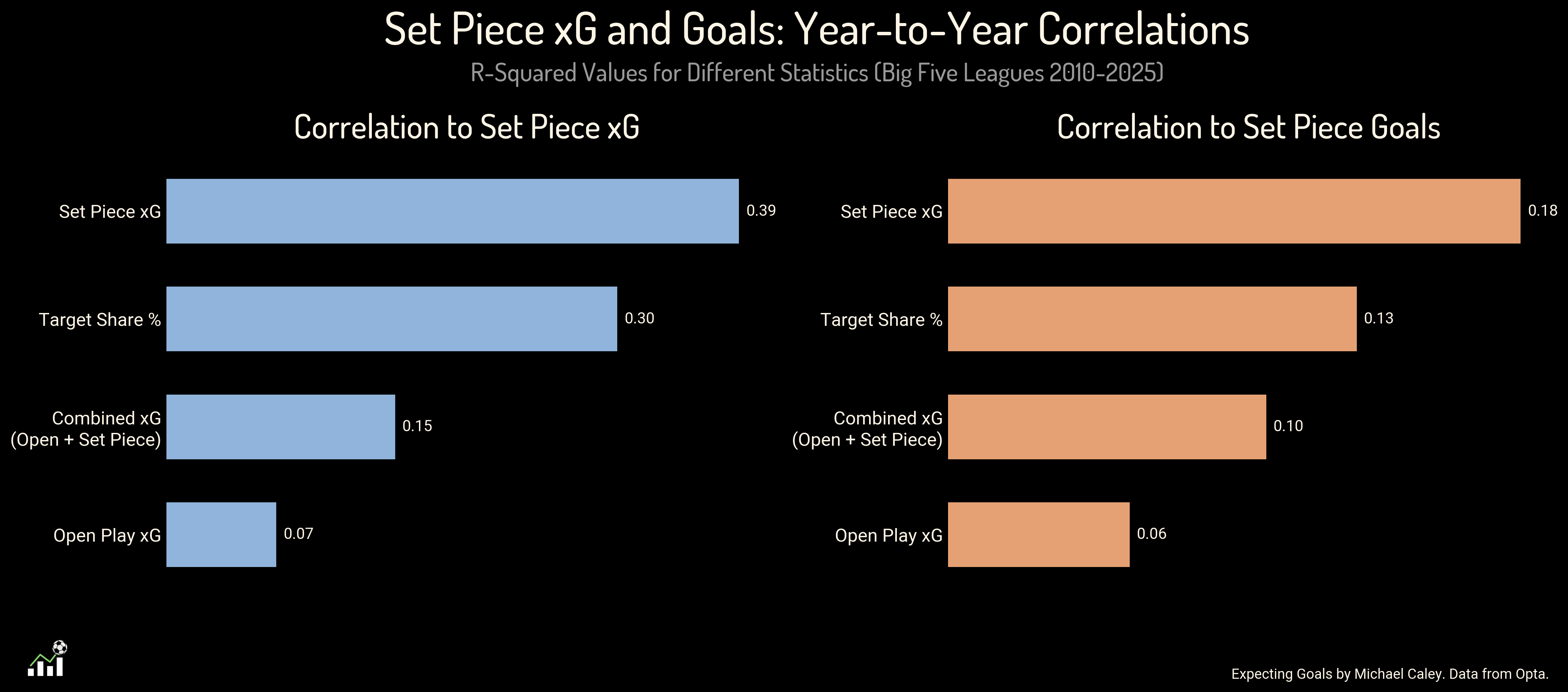
The year-to-year correlation of these statistics shows that future set piece goal-scoring has a much closer relationship to past set piece shot production than to overall or open-play shot production. Now, correlations do not necessarily tell the whole story, as they are a rough measure which is also affected by underlying variance as well as real relationships. As I go through the data we will find some uses for open play statistics in projecting set piece numbers as well.
Note that direct free kick shots have been removed from set piece goals for this analysis. DFK shots have an easily knowable value and assignment process, and so they should be handled separately from set piece chances on crossed or launched balls.