


In the first transfer window newsletter, I wrote about Elliot Anderson and the uniqueness of his statistical profile. Anderson’s involvement in possession and progressive passing statistics were both two to three standard deviations above the league median. This meant that he had very few highly comparable players and those that made the list were all highly recognizable types: elite midfield passers, some capable of playing as a lone pivot 6 and some needing a midfield partner to carry some of the defensive load.
Morgan Rogers does not have that kind of profile. He is an attacking midfielder who can play either wide or central. He does a fair amount of ball progression with passes and with carries, but falls well short of the league leaders at these positions. Rogers made news with his goal-scoring, including some gorgeous finishes, but he ended up with 10 goals last season in well over 3,000 minutes, and his xG was somewhat behind that. His shot creation numbers fall into roughly the same zone: average to above average depending on how you look at it, but short of elite. Now, it could be the case that despite not having one standout metric, the aggregate of his production might place him among a rarefied set of players. That is exactly what the comparables score I developed in the Anderson piece can help identify. How many players have put up numbers similar to those that Rogers most recently produced in the 2025–26 season?
How the Comparables Work: Ball Progression by Carry
With ball progression, I am using the same numbers that I used in the Messi and Ronaldo articles.
“Progressive” actions defined as those that move the ball at least 25% of the distance toward goal
“Expected threat” or “xT” added, comparing the likelihood of goal-scoring from the point where an action began and the point where it ended
Passes and carries into the penalty area
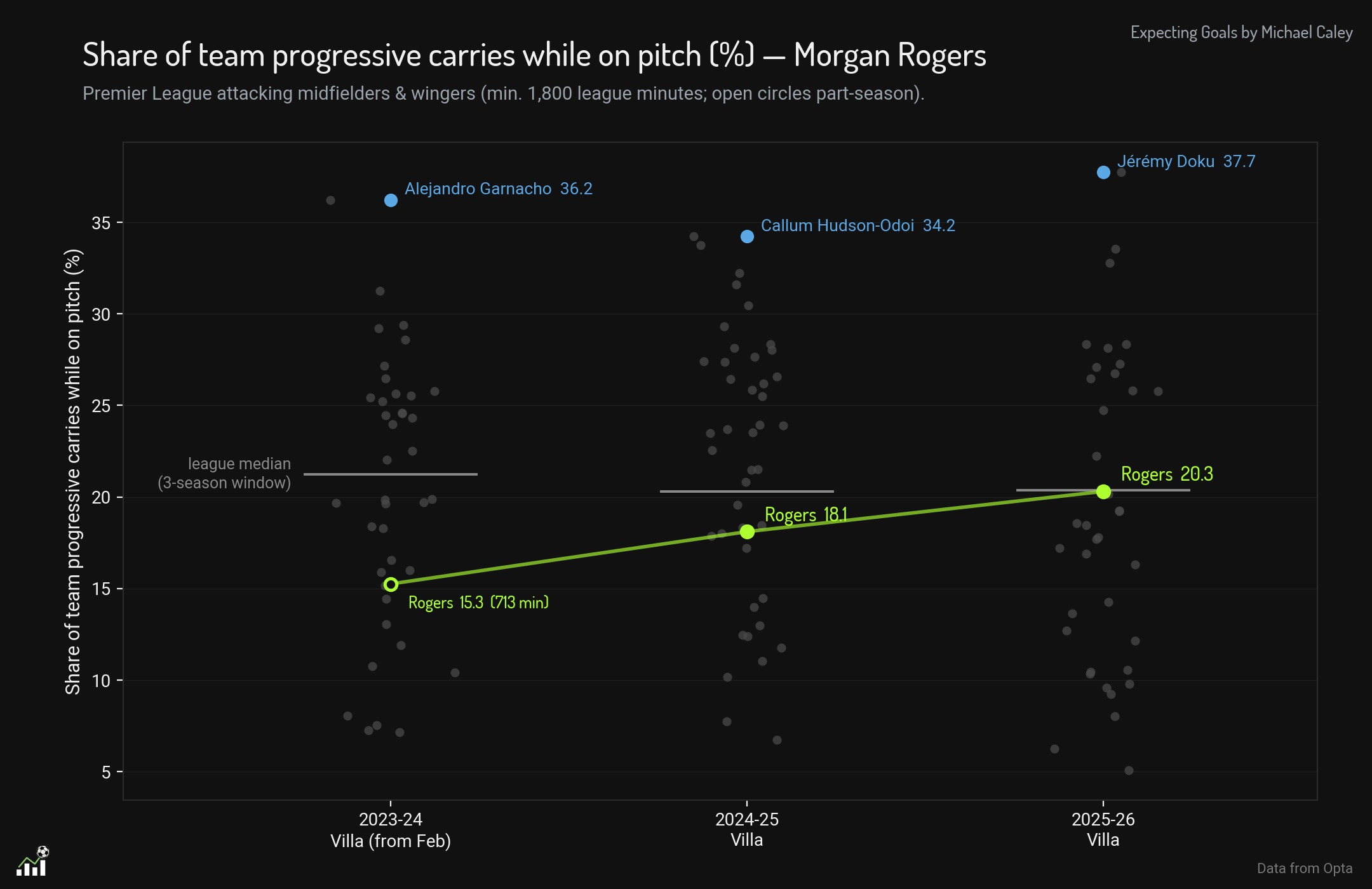
For each of these, I’m looking at both the player’s raw numbers, and their share of team production. “Share of team production” refers to the player’s individual share of the team’s total in that statistic while the player was on the pitch. So if a player completed 10 progressive passes, and in those minutes the whole team completed 100, the player would be responsible for a 10 percent share of team production. For comparable players, I am looking for players with at least 1800 minutes played at central and wide attacking positions, excluding strikers. (For further elaboration of how these numbers were produced, see the Appendix on Method below.)
The story across all of these metrics is that while Rogers’ raw numbers do not distinguish him very much from the median qualifying attacker, he did clearly carry an outsized load of the work for Aston Villa.
These are the charts for progressive carries.
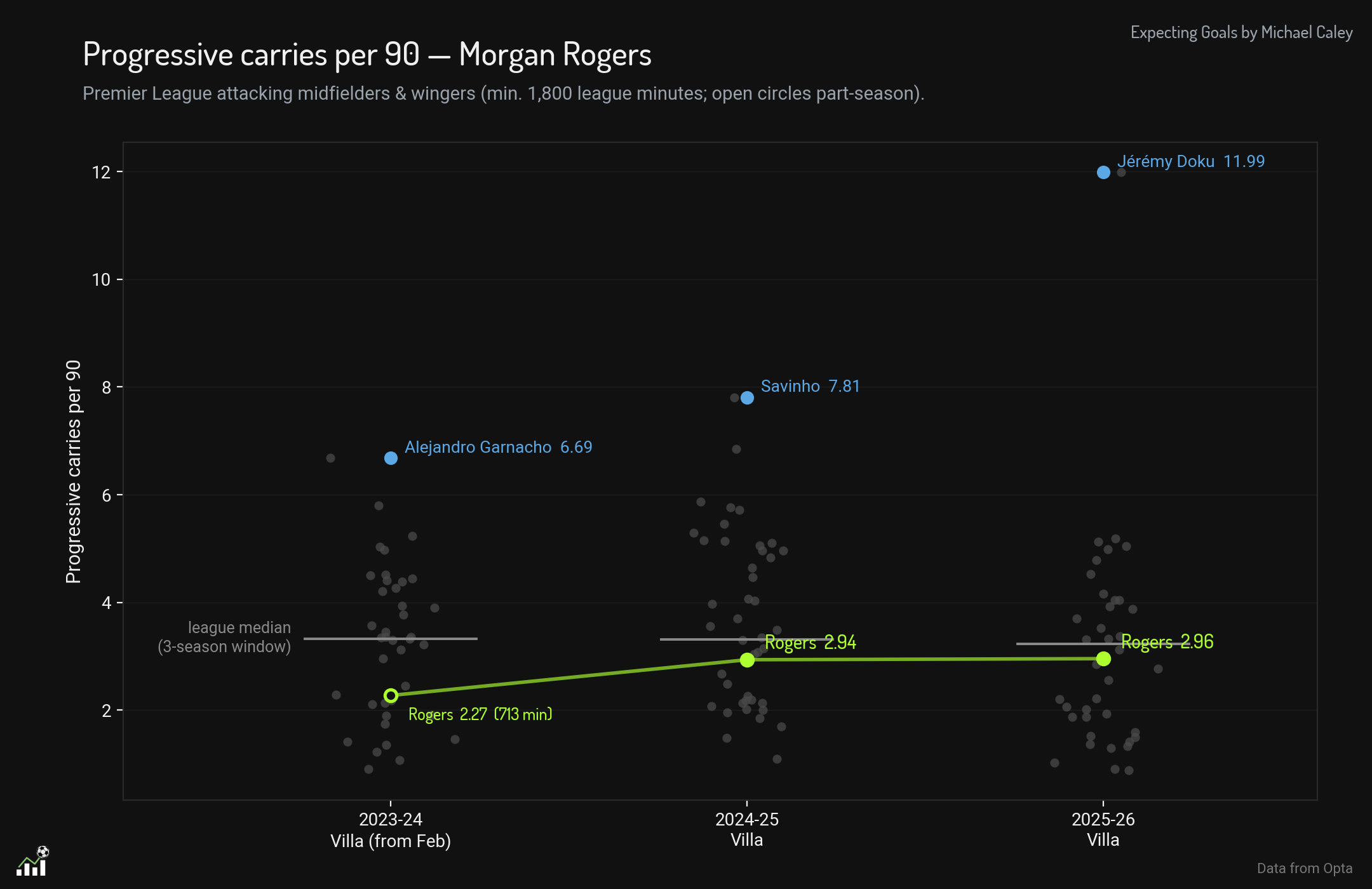
One clear thing that stands out in the numbers is that Rogers, despite being known for his ball-carrying, is not a huge volume ball progressor. Playing in a more central role, he has fewer opportunities to get on the ball and drive into space than a true winger like Jérémy Doku, Savinho or Alejandro Garnacho. Even within Aston Villa’s system, he has not been asked to do an unusual amount of carrying given his position.
Now, this could be an issue with the progressive action definition, which tends to favor true wingers who get more space to drive the ball forward. Expected threat typically gives far more credit for actions taken in and around the penalty area, where there are much larger differences, from one spot to another, in the likelihood of goals being scored. Here the numbers tell a slightly different story. Rogers produces no more than an average amount of penalty area danger from his carries, but he is crucial to Aston Villa’s tactical approach as their core ball-carrier near the penalty area.
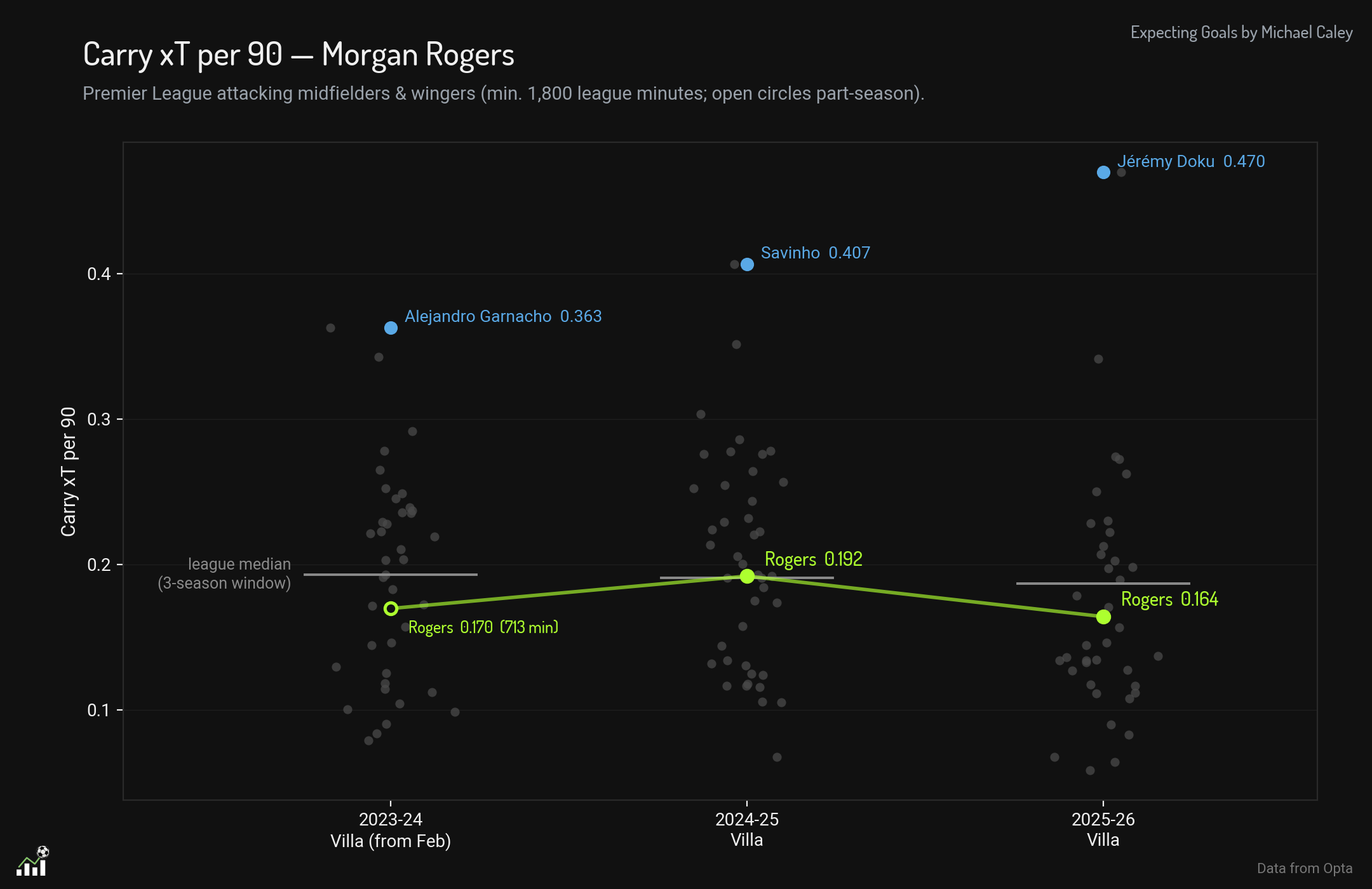
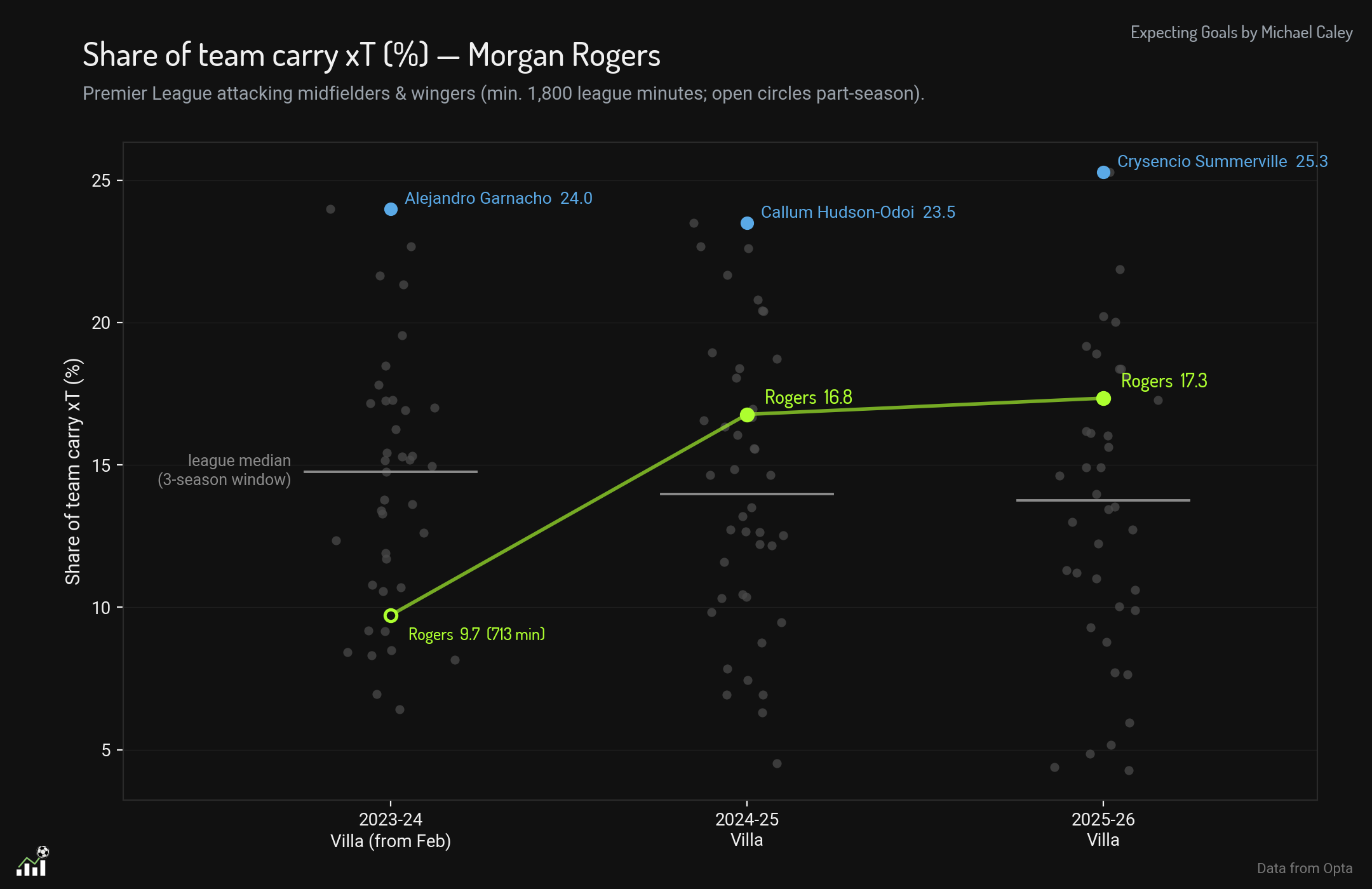
The numbers for carries into the penalty area are similar, with Rogers becoming increasingly important to Villa’s attacking plans.
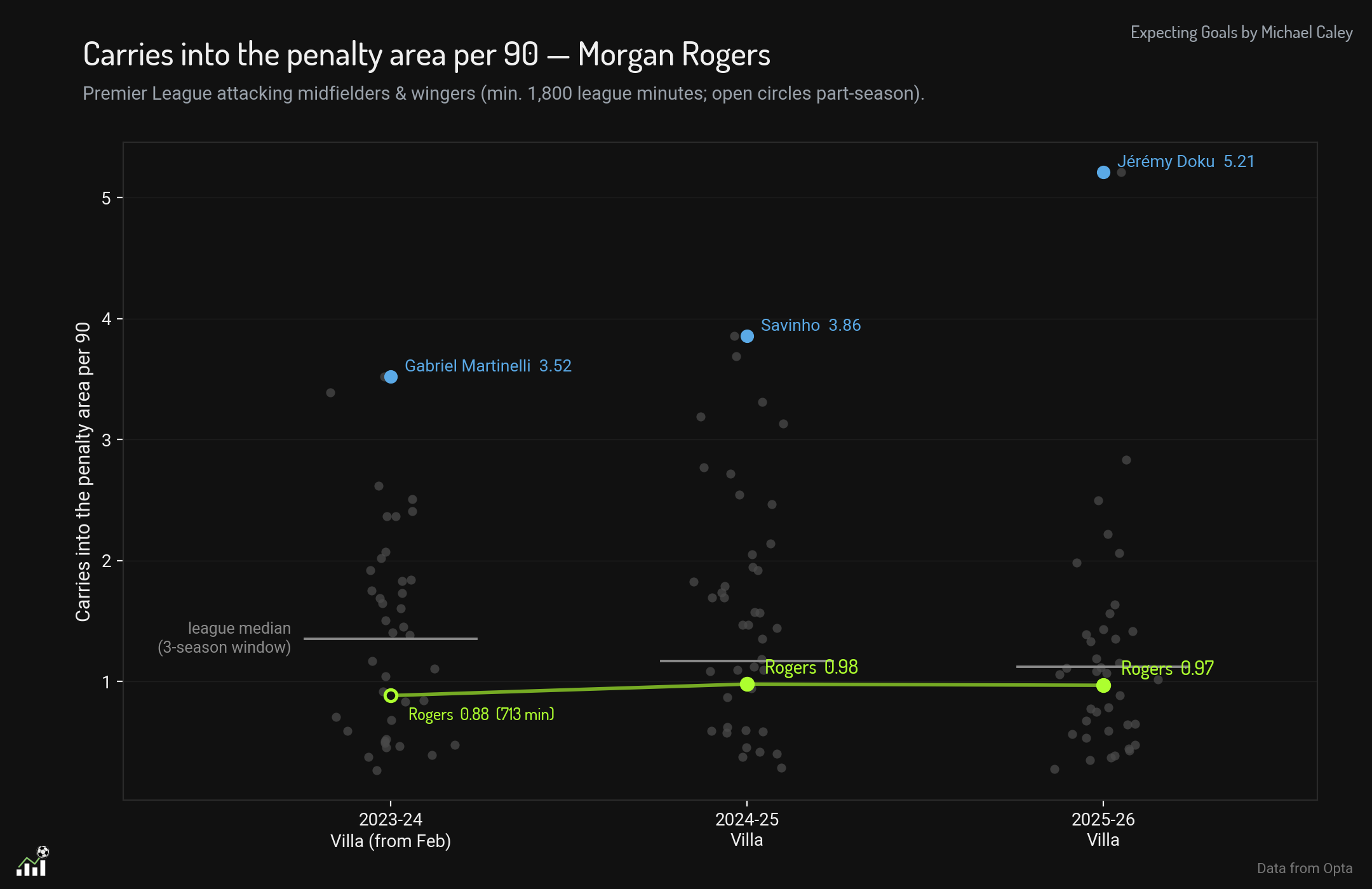
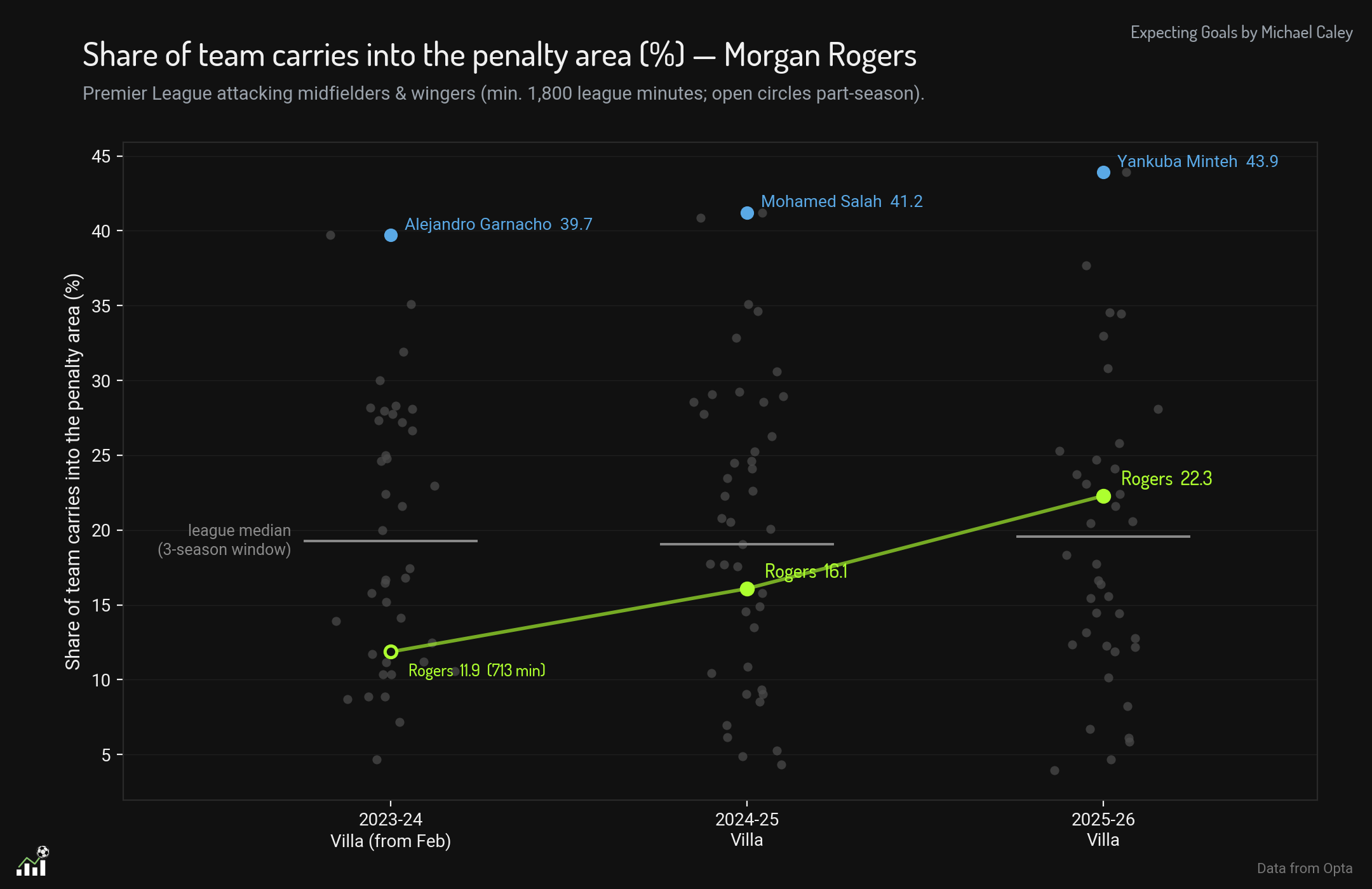
As in the Anderson piece, I use a blend of raw and team share to produce an overall score. Here I am also mixing together the three statistics, with higher weight on progressive actions and xT added, to produce a “carry progression” score and comparables.
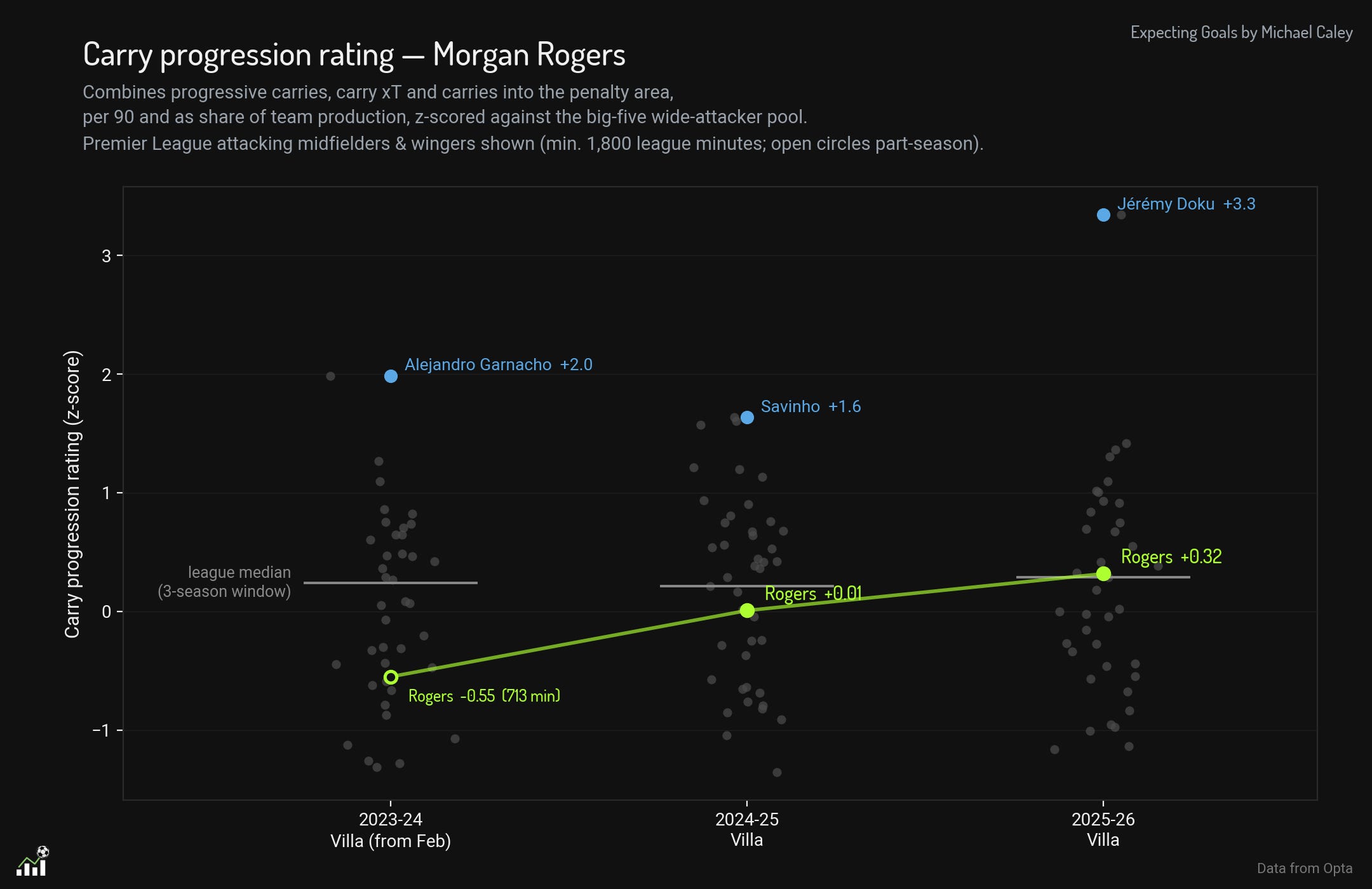
Broadly, this is one of the stories I have found with Rogers. His ball-carrying produces the occasional highlight-reel moment, but in the aggregate it is hard to distinguish his statistical profile from most Premier League attackers.
But he does begin to separate himself, at least somewhat, when the full breadth of his attacking production is accounted for.
