


During the World Cup, Manchester City briefly set the summer’s transfer record by signing Elliot Anderson from Nottingham Forest for a 116 million pound fee. The enormous cost of this acquisition—Anderson is also reportedly being paid over 15 million per season—has been the headline story, especially after Aston Villa received a fee exactly one million pounds higher for Morgan Rogers. But Anderson is a fascinating player with a statistical profile that is both highly unusual and shared by a specific and immediately recognizable group of past and present football players. He has also developed this profile quickly over just a few seasons, shedding earlier tendencies and transforming himself into the sort of player that will draw intense interest from some of the richest clubs in the world. The question of whether Anderson is “worth it” raises questions about quantifiable player value that remain out of the reach of public analytics, but I think getting a handle on his profile can offer some explanations of why he would reasonably be understood as the type of player that only rarely appears on the transfer market.
This profile has three fundamental pillars. Anderson gets on the ball at an exceptionally high rate. He is effective moving the ball forward through the defense, primarily via passing. And he does a good amount of defensive work. It sounds simple, but very few young players can manage such production.
In this newsletter, I will go through Anderson’s development and produce a set of methods for identifying comparable players over the last 17 years. It will take some time to explain, but by my preferred method, these are the six most comparable seasons to Elliot Anderson’s 2025–26 in my database:
Jorginho, Napoli 2016–17
Granit Xhaka, Gladbach 2015–16
Hakan Çalhanoğlu, Inter 2023–24
Toni Kroos, Real Madrid 2022–23
Marco Estrada, Montpellier 2012–13
Marco Verratti, PSG 2022–23
It is an impressive set of names, and the full comps list has another Arsenal connection, fantastic Serie A playmakers to remember, and a few more world-class pivot midfielders. Let’s go through the numbers and see how we get there.
Elite Involvement in Play
A simple way to think about touch volume is involvement in play. How often is this player showing for the ball and receiving a pass when the team is in possession? Over the course of the last three seasons, Anderson went from, at Newcastle, a player who was relatively uninvolved in possession to, last season with Forest, the Premier League’s leader in involvement among qualifying central midfielders.
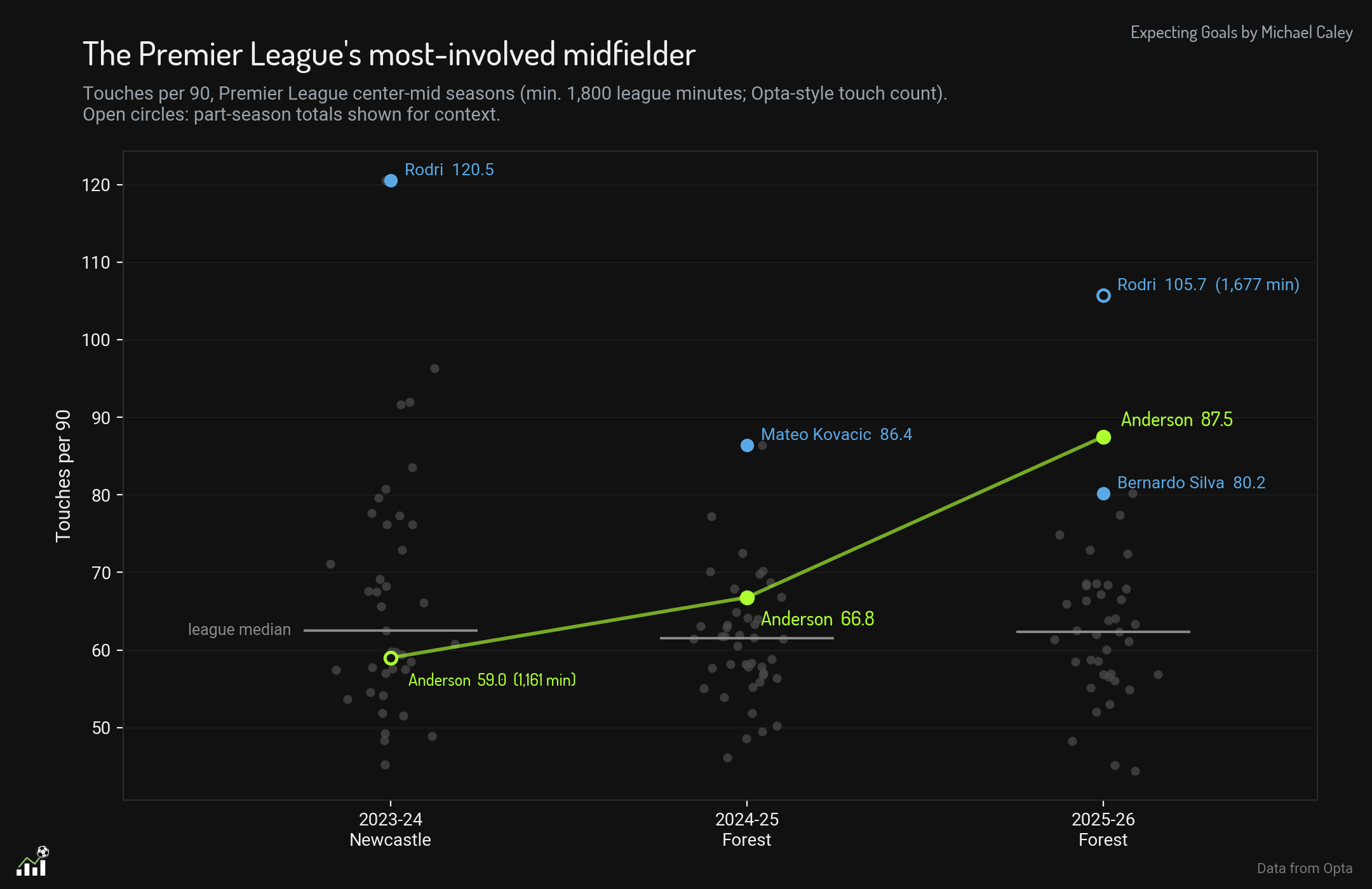
What is notable here is that the other leaders in this statistic all played for Manchester City. Not just Rodri, but also Bernardo Silva and Mateo Kovacic. It is much easier for a player to get a lot of touches in a team that dominates possession and circulates the ball in midfield. In the next chart I look at a player’s involvement in context: what percentage of the team’s possession touches does that player account for while they are on the pitch? Strikingly, Anderson’s 2024–25 season now appears as among the elite, an early indicator of his breakout season to come.
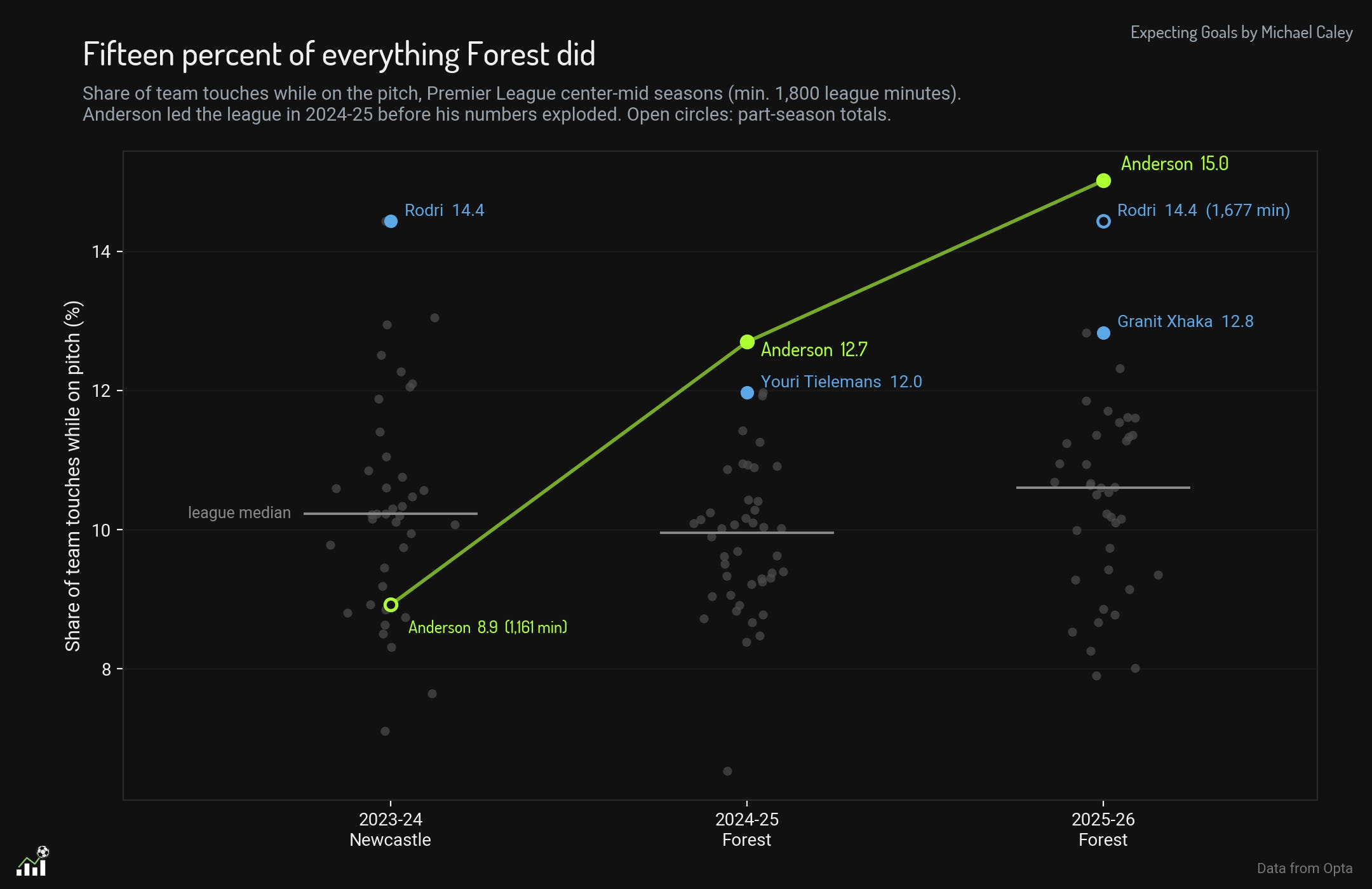
The only Premier League midfielder over these three seasons who was as integral to their team’s possession play as Elliot Anderson in 2025–26 was Rodri. Reporting on Manchester City’s interest in Anderson has consistently mentioned the importance of his ability to constantly look to receive passes, and the data confirms this skill.
Of course, Rodri is not known just for his ability to find space and show for the ball but what he does when he gets it. And on this measure, Anderson’s development has been equally impressive.
Elite Ball Progression, Too
When Anderson was first coming up through the Newcastle system, he played as much more of a free eight looking to drive the ball upfield. He used his athleticism and technique to move the ball forward at his feet. The classic problem for a player like this is two-fold: they move themselves into a new zone where they may not be as ideally positioned for recirculation of possession, and of course they are no longer in their defensive position should the ball be turned over. Midfielders who progress the ball by carry at high rates tend to be free eight types, often involved in play near the penalty area. As Anderson developed at Nottingham Forest, he cut back on ball-carrying.
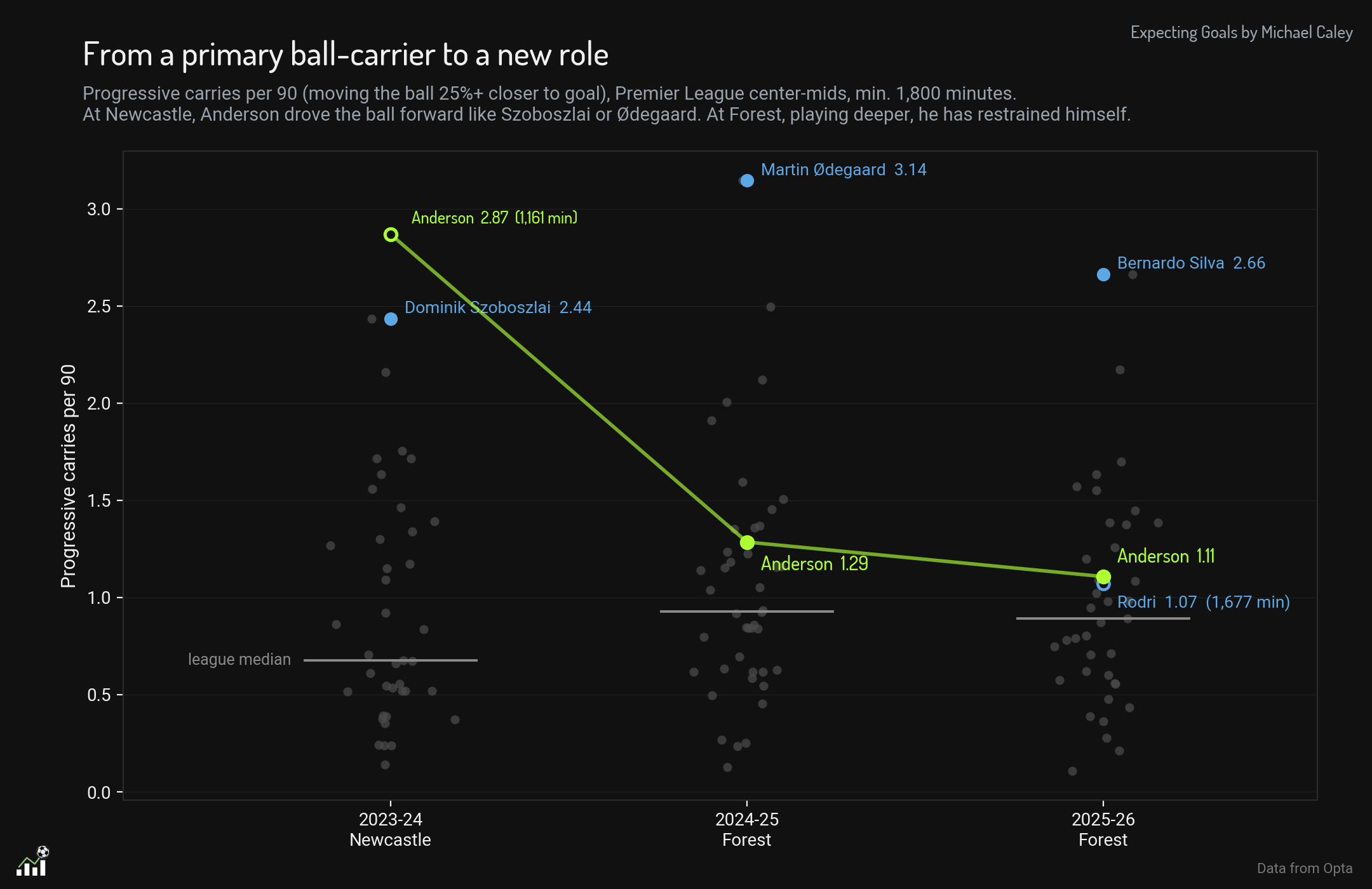
Sometimes Anderson’s ball-carrying gets mentioned among his elite skills because he still does flash the ability to move the ball forward at his feet. But this is no longer a large portion of his game. Anderson has shifted his ball progression responsibilities from carrying to passing.
