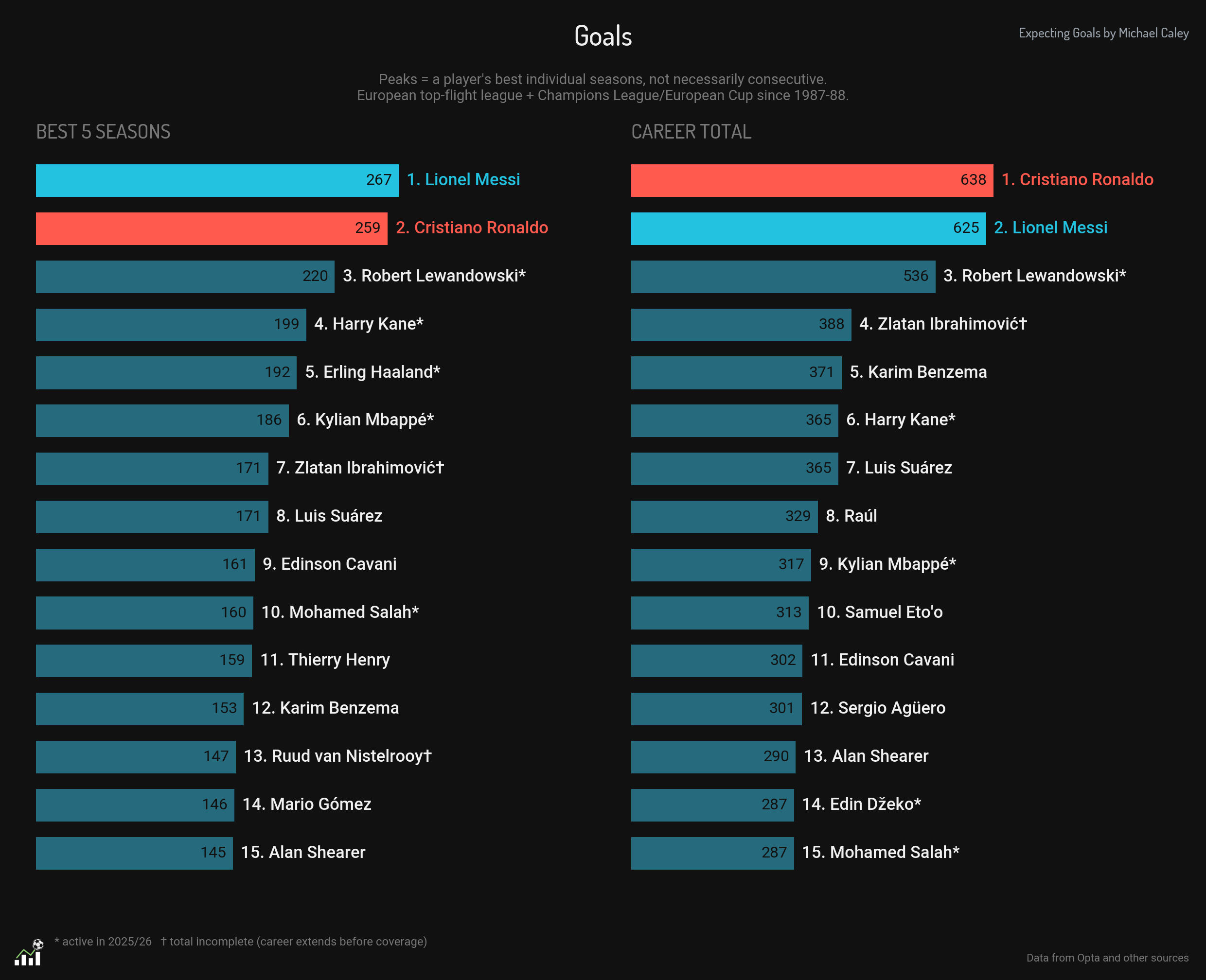
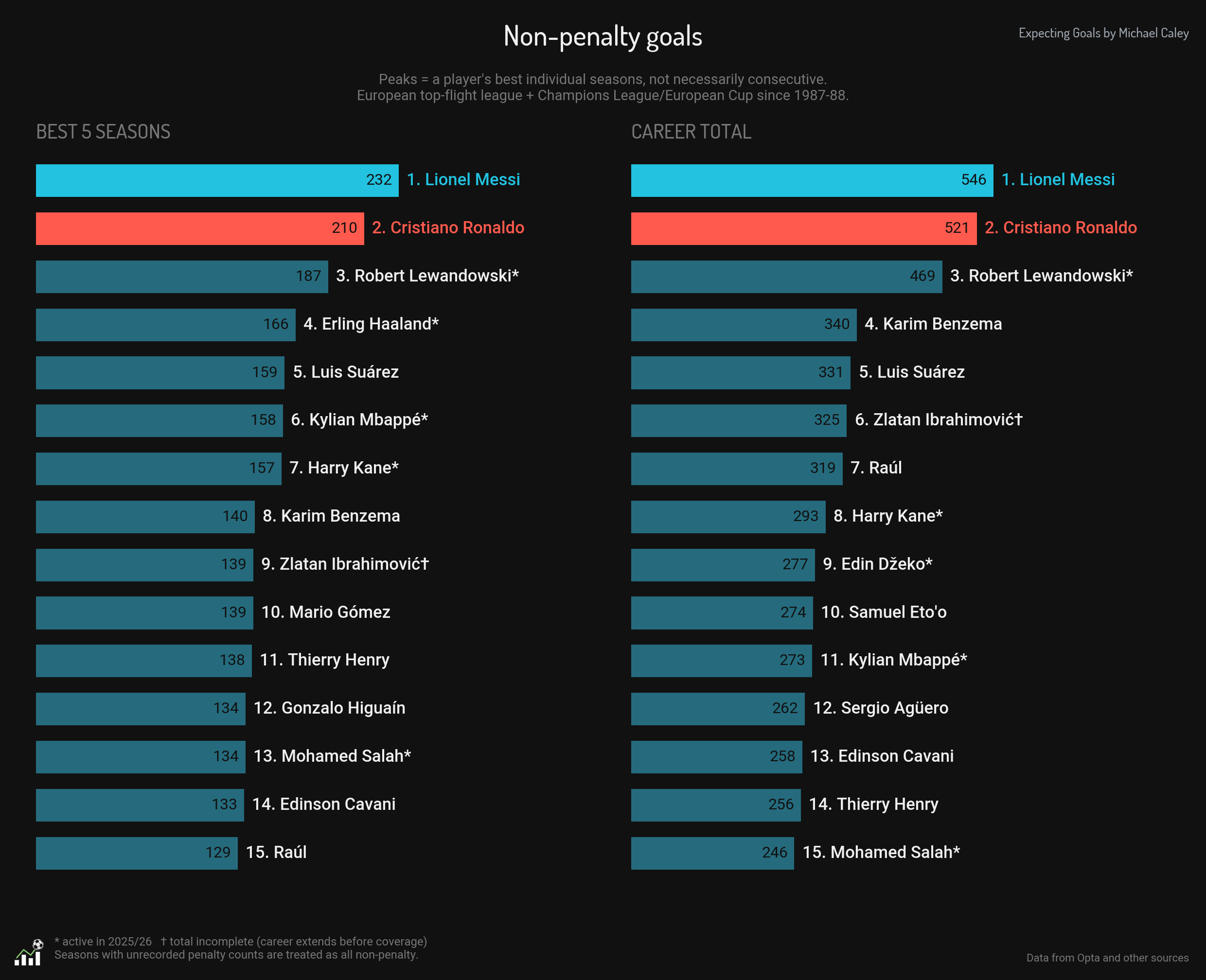
I wrote a newsletter about Lionel Messi and Cristiano Ronaldo and I got some feedback on social media. I cannot exactly complain about this. I am not a naïf—I knew what I was doing when I wrote that newsletter. And it turns out, a fair amount of the feedback was constructive1 and pushed me to expand both the materials I was working with and the scope of the project. These productive questions fell into two categories.
Can I reasonably argue that Messi is the Greatest Of All Time with a database that only tracks goals and assists back to 2002 and only tracks the other underlying statistics back to 2009?
In comparing Messi to other modern players in underlying statistics such as progressive passes and expected threat (xT), was I only making a career value argument? Was Messi simply the best in these numbers because he was so durable, or was he the greatest season to season as well?
This newsletter will be organized around answering those questions.
First, it is true that statistical analysis of football faces terrible data availability problems. The advanced on-ball statistics are not available comprehensively before the mid-2000s. Assists were not consistently tracked until shockingly recently. The only reason we have assist totals for the Premier League before 1999 is because some heroes at Opta went back to watch tape of every single Premier League goal and assigned the assists after the fact. It is not even trivial to assemble databases of goals scored in top league competitions before 2000. What I was able to do here was to expand my databases by one good step beyond the previous newsletter. I now have assists back through the 1999–2000 season, and goals through the 1987–88 season. This data obviously cannot answer a number of questions: it cannot treat the game before the late 1980s, and it still only allows me to dig so deep before 2009. But the results were telling nonetheless.
In the data now extending back 15 years before Ronaldo’s top league debut, I find no one with remotely comparable goal-scoring to Messi or Ronaldo. When that is combined with the findings on Messi’s dominance in most on-ball creation statistics, it makes it very hard to believe anyone from either era came close.
As I said in the last newsletter, going further back into the history of the game faces not only severe data availability problems but also runs into fundamental problems of differences in tactics, and more than that, differences in quality of competition. The concentration of top talent into the biggest leagues, and thus the ramping up of opponent skill levels for the greatest players, took off with the globalization of football as a business in the 1980s into the 1990s, and was not fully achieved until the 2000s. Even if somehow a database of statistics appeared for the earlier era of Pelé and Beckenbauer, contextualizing those numbers properly for comparison would verge on impossible. Any statistically oriented discussion of the GOAT in football must carry a disclaimer that era comparison beyond the relatively recent past has these two fundamental and probably unsolvable confounders.2
There are questions about “all time” that may be unanswerable. But Messi’s (and indeed Ronaldo’s) greatness appears all the clearer when you move the window of analysis back into the 1980s.
Updated Goals and Assists Charts: Messi and Ronaldo Still Far Ahead
The most striking thing I found is that not only did no goal-scorers in their own era compare to Messi and Ronaldo, the same was true for the generation of stars that preceded them.
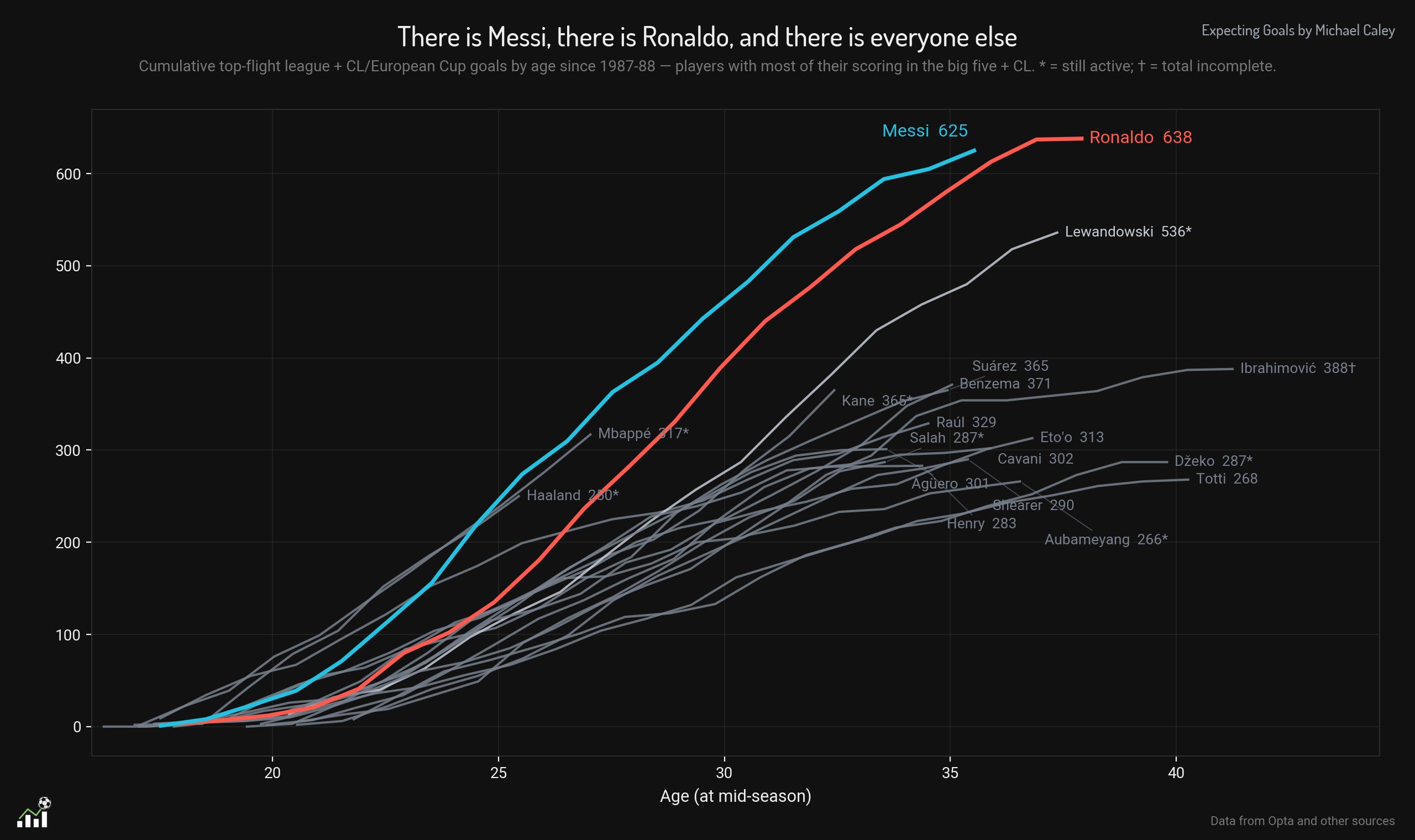
As noted in the previous newsletter, Ronaldo’s lead here is a function of penalty goals, and when penalties are removed (or credited relative to expected finishing), Messi also passes him in goals.
Among the new additions here are Samuel Eto’o, Raúl, Thierry Henry and Alan Shearer. All of them put up goal-scoring numbers in their era competitive with the greats of the 2010s, but none came close to Messi and Ronaldo.
This chart highlights what has made Lewandowski different. Through his early 30s, he was something like first among equals. But he remained an elite goal-scorer far longer than any of his rivals other than Messi and Ronaldo and locked up the second place on these charts. It will be interested to see if Harry Kane can have a similar late career run.
It is easy to see here how most of these lines begin levelling off at age 30, besides Messi, Ronaldo and Lewandowski.
The early career trajectories of Kylian Mbappé and Erling Haaland are clearly unprecedented in the modern game besides Messi and Ronaldo. It is unlikely for obvious reasons that either could maintain this level of production well into their 30s, but they it is impressive to be at this level in their 20s regardless. (And as I will note in the peak chart, there are still gaps to make up.)
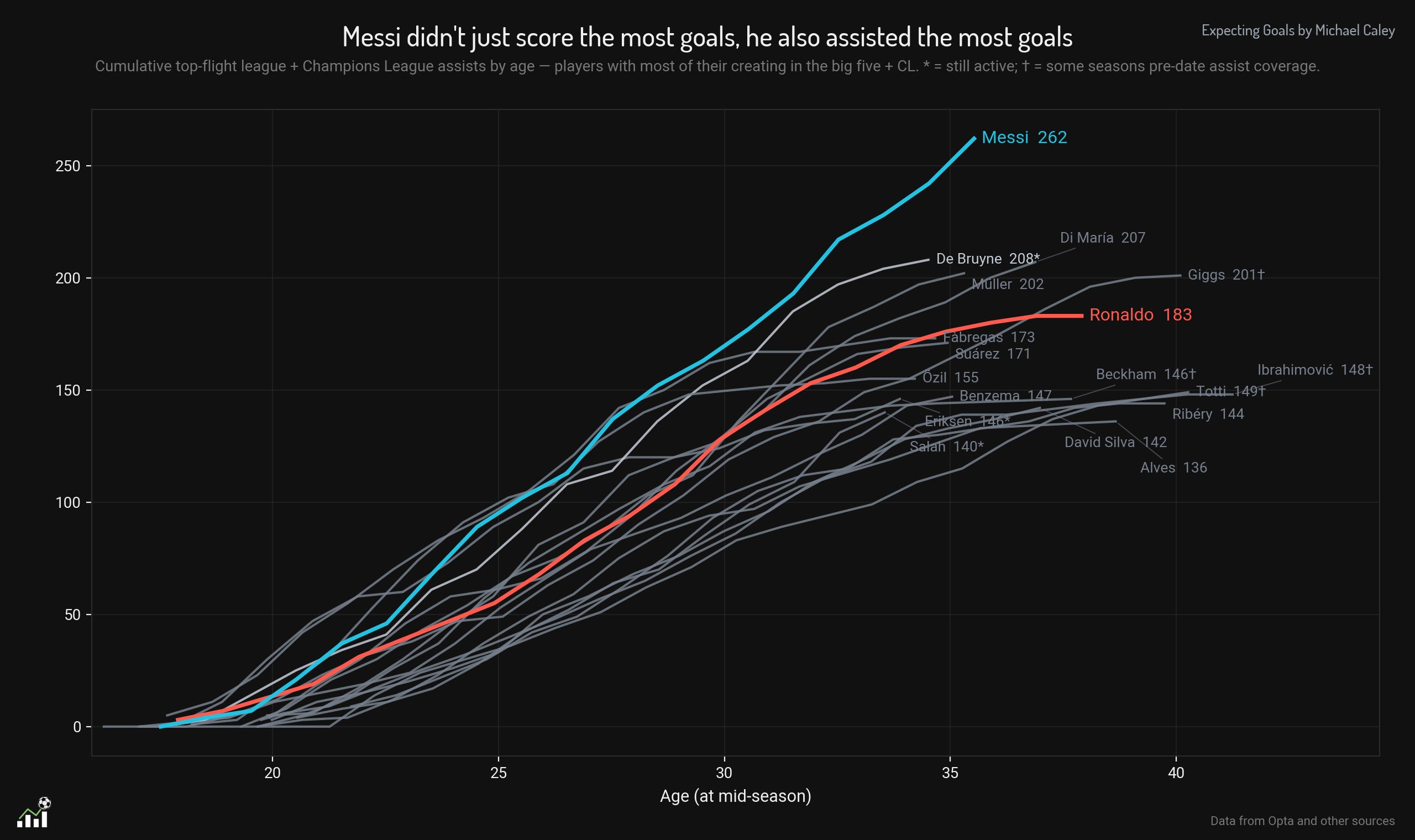
Adding in assists, with particular added coverage in the Premier League, gets Ryan Giggs’ exceptionally long career onto the list, along with David Beckham and Francesco Totti with another couple seasons of Serie A assists.
Unlike with goals, a number of players did keep pace with Messi on assists through their 20s. But at different points along the path, Mesut Özil and Kevin De Bruyne began to play fewer minutes, while Cesc Fàbregas picked up a new role playing further from goal.
And of course when these two data sources are combined, that puts Lionel Messi into a clear lead.
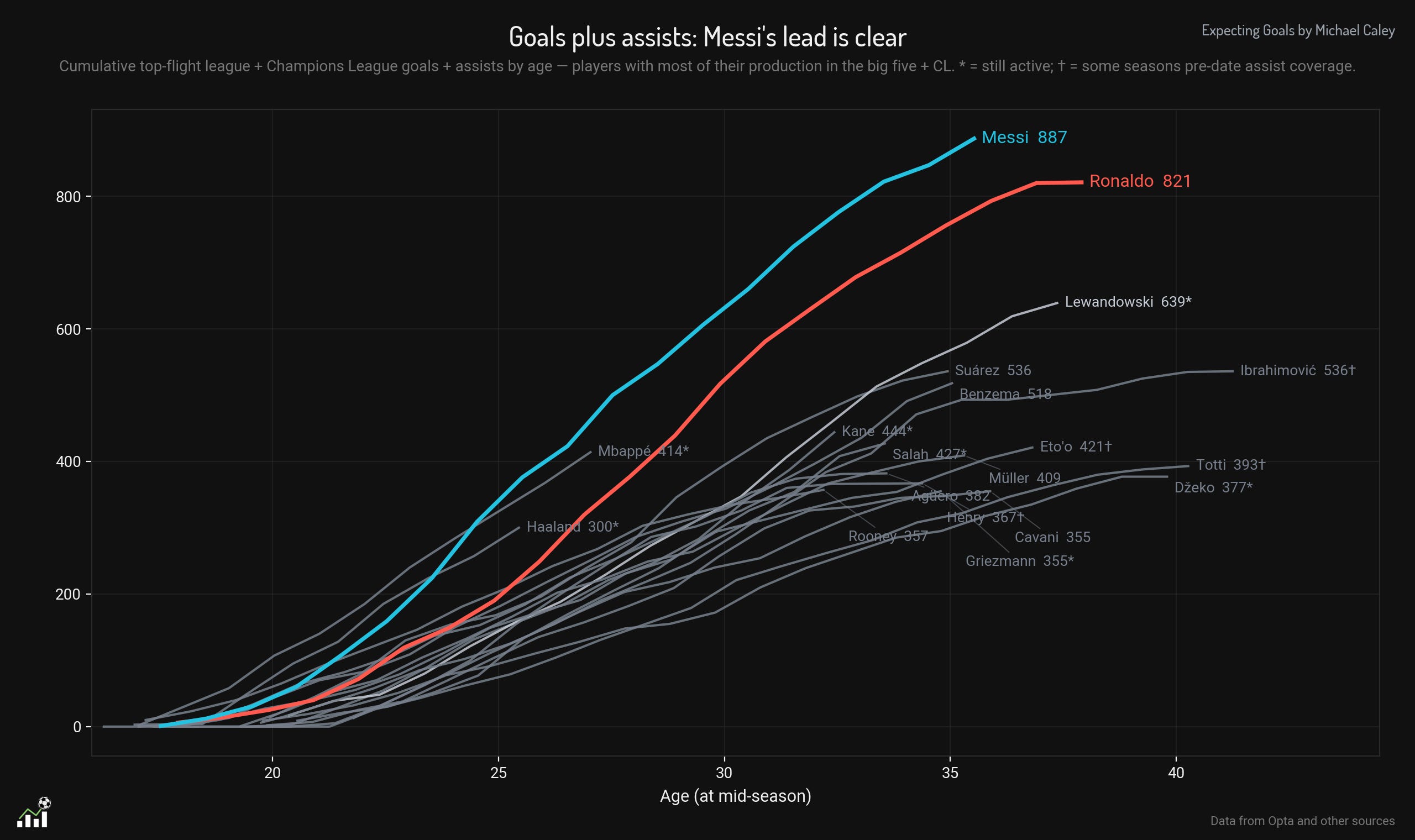
The greats of the 1990s all fit comfortably next to the greats of the 2000s and 2010s, but none of them come close to Messi and Ronaldo. Expanding the scope of coverage throws into further relief what outliers both players were.
The new additions to this chart are Wayne Rooney and Antoine Griezmann, both great players whose combined goals and assists push them onto the leaderboard where they would have otherwise fallen a bit short.
Thierry Henry and Samuel Eto’o likewise appear competitive with the greats of the 2010s.
It’s also clear that Kylian Mbappé and Erling Haaland right now are on paths unprecedented besides Messi and Ronaldo.
These contemporary stars also raise the question of peak value. The way that Messi and Ronaldo both kept putting up numbers through their 30s will be incredibly hard to replicate. But this is not the only measure of greatness. Have any of these players, in their best seasons, reached a similar level?
In this newsletter, I will present the peak goals and assists leaderboards, and then begin to consider some of the more advanced stats on shot creation. Tomorrow’s Part III newsletter will then include the full leaderboards for the various ball progression statistics.
Peak Goals and Assists: It’s the Same Story
For peak studies, I am using a similar process to the study of peak in baseball. Jay Jaffe’s JAWS system provides a first measure of greatness by combining a player’s career totals with their totals over their seven best seasons. There is of course nothing magical about the number seven, and Bill James often looked at three, five, and seven year peaks. I found in going over these numbers that all three selections told similar stories, and I preferred the five-year peak because soccer careers tend to be shorter and it gave players who may have a few seasons outside the data coverage window more room to make the lists.
I am looking at numbers by season here because the season is the proper focus for analysis at the team or player level. Trophies are handed out based on team performance over a season, and players consistently see their jobs as contributing toward these team achievements. A player’s peak should be the seasons in which they did the most to improve their team and move them closer to winning these trophies.
With these charts, I was also able to separate penalty and non-penalty goals for almost every season under consideration, and so I can present the peak and career lists with penalties both included and not included.
As I noted in the first newsletter, one of the hardest problems in soccer analytics is accounting for context. How did a player’s role and teammates affect their ability to produce? Strikingly, context becomes much less of a problem in comparing Ronaldo and Messi, who played for the best teams in the world, surrounded by the best teammates, in systems designed to funnel the ball into the situations which best suited them. But as we move down these charts, and especially as we look more deeply at the on-ball creativity statistics, the question of context must arise again.
In this newsletter I will not be accounting for this problem specifically. It is one of the great questions in soccer analytics, with limited treatment in the public sphere. I hope to be able to return to this data in the next year with a context-adjustment system, but that will be a whole series of newsletters to produce.
Note the marks on these charts for data availability.
* for players whose careers were still active at the end of the 2025–26 season
† for players who have 1–4 seasons at age 22 or older for which data was unavailable.
‡ for players who have 5 or more seasons at age 22 or older for which data was unavailable.