


On July 7, Argentina managed to survive to the World Cup quarterfinals with a dramatic comeback against Egypt, while the previous day Portugal were dispatched by a late Mikel Merino winner. This means that Lionel Messi, at age 39, is still in the frame to win his second World Cup trophy, and Cristiano Ronaldo, at 41, will not win his first.
Obviously winning trophies is a terrible metric for comparing football players, as the sport is fundamentally a team competition given the enormous size of the pitch. One player can only be involved in so many plays, and no one can have the outsized impact on winning of a basketball superstar, or even probably an NFL quarterback. But there is no escaping the question of the GOAT.
If you work in analytics, eventually you will be asked about Lionel Messi and Cristiano Ronaldo. Who do you think is better? Who is the greatest of all time? And people will often be surprised that analysts don’t hem and haw, don’t talk about all the complex, dynamic, still-unanswered questions about how the game works, but instead respond quickly, “oh, it’s Messi.”
In this newsletter I plan to explain why there is an effective consensus within the analytics community on Messi–Ronaldo, but in some ways I think the question of why a consensus exists is the more important one.1
In the very first Expecting Goals newsletter, I offered my own definition of “sports analytics” as distinct from simply talking about statistics. It has three parts: valuation, the attempt to quantify a player’s contribution to winning; context, the attempt to identify the various ways a player’s teammates, coach, league, home field, and so many other factors impact measurements of any one player’s contributions; and randomness, the consideration of how the inherent variance of people and of complex, contested physical actions may show up in the statistical record. In soccer analytics, the latter two confounders are so richly varied, and so baked into the reality of the game, that analysts often struggle to make determinative statements on anything. But in an oddly precise way, all of these problems are minimized in the Messi-Ronaldo debate.
This is Part I of a three-part series. Parts II and III serve to respond to some questions about this newsletter as well as to extend the analysis across a larger set of players.
Messi-Ronaldo Part II: A Larger Database, Thoughts on “All-Time” and Peak Value
Messi-Ronaldo Part III: Ball Progression Peak and Career, and Remembering Some Guys
Messi and Ronaldo: The Reverse Image of Everything Difficult about Soccer Analytics
The first and most obvious point here is randomness. Messi and Ronaldo played long careers and maintained near-perfect fitness, so that the samples of their production are just about unmatched in the data era. Many people would have said in 2022 that it was a major achievement that both were still starters for their national teams at 35 and 37, respectively, at the World Cup in Qatar. (The age curve in football is peculiarly vicious: in a sport demanding extraordinary fitness, outfield players are typically in decline at age 30.) Four years later, Ronaldo has started every match for Portugal while Messi missed the starting XI only in Argentina’s dead rubber against Jordan.
And through their careers, neither faced serious injury issues until they were well into their 30s. Further, the tracking of in-depth event data in soccer began in earnest in the 2000s, just as both were kicking off their careers. For these reasons, the statistical sample on both is unusually robust. The two players in my database with the most shots attempted in domestic league and European competition are, by far, Cristiano Ronaldo and Lionel Messi. Ronaldo has about 3,300 shot attempts since 2009–10 in my database, and Messi about 2,850, with Robert Lewandowski the only player over 2,000 behind them. The sample allows analysts to make confident claims about these two players which responsible commentators would not on the basis of just a few seasons of data.
Their longevity also highlights another problem that bedevils greatness debates across sports analytics but does not apply here: how to weight peak against career value. This is a concept developed in baseball analytics. As one example, two of the greats of mid-century baseball were Mickey Mantle and Hank Aaron. Mantle was clearly, to an analytical lens, better than Aaron in his best seasons. But Aaron was impossibly durable, eventually breaking Babe Ruth’s career home run record while Mantle’s career was first slowed and then derailed by injury. Who was better? It is not a question with any simple answer. And fortunately for us, it does not apply here. At their best, Messi and Ronaldo were clearly the greatest goal-scorers of their era, and both maintained that level of performance their entire careers.
On the question of valuation, once again the Messi and Ronaldo question sidesteps the largest problem in the sport. While the tracking of on-ball statistics has allowed analytics to move back from goals and assists to better quantify how players contribute to chance creation and ball progression up the pitch, as well as to ball retention within possession systems, the on-ball data offers much more limited insight into defensive contributions. Defensive “actions” such as tackles and interceptions are tracked, but they are contextually variable and, more importantly, only a subset of the actual defensive contributions that individual players can make. With the advent of statistics based on tracking data, more progress is being made toward understanding defense, but that work is still in process.2 Fortunately, once again, this is of only minimal relevance to Messi and Ronaldo. Both players had few defensive responsibilities and were the on-ball focus of their team’s attacks, and both made their obvious and most-famous contributions in goals, assists, and other actions around the penalty area which are best tracked by the on-ball data.
These issues of defensive responsibility and tactical role then raises the third point, that of context. Messi and Ronaldo both played as the focal point attacker in systems built, obviously reasonably, around their unmatched abilities. But more to the point, they played almost all of their peak seasons in the same league, Spain’s La Liga. And their clubs, Barcelona and Real Madrid, were probably the top two clubs in the world over that period. At their peaks, both were surrounded by teammates rated among the best in the world.
To quantify this, I collected the data from Transfermarkt on team and league estimated player value, and unsurprisingly it is Barça and Real at the top for virtually the entire period the two shared.3
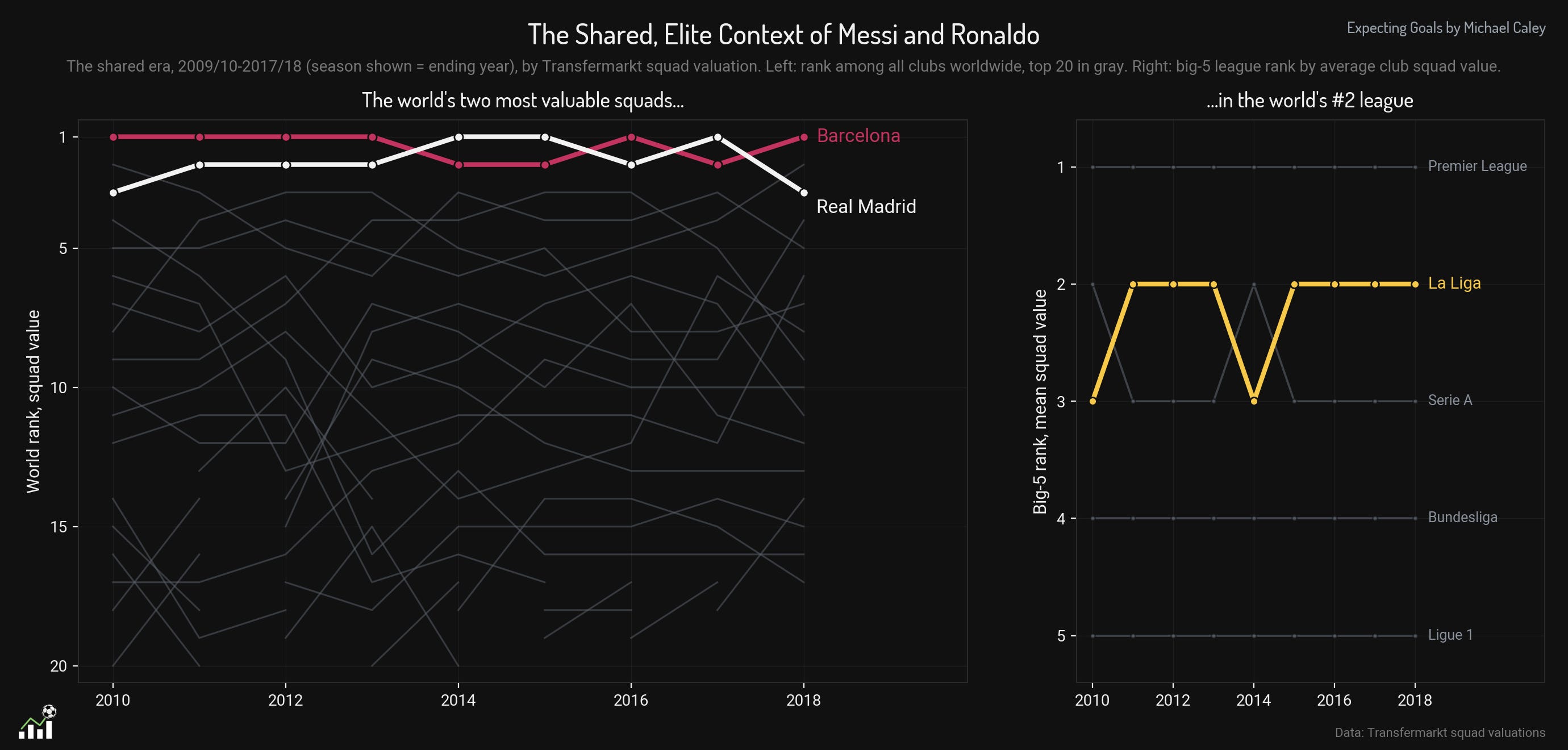
Further, each of these teams worked to funnel their scoring chances to their star players, a clear shared tactical context. Despite being surrounded by the best teammates that money could buy at the time, Messi and Ronaldo each accounted for about one-third of their team’s shots, expected goals, and non-penalty goals.
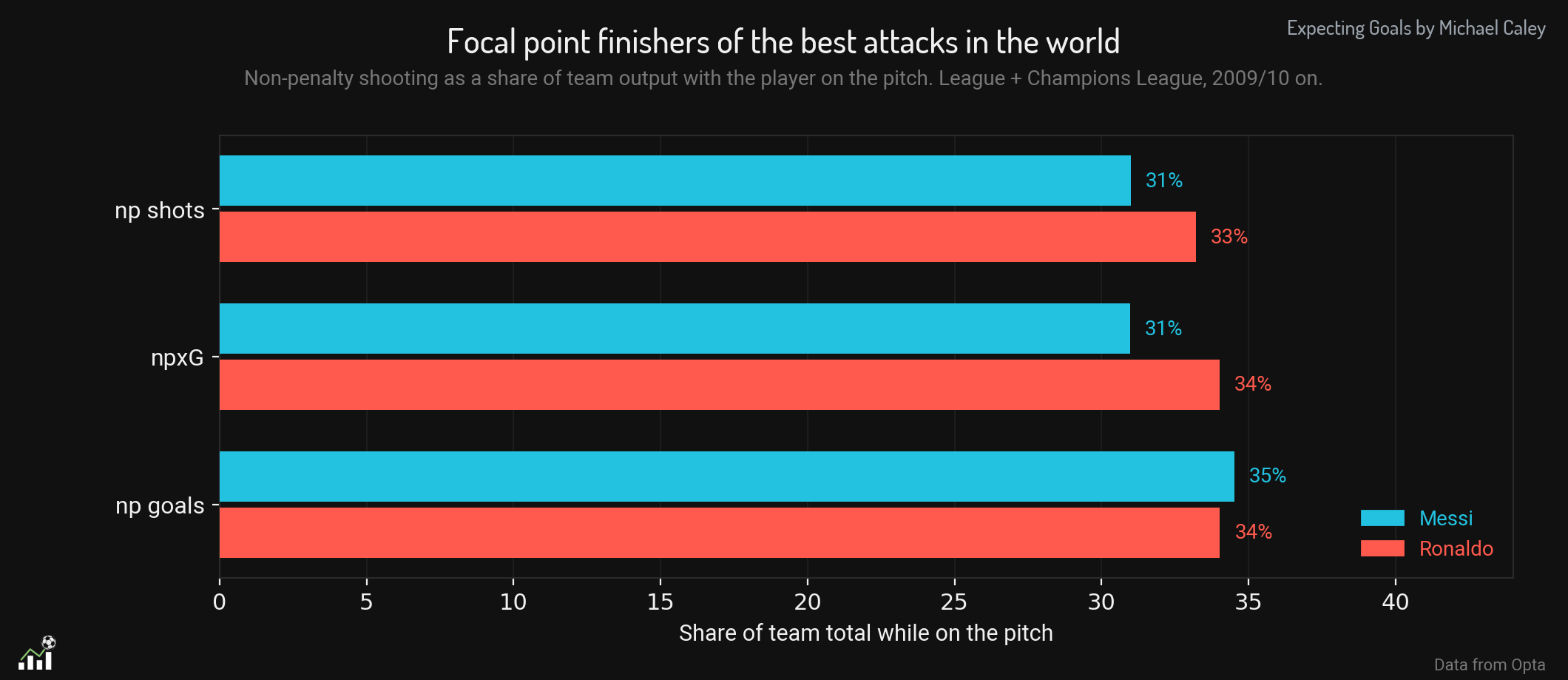
This chart also demonstrates a side point—that Messi was one of the greatest finishers of the era, relative to expected goals, while Ronaldo converted his chances at an above average but not elite rate. My data here accords with Marek Kwiatkowski’s more rigorous study of finishing.
In my writing for this website, I have primarily focused on these hard problems of analytics, seeking a deeper understanding of team and tactical contexts, of substitution effects and the age curve. But with this topic, most of those difficult issues can be set aside. We can get a clear sense of what Lionel Messi and Cristiano Ronaldo brought to their clubs through their on-ball statistical profiles, and we do not need to present the findings with excessive modesty because so many of the confounding issues do not apply to this particular problem.
It’s fun. We can just start with goals.
Goals: Before you stand two GOATs
Between domestic European and Champions League play since 2000, no one has scored more goals than Cristiano Ronaldo and Lionel Messi. Ronaldo has scored 639 and Messi 625.4
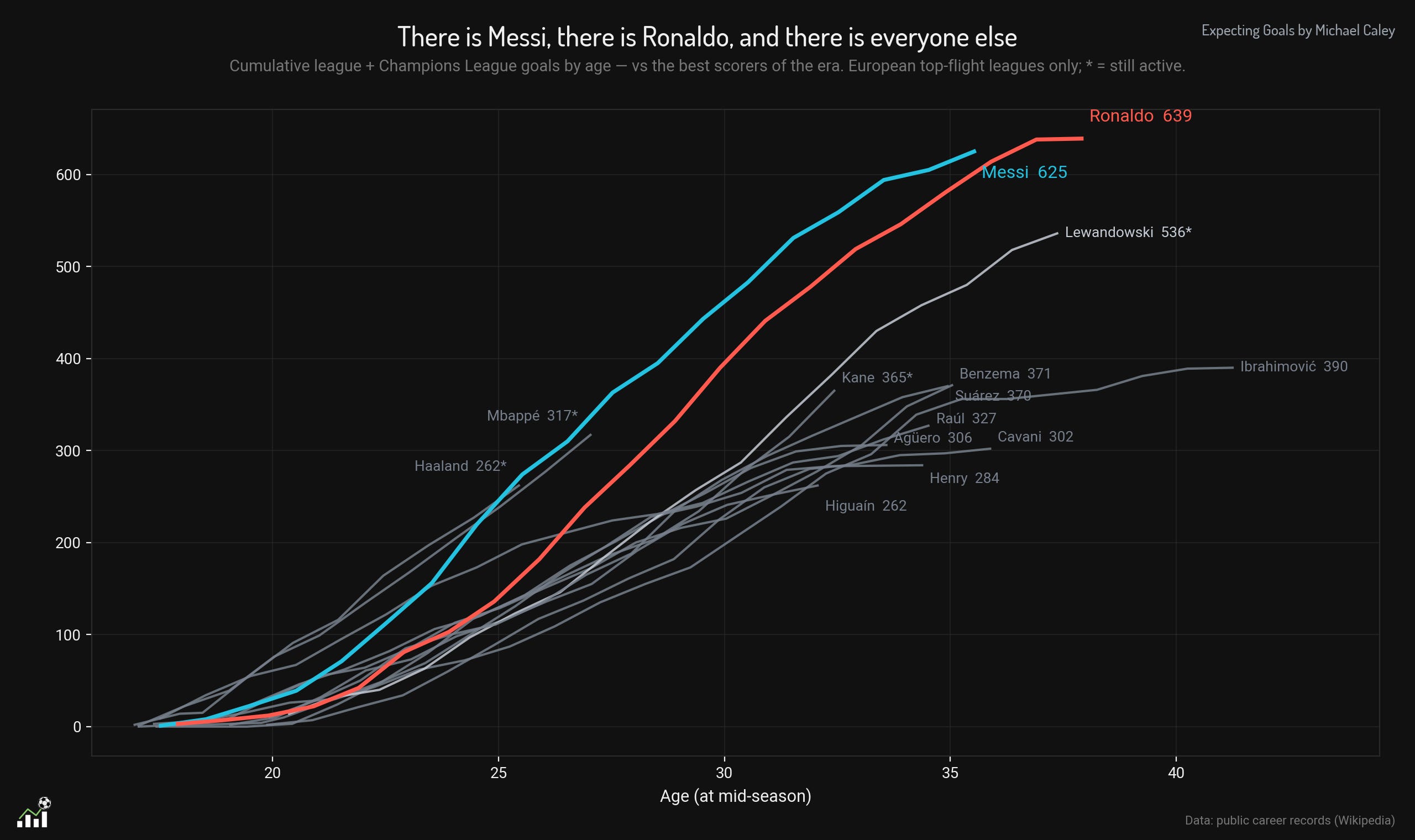
Robert Lewandowski, who this summer has decided on a move to Major League Soccer’s Chicago Fire, is the only player within even 100 goals of the two. And Lewandowski was a pure striker his entire career, unlike Ronaldo who played wing and wide forward for many years, and Messi who played a variety of more on-ball roles from wing to 10 to a false 9 when he played nominal center forward.
Even now, as a number of new greats climb the list, what is most striking is how far they still have to go. It is noteworthy that Kylian Mbappé and Erling Haaland are keeping pace with Messi and Ronaldo at ages 27 and 25 respectively. But the chart shows that Mbappé and Haaland benefited from earlier starts as elite goal-scorers, and in their peak seasons now neither has been scoring goals at a fully competitive rate. To keep pace with Messi and Ronaldo, they would need to begin scoring more goals now and keep it up well into their 30s. It is unlikely.
Now, raw goals can be misleading. In particular, these numbers have included penalty kicks, a peculiar set of goals which are scored primarily according to the team’s choice of penalty taker rather than due to any actions taken with the ball in play. Ronaldo scored 34 more penalty goals than Messi, a total larger than the gap between them. Messi actually scored more non-penalty goals than Ronaldo over his domestic and Champions League career in Europe.
As this newsletter is going to be highlighting any number of measures where Messi shows up as the greatest of all time, it is worthwhile to start with one where he is decidedly not. Messi has been a merely average penalty kick taker over his career, scoring 79 percent while Ronaldo scored 85 percent, compared to a 77 percent global average. One way to account for a more successful penalty kick taker is to credit players with penalties scored above average, which would net Ronaldo about 11 goals. Crediting penalties in this way would place Messi ahead of Ronaldo by a handful of goals.
And this is the fundamental case for Messi over Ronaldo. The goals are about even. Everything else, including chance creation and ball progression, puts Messi far ahead.
Everything Else: Messi leads in chance creation and ball progression
What are the various ways to measure player production apart from goals? The most obvious is assists, passes that assist goals. But even over relatively long periods of time, assists can be misleading as they depend on other players finishing chances. For this reason we can also look at expected goals assisted, the xG of shots assisted, as well as total shot assists, to confirm the results.
To measure ball progression beyond just shots, there are a number of statistics that capture some of this. We can look for passes and carries into the penalty area, recognizing that defenses seek to prevent players from reaching the 18-yard box. Take-ons measure when a player gets past their defender one-on-one. Progressive passes and carries capture actions where a player moves the ball, by a pass or carry, at least 25 percent of the way to the goal. And there is expected threat, a measure of a player’s successful ball movements by pass and carry that take possession into areas where goals are more likely to follow.
And across nearly every one of these stats, Messi produced far more ball progression and chance creation for his teams than Ronaldo.
Note that for these numbers, we cannot go back as far into the past as with goals, but with a starting point in 2009–10, still the large majority of their shared careers are covered.
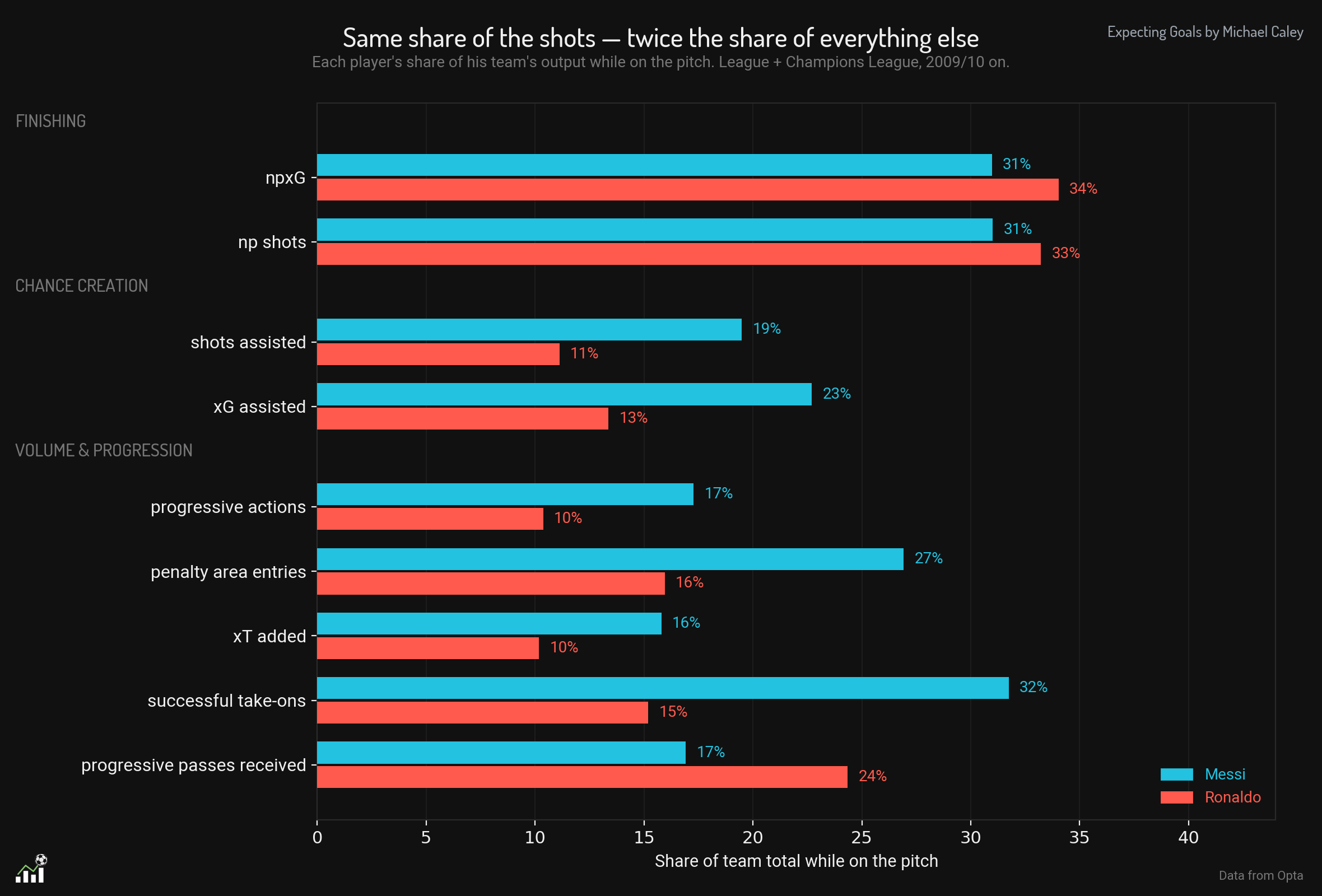
I included progressive passes received here to help break down the two players’ responsibilities. Ronaldo played as more of a ball-carrying outlet winger than Messi, and so more often when a pass was played forward out of defense or midfield to the attack, it went to Ronaldo.
If we look at the overall statistics that both players put up, once again Messi’s dominance across categories of chance creation and ball progression is clear.
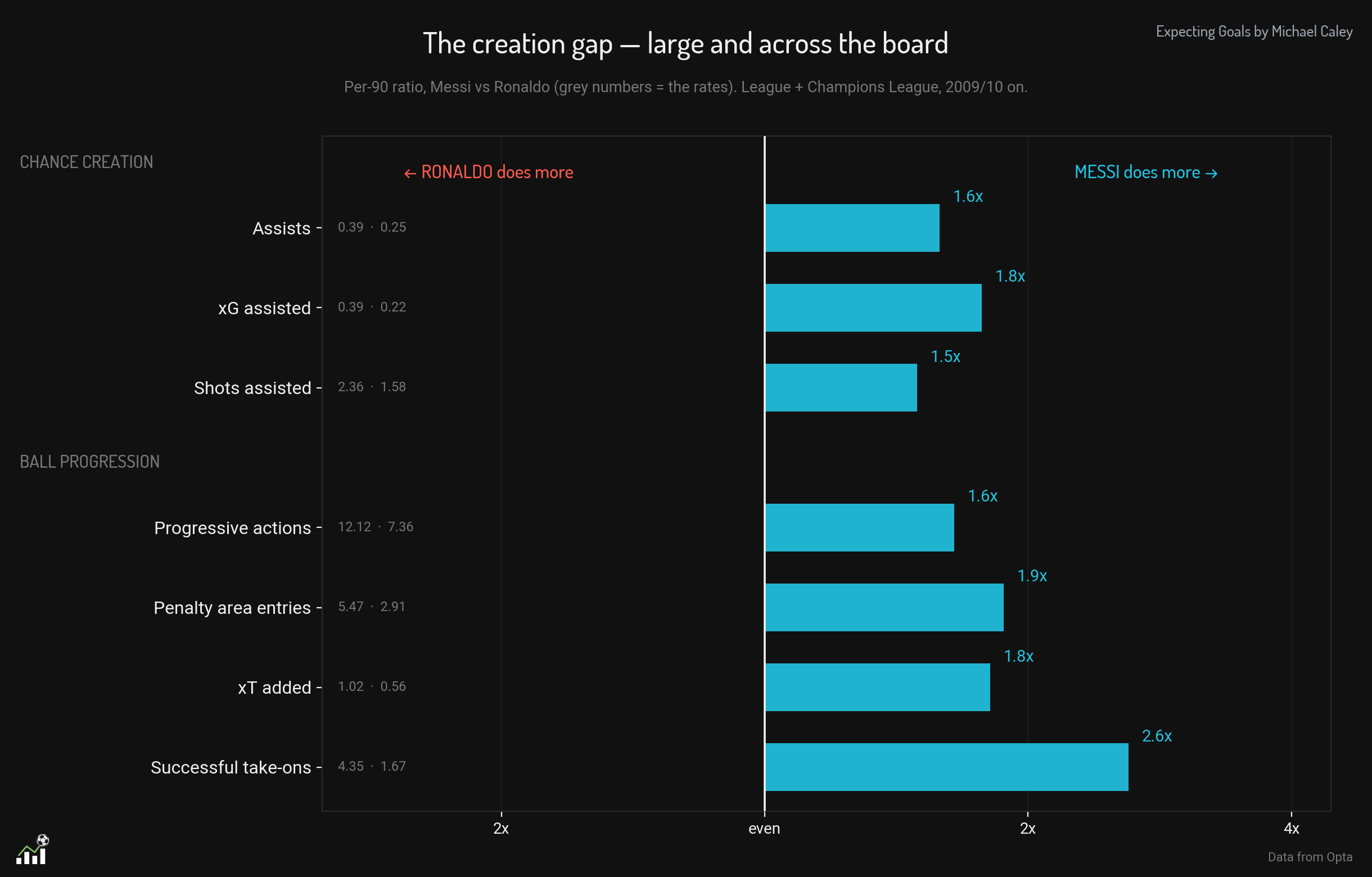
Of course, Messi’s role involved more passing, while Ronaldo’s was much more concentrated in ball carrying. For chance creation, which necessarily involves passing under these definitions, that simply shows Messi’s greater contributions. For ball progression, the distinct shapes of Messi’s and Ronaldo’s production become clear when these statistics are split into carry and pass numbers. Ronaldo was an elite ball-carrier, one of the greatest of all time. He did provide penalty area entries by carry than Messi did, although he falls a little behind on progressive carries and xT added by carry. Most of Messi’s advantage comes from his massively superior passing metrics. And Messi also shows a large advantage in take-ons: while Ronaldo may have moved the ball further forward at his feet, Messi much more often unsettled a defense by getting past his defender in the midst of a successful carry.
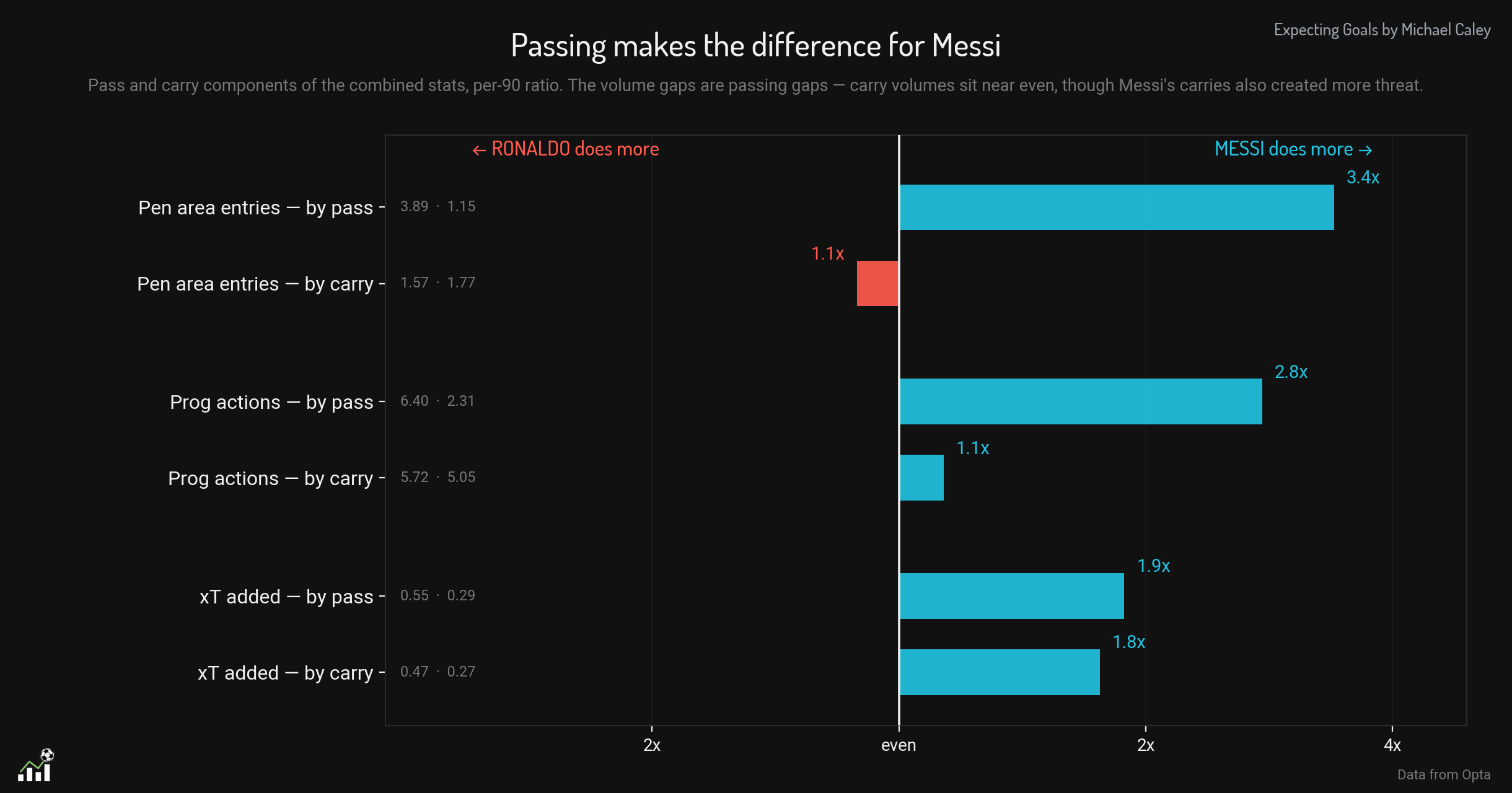
This is why analysts find it so easy to argue for Messi over Ronaldo. They played similar focal-point attacking roles for their teams, and they scored similar numbers of goals. But Messi assisted about 60 percent more goals for his teammates, moved the ball into the penalty area twice as often, made progressive actions 60 percent more often, and created 80 percent more expected threat. While there is no agreed-upon method for adding together these statistics into one unified value metric, it is hard to imagine any method that would not credit Messi with far more value to his teams.
It would be one thing if Messi held this advantage in chance creation and ball progression over Ronaldo, his closest competitor in goals scored. But when we expand the scope to compare Messi to all other players of the same era rather than merely to Ronaldo, these statistics suggest Messi was also probably the greatest chance creator and ball progressor of his era. He does not merely tie Ronaldo in goals and surpass him everywhere else. Messi roughly ties Ronaldo in goals while beating everyone else, and also surpasses everyone else in shot creation and ball progression metrics.
Everthing Else: It gets a little bit absurd at this point
The one statistic that, like goals, can be isolated further back to the 2000s is assists. Messi’s lead in assists against all competitors, over this period, is similar to his and Ronaldo’s advantage in goal-scoring.
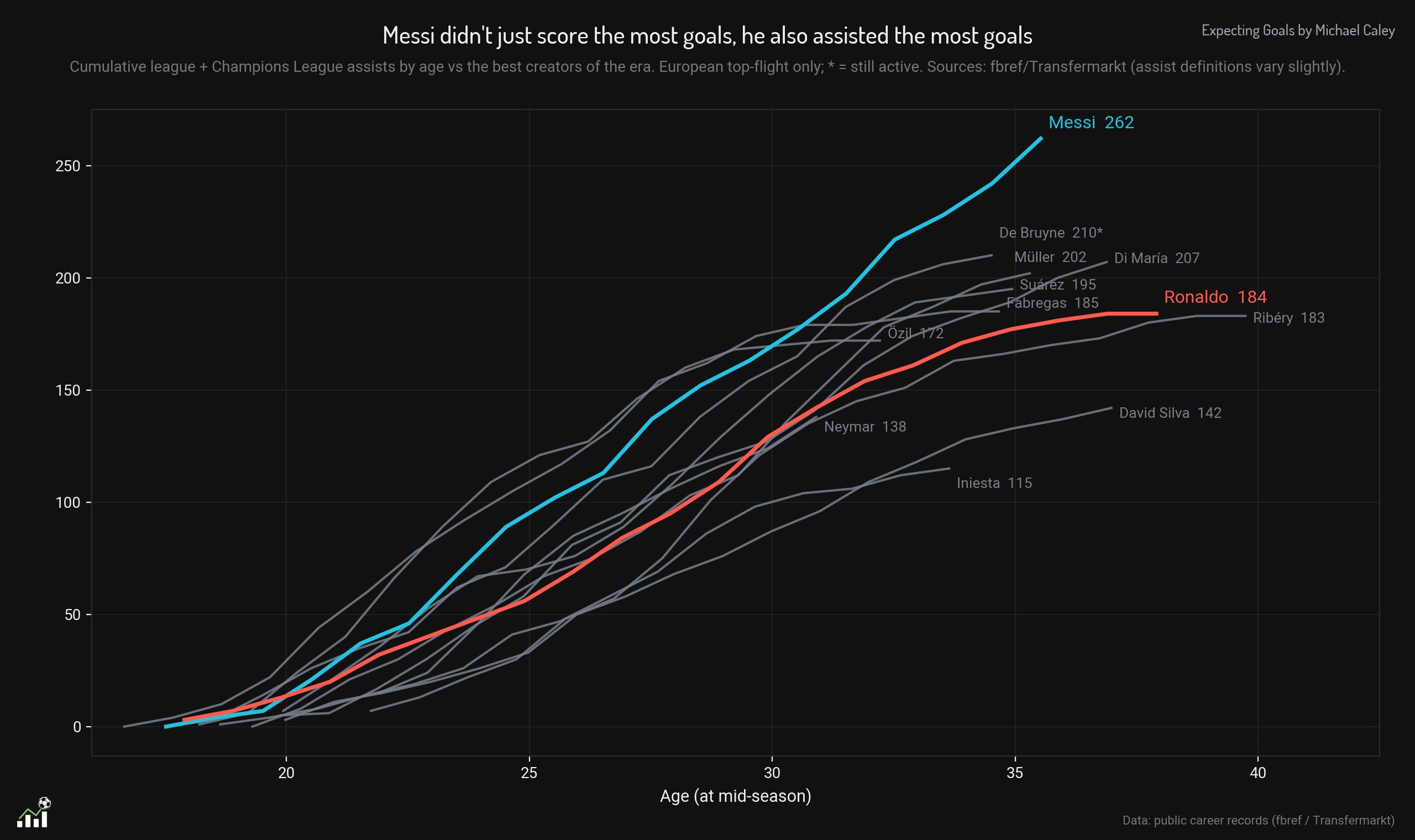
This also serves as another simple way of establishing Ronaldo as the clear #2 to Messi’s #1. While Ronaldo stands far behind Messi in goals assisted over their careers, he and Luis Suárez are the only other players to grace both charts.
When you zoom in to the other, more detailed metrics, incredibly, Messi is the career leader in almost every single one.
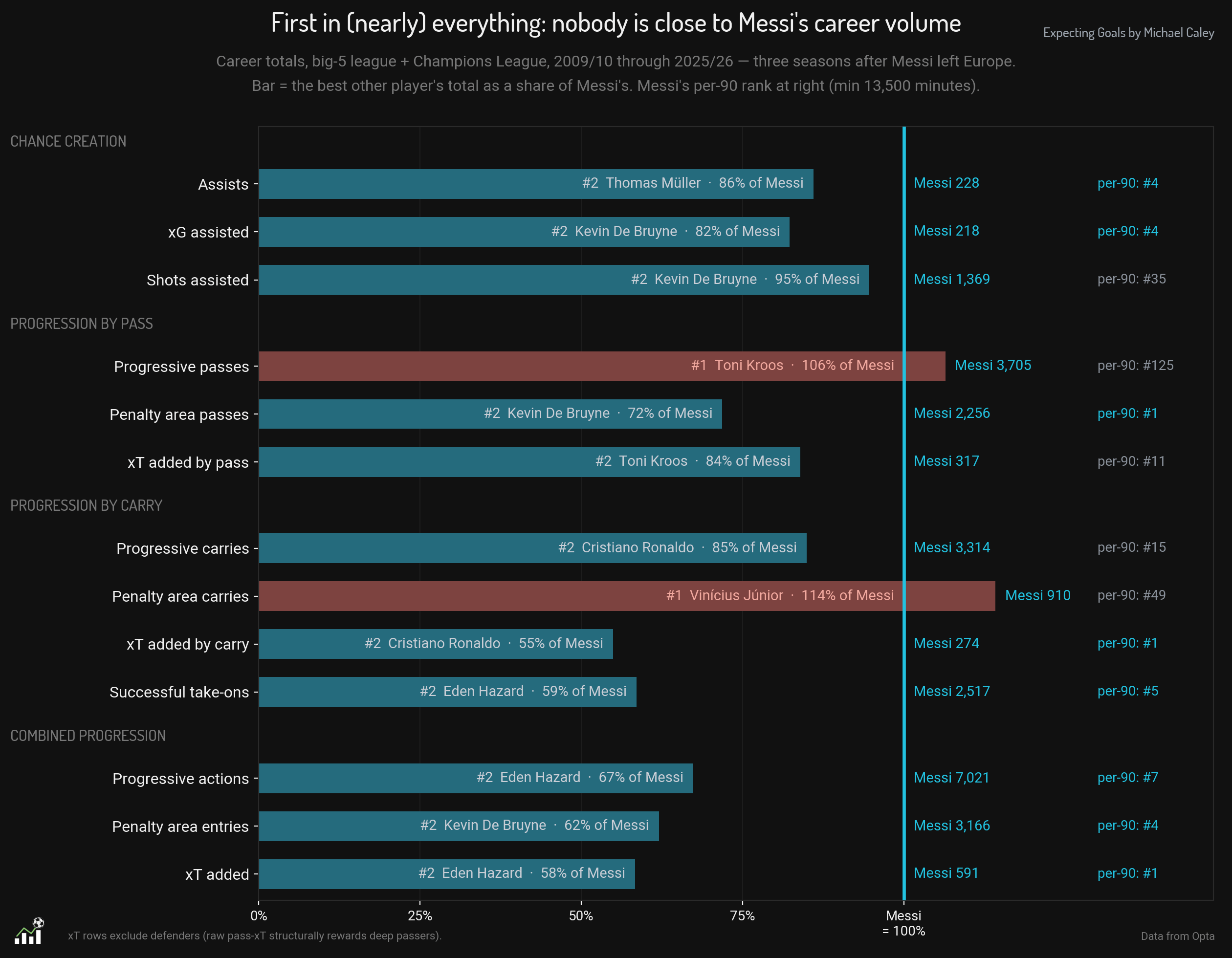
I particularly enjoy Toni Kroos showing up as the player with the most progressive passes in this period. While Kroos did more than Messi on a per-90 level, it captures something of Messi’s greatness that the player whose core job for most of his career was to cover ball progression responsibilities on Ronaldo’s teams, ended up only slightly ahead of Messi on progressive passes.
This chart also helps narrow the focus on why Messi was the greatest ball progressor of the era. It is not necessarily that he was the best passer. Cases can be made for players like Kroos or Kevin De Bruyne. It is not necessarily that he was the best ball-carrier, as either Vinícius Júnior and Ronaldo could stake a claim. But as a player who was equally dangerous moving the ball forward by pass or carry, he clearly had no equal. Eden Hazard, at his peak, was perhaps the only player who compares, but Messi was able to maintain his top level for far longer.
The Greatest
In many ways, what this analysis shows is that the GOAT debate can serve to obscure the greatness of Cristiano Ronaldo. It is easy to imagine how this article would read, in a world without Messi. How incredible is it, we would write, that the best goal-scorer of this era, a player so durable and with such a long peak, was also among the best chance creators and ball carriers of the era as well. No one else comes close to the top of all three component charts.
But as is so common in these sorts of discussions, even trying to narrow the lens on Cristiano only serves to throw Messi’s greatness into starker contrast.
Lionel Messi was not the best player of his era. He was the three best players of his era.
He was roughly tied with Cristiano Ronaldo as the greatest goal-scorer. He stands alone as the greatest chance creator, with Ángel Di María, Neymar and De Bruyne his only competitors at his peak level. And he was the greatest ball progressor, with only perhaps Eden Hazard in the same class in his best seasons.
While reaching further back into time to compare Messi to people who played in earlier eras is necessarily speculative, it is difficult to imagine that any other players dominated the game this thoroughly for this long. Certainly none of them did it against a sustained and consistently elite level of competition, as such a concentration of talent only occurred in the modern era.
Lionel Messi is the greatest of all time and, despite how uncertain so much of our statistical knowledge of soccer remains, the data really does demonstrate that.
This is Part I of a three-part series. Parts II and III serve to respond to some questions about this newsletter as well as to extend the analysis across a larger set of players.
Messi-Ronaldo Part II: A Larger Database, Thoughts on “All-Time” and Peak Value
Messi-Ronaldo Part III: Ball Progression Peak and Career, and Remembering Some Guys
If you are looking for just the Messi-Ronaldo stats you can scroll down to the “Goals” subsection, or you can just take the tl;dr here: they scored the same number of goals, more or less, and Messi did much more of everything else.
One recent example is the recent publication by Hudl (formerly StatsBomb), of their new defensive responsiblity metric.
Did I put together a new database to demonstrate that, in the 2010s, Real Madrid and Barcelona were good? Yes, and you now understand the entire vibe of this newsletter.
Both totals could be enhanced by including their post-European careers, Ronaldo in Saudi Arabia and Messi in MLS. But this more conservative accounting, in which Messi and Ronaldo also scored nearly all of their goals in the most competitive leagues in Europe, and players in top division European leagues not as wealthy as La Liga are included, makes the point more clearly.
It's time to start some fights on the internet!
Vini, Jr has 114% of Messi's Penalty Area Carries in 57% of the time? FBRef has Vini playing 8 seasons in your set and Messi playing 14 seasons in your set. Is Vini just off the charts in this category or is their something wonky in the dataset?