


When Scotland lost 3–0 to Brazil on June 24, it was obviously a bad result for the Scots. But few predicted it would be this bad. Likewise, when South Korea lost 1–0 to South Africa later that same day, the story was not that South Korea were now at risk of elimination but that the Taegeuk Warriors would likely qualify, undeservingly, for the knockouts. As the third round of matches has continued, not only Scotland’s but also South Korea’s chances of qualifying for the knockouts have collapsed.
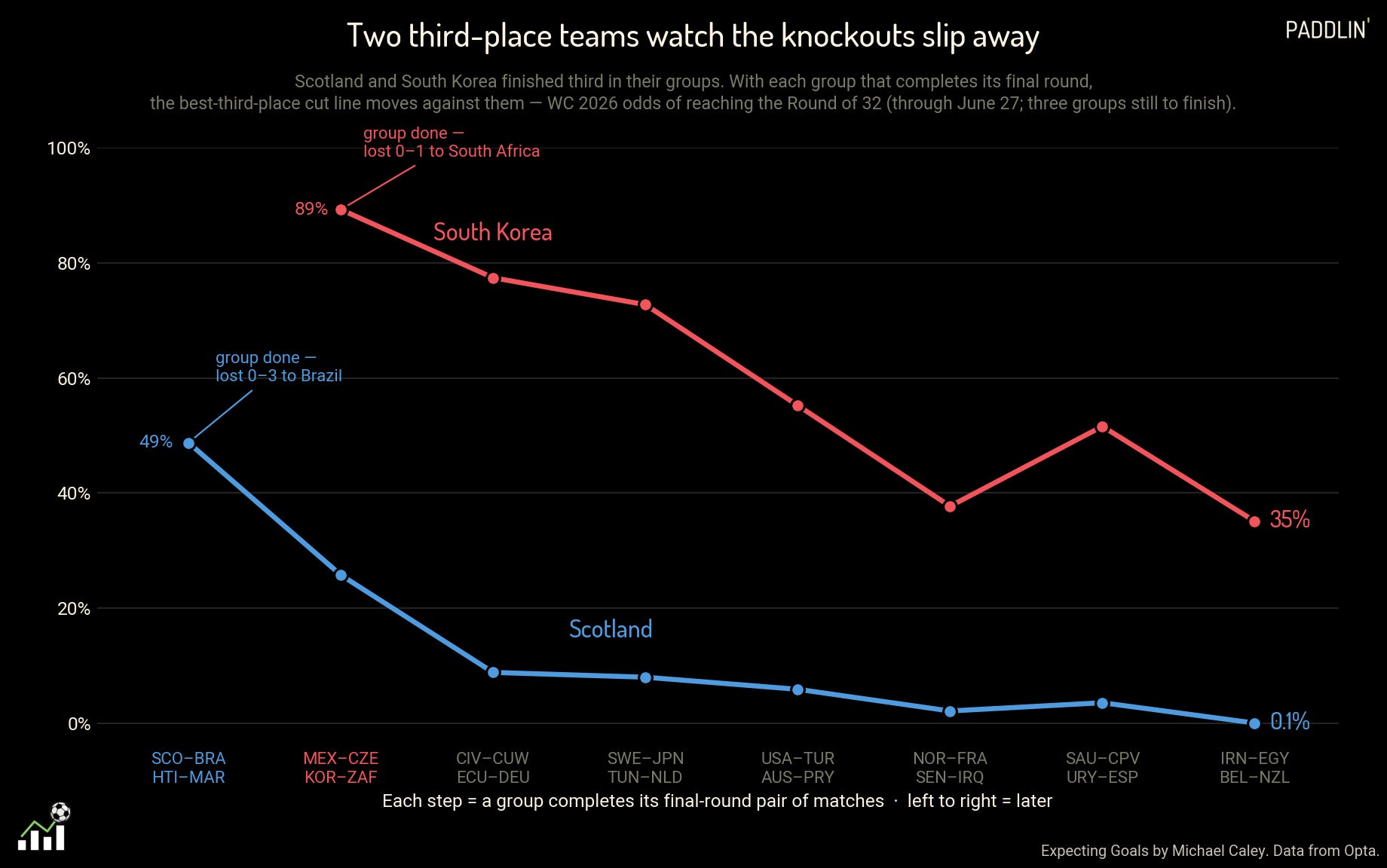
One question this raises,1 is whether the model was wrong to begin with. As the third round of matches continues, and teams gain a clearer sense of what results will give them a better chance of qualification, are these teams motivated to secure specific results which they know will gain them a berth in the knockouts?
Sometimes, such a competitive situation can lead to greater excitement. Senegal, for example, did not stop attacking against 10-man Iraq because they knew every additional goal increased their chances of qualifying for the round of 32. As discussed in yesterday’s newsletter on “dead rubbers” and match projections, Ecuador’s dramatic upset of Germany reflected a situation where Ecuador knew they needed a win while Germany had nothing to play for.
However, in many cases the incentives cut against football excitement and even border on collusion. This is the story of the famous “Disgrace of Gijón”, and the scene is set for such a result in Kansas City. (Obviously should it play out, we should call it “the new Missouri Compromise.”) Algeria and Austria are both on 3 points, and 4 points would secure second place for Austria and for Algeria, a guaranteed place in the round of 32 and one of the best third-place teams. Because Austria has even goal difference and Algeria has minus-2 GD, both teams would be at serious risk of elimination with even a one-goal loss.
A similar but not identical situation arises with one of the earlier matches, Croatia–Ghana, where Ghana have secured a knockout berth on 4 points, while Croatia need a draw to guarantee survival. While Ghana could go all out for a chance to top the group and surpass England, it is also possible the Black Stars will seek to avoid injury and prepare for the next round.
I have wondered, as I’ve watched these matches play out, whether my model has it wrong. Although PADDLIN’ does incorporate handling for matches like Ecuador–Germany where only one team has something to play for, was it a major oversight not to include handling for potential biscotti and quasi-biscotti like Algeria–Austria and Ghana–Croatia?
For this newsletter, I looked back over results from the last 15 years of international tournaments, and my conclusion is: probably.
