


The first round of group matches is completed at the World Cup and the PADDLIN’ World Cup projection pages continue to update after every match.
In the late match last night on June 17, Colombia beat Uzbekistan 3–1. This was hardly an unexpected result (although you should do yourself a favor and watch Daniel Muñoz’s opening goal), but the results page shows an xG result that might be surprising if you are following the live xG published during the match.
Uzbekistan is credited with 0.6 “Adjusted xG” while Opta’s published xG rates their chances at 1.2 xG. While my xG system will differ from others at times,1 this is not the case here. In unadjusted xG I had Uzbekistan with 1.1 xG.
Adjusted xG: Chance Compression
The reason that adjusted xG differs so much from published xG here is that Uzbekistan’s equalizing goal was a header into an open net by Abbosbek Fayzullaev off a saved shot from wide in the penalty area. The chance is credited at 0.98 xG by Opta’s system and 0.92 xG by mine.2 If the job of xG is to tell you how many goals are likely to be scored in the match, based on the shooting chances, then this is correct. Uzbekistan were going to score a goal in this match barring an Eric Choupo-Moting situation.
But if the job of xG is to evaluate the quality of the two teams in the match and how well they played, that massive xG is misleading. The deflection creates the chance for Fayzullaev much more than it follows from his team’s attacking play. Broadly speaking, this has always been one of my questions about expected goals. If a player gets played through on goal, one-on-one against the keeper but somewhat wide in the penalty area, it is likely to be rated between 0.3 to 0.5 xG. If a player gets a tap-in from in front of goal on a rebound, or even from a well-played ball across the face, they will likely get 0.8 xG or more. Was the attacking play to create the latter chance two to three times better, even if the likelihood of scoring the latter was indeed that much higher?
This is a question I studied in the making of PADDLIN’, and some of the study materials will be discussed below. What I found was that it improved the predictivity of my model, and of expected goals within league seasons, to regress very high xG chances. “Adjusted xG” is set up so that no chance is worth more than about 0.4 xG, and then scaled to a normal match’s total xG. Colombia, whose two best chances were both rated at about 0.5 xG, receive significantly more credit for those two chances combined than Uzbekistan do for their best chance, even though the raw xG is much closer.
The chart below shows the way chance compression is factored into the PADDLIN’ model.
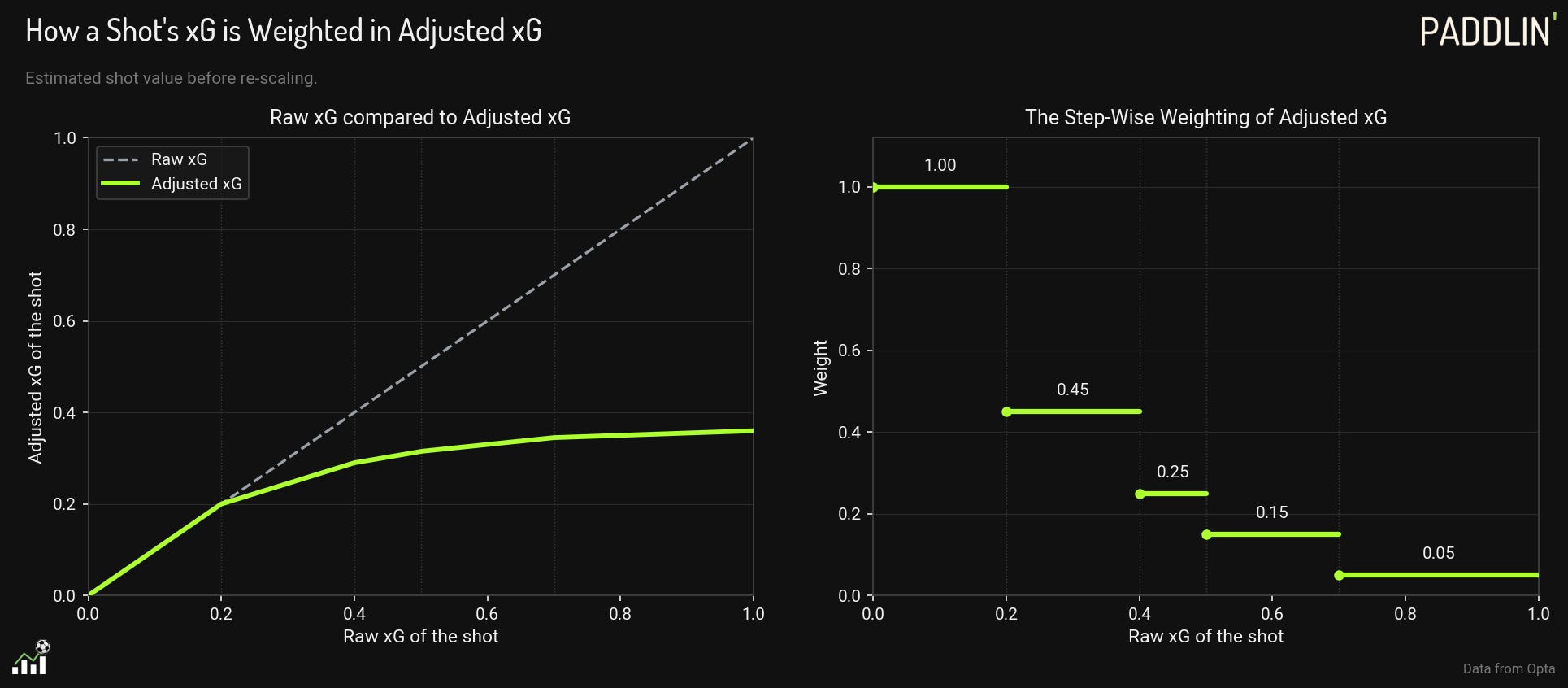
This “chance compression” is one of the two adjustments in Adjusted xG. The other is the game state effect, which played a major role in England shooting up the chart of likely World Cup winners.
