


It was a match that more or less no one—certainly not me, and certainly not the PADDLIN’ model—expected to be terribly competitive. It turned out to be the first stone-cold classic World Cup knockout match this tournament has delivered. Cabo Verde took defending champions Argentina to extra time and, even after falling behind early in the extra period, found another equalizer and pushed the Albiceleste to the brink of a shootout.
In the adjusted xG, the result reads like a fluke. Argentina ultimately attempted 22 shots, the large majority of them inside the penalty area and 6 within 12 yards of goal, rated at over 2 xG. None of Cabo Verde’s 16 shots came from such close range, and they ended up with about 0.5 xG.
But this is not going to be a newsletter about how, actually, the dramatic match that everyone loved was a fluke of finishing. To a meaningful degree, of course, it was. Cabo Verde’s extra time equalizer was one of the greatest shots in World Cup history, and everyone watching knew they had seen a truly special finish, one that commentator Stu Holden noted was probably the greatest Sidny Lopes Cabral has ever managed to pull off in his life.
But in analytics terms, it is not exactly news that Cabo Verde needed a bit of magic to push Argentina to the brink. What is far more impressive is that the Tubarões Azuis had made it to that point, and that they were by no means played off the pitch by Argentina. As noted in an earlier Expecting Goals World Cup blog, a deeper analysis of the event data and the adjusted xG methodology show that Cabo Verde played Uruguay close to even and did not require much in the way of good fortune to pull off that draw. And in the final group match against Saudi Arabia, needing a draw to reach the World Cup knockouts for the first time in their nation’s history, Cabo Verde did not sit back and play for the point but took the game to the Saudis. By xG, adjusted xG and field tilt, the match was Cabo Verde’s to win, and for once they could not make one of their many good scoring chances count.
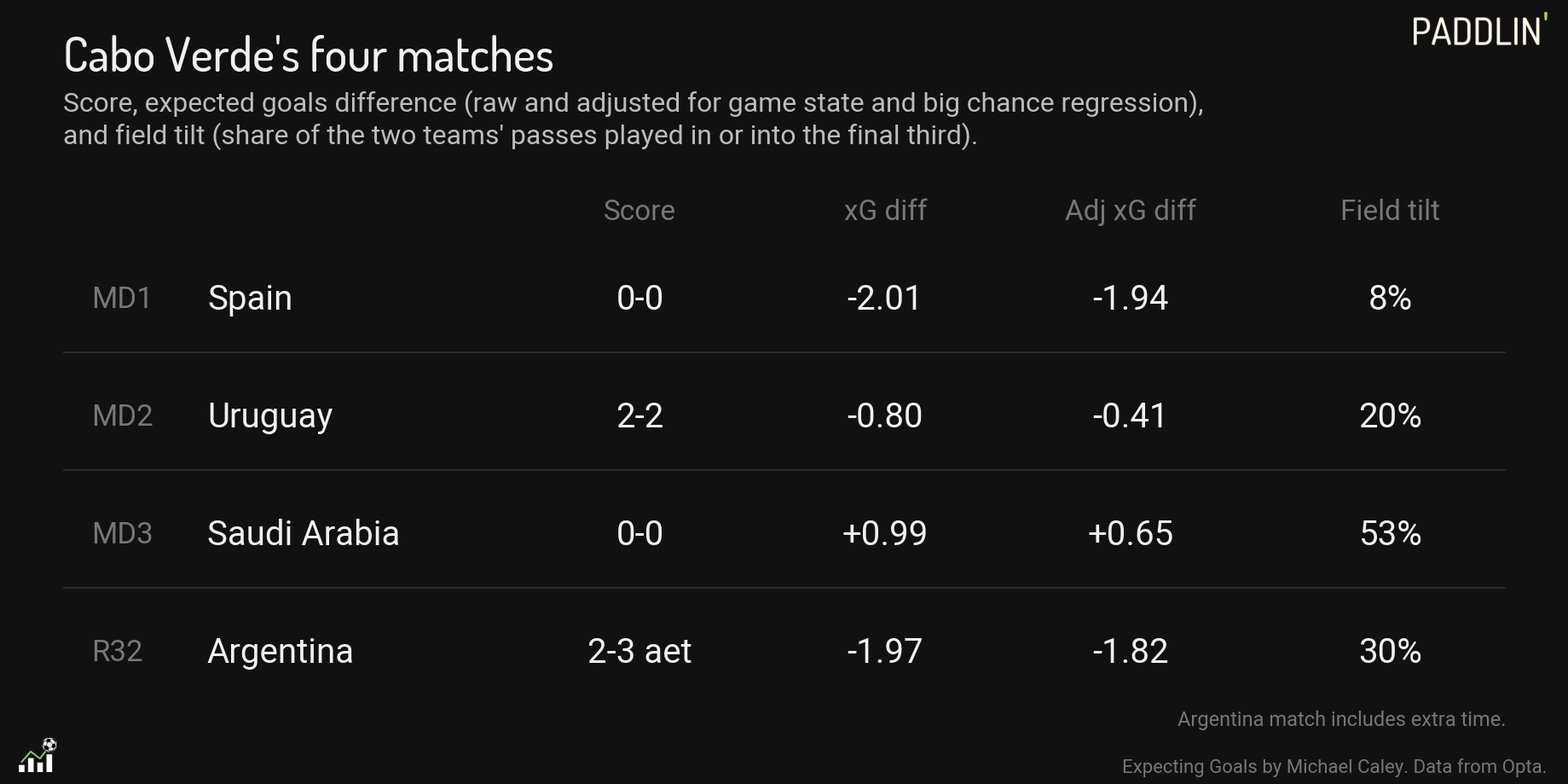
One scoreline can always be a fluke. The PADDLIN’ model is built on that suspicion, and it actually docked Cabo Verde rating points for the famous draw with Spain even as the rest of the world celebrated it. But I found that if I take all the underlying data seriously in the aggregate, even the numbers that call into question most of the praise for Cabo Verde’s opening draw, what appears is a story much larger than a single result. When a team keeps passing every test that international competition provides—at the level of the players, the program, and the tournament—the flukes stop being the story.
This is true first within the arc of the 2026 World Cup, and as I will argue, also over the past several years. In this World Cup, Cabo Verde played an unusually difficult schedule and managed to avoid being completely dominated by two of the best teams in the world and went at least toe-to-toe with their other opponents. By PADDLIN’ expected points relative to schedule difficulty, Cabo Verde’s numbers at this tournament are competitive with Croatia, Belgium and Egypt.
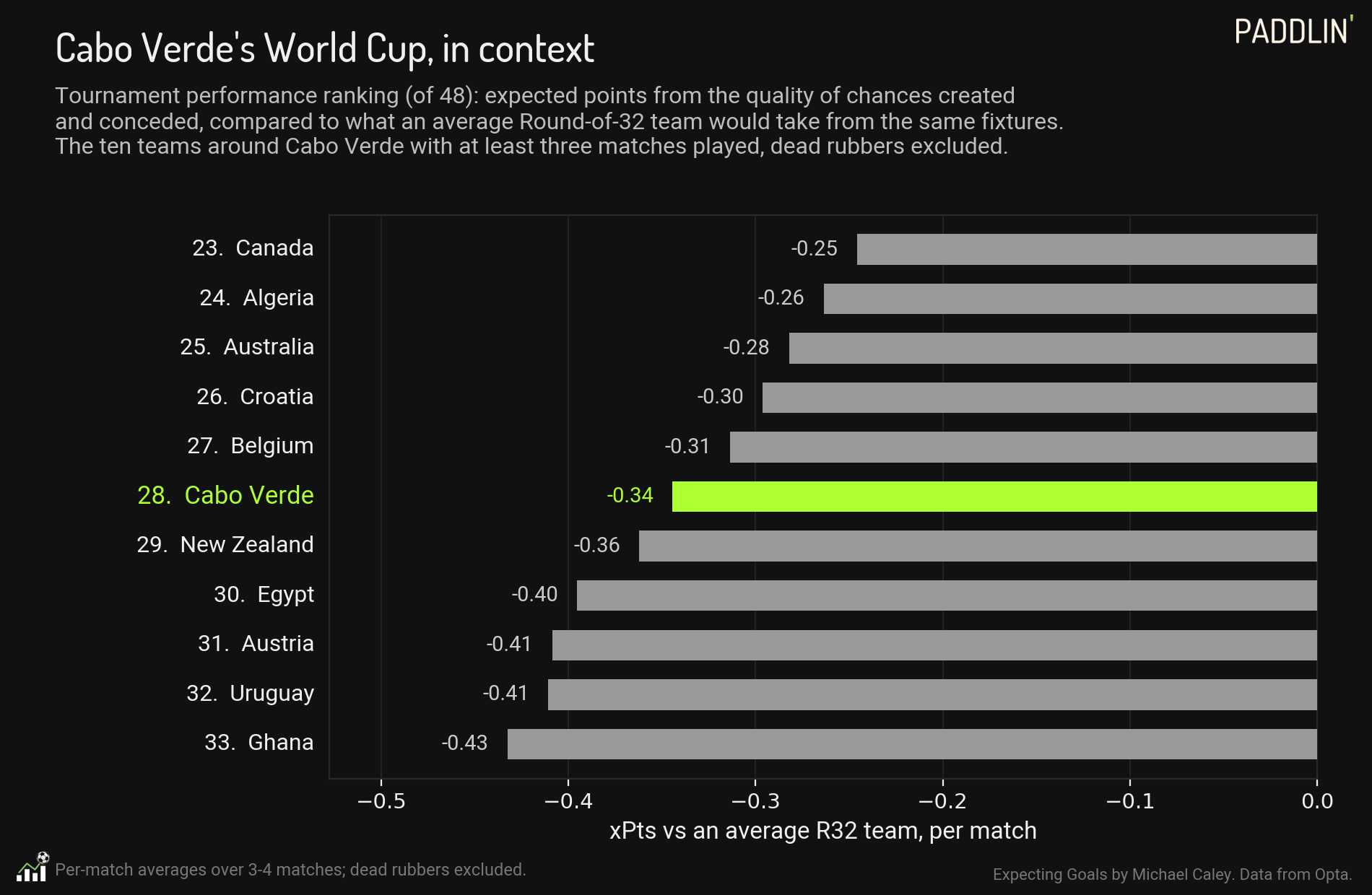
This chart throws into relief the larger reason why Cabo Verde’s run has captured the world’s attention. This is a tiny archipelago nation of about 530,000 people, with a diaspora population, primarily in the United States and Portugal, only slightly larger than that. The Saudi Arabia team they were unfortunate not to dispatch draws its players from a population nearly 70 times larger—still roughly 30 times larger even if you credit Cabo Verde its entire diaspora.
To understand the incredible nature of this run requires consideration of several different points: how much football talent Cabo Verde has produced for a nation of its size and wealth, how how far the team punched above that talent for years, and how this World Cup exceeded even what that record promised. This is a story of player development, as well as recruitment from the diaspora, a story of tactics and player relationships leading to improved play and a testament to the work of team manager Bubista, and finally a story of how it all came together on the biggest stage.
