


On June 29, Jonathan Tah scored a goal that looked like it would seal passage to the Round of 16 for Germany. He got free on the far side the six-yard box to meet a long, in-swinging corner, thumping a headed shot across the keeper and into the back of the net. But the goal was denied after a VAR check. Germany had stationed Waldemar Anton on top of Paraguay’s goalkeeper Orlando Gill, and a collision between Gill and Anton had dropped Gill to the ground as the cross came in. The keeper was able to get up but the match officials determined it was a foul on Anton and waved off the goal.
It was a controversial call, but FIFA’s head of refereeing Pierluigi Collina explained that this decision was consistent with new guidelines at the World Cup for corner kicks.
“Although keeping a position is not a foul per se, when an attacking player is not interested in the ball and deliberately moves, even marginally, with the clear intention of obstructing opponents’ movement and prevents him from defending, then referees, and VAR when needed, should carefully analyse the incident and intervene,” Collina said.
“This is especially the case when the tactic aims to prevent the opposing goalkeeper from being able to defend the goal.
“Coaches and players were informed, so it should come as no surprise that referees will punish these fouls.”
Such a standard offers a major change from the norms of refereeing in the Premier League, where the standards of acceptable contact with goalkeepers on corner kicks were exploited in radical new ways in the 2025–26 season.
The Meat Wall, Explained
The logic behind the tactic that this blog christened “the meat wall” is easy to follow.1 Scoring headers is difficult, and the further from goal you are the harder it is to get the power or find the angle on your shot to beat a goalkeeper. On corner kicks, headers attempted from inside the six-yard box are scored about 15 percent of the time, while headers from outside the six-yard box are scored about 5 percent of the time. If you could simply play all your corner kicks to the area right in front of goal, you should be able to score more goals. But there is an obvious problem: the goalkeeper. Keepers are expected to “control their area” and rise to claim crosses hit close to goal, and so a strategy of more six-yard box crosses will likely lead to more claims not more goals. The solution, developed most influentially by Nicolas Jover and Mikel Arteta at Arsenal, was to station attacking players near the keeper, who would in turn be marked by defenders, to create a wall of bodies that the keeper could not fight through to claim the cross.
The meat wall worked. During the 2025–26 season, the crosses hit to the six-yard box became a dominant strategy across the league, but the rate of claims by goalkeepers nonetheless decreased slightly. I created a model of keeper claims based on cross location, and this suggested claims were down more than 50 percent compared to expectations.
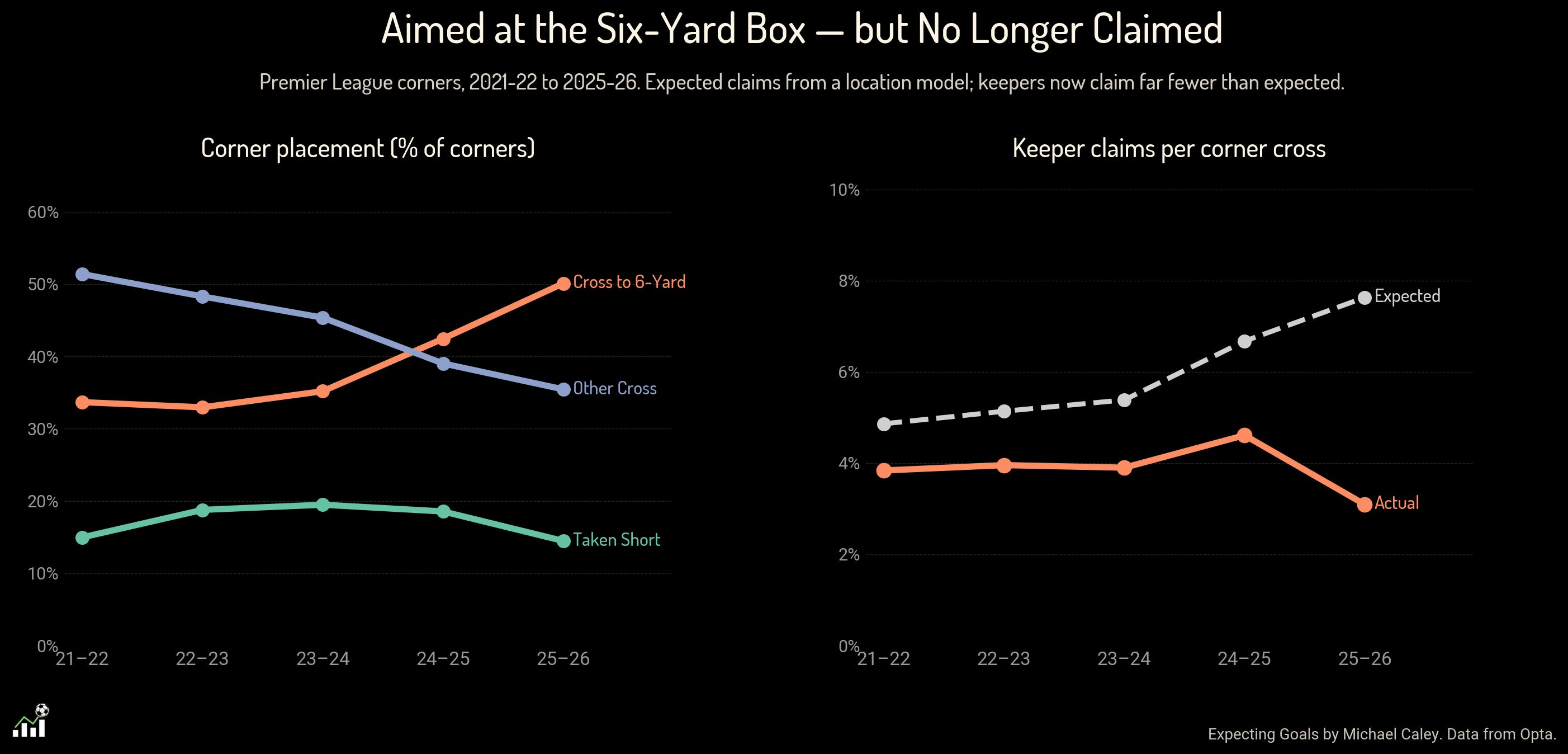
This analysis has also been confirmed with player tracking data, as David Reed showed on Sky Sports that the number of attackers in the six-yard box on corners has increased by about 70 percent over two seasons.
And of course the goals came too. There were 183 corner kick goals in the 25–26 season, up from an average of about 150 per season in the previous four seasons. And it was not just corners—there was also a massive increase in goals from throw-in set pieces. But while set piece goals exploded, open play goal-scoring actually decreased. Instead of set piece goals adding greater excitement to the game, it seems they crowded out other goals. Teams chose to play a more conservative style, taking fewer risks to create chances because they could count on set pieces.
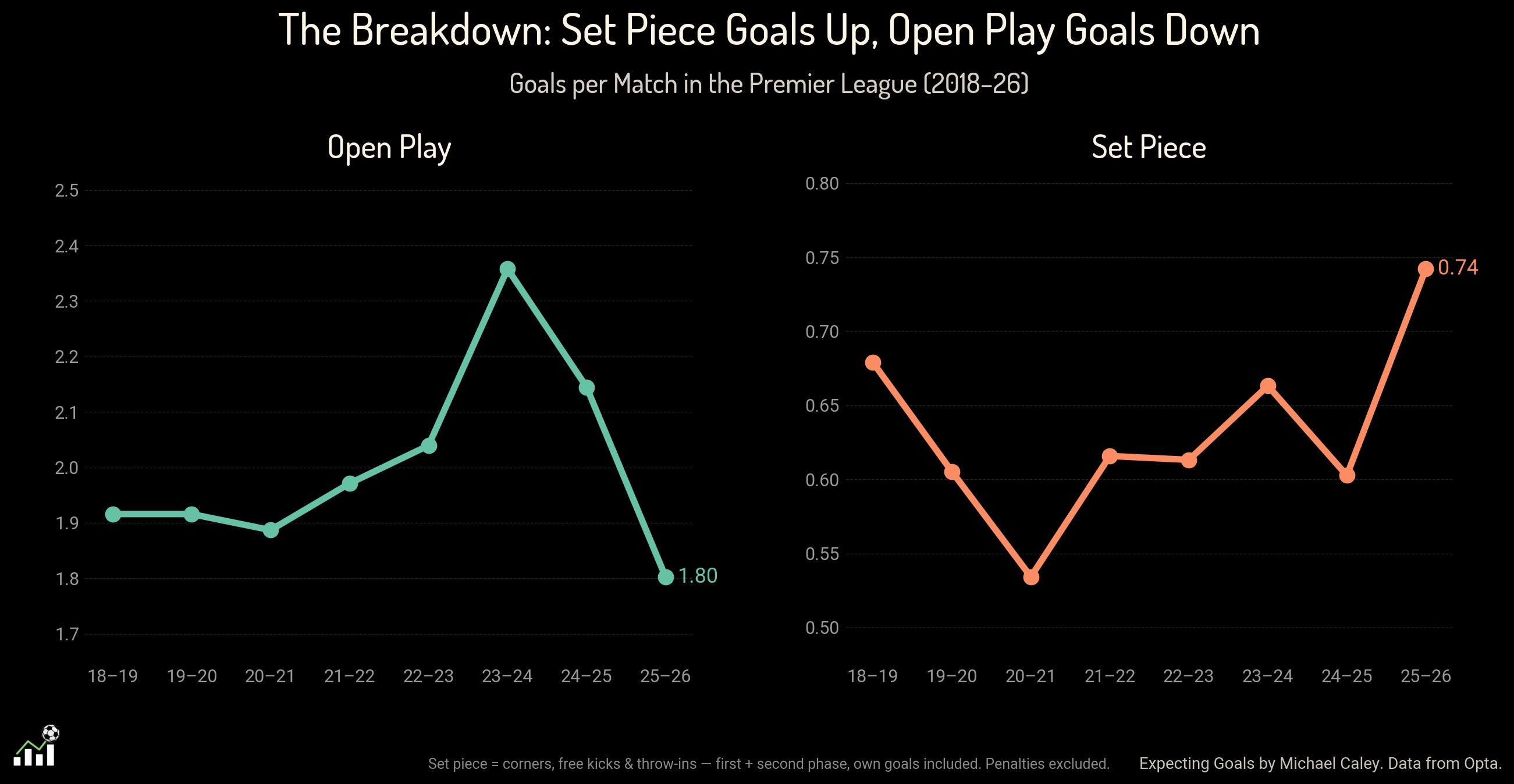
All of these points are drawn from larger studies from Expecting Goals over the previous season:
Long Throws and Meat Walls: The Set Piece Revolution in the Premier League
Who Made the First Meat Wall? The Origins of the Set Piece Revolution
So one of the big questions heading into the World Cup was whether this strategy would transfer from the Premier League to the international game.
Corner Kicks at the World Cup
So far in 2026, through the matches on July 1, the rate of goal-scoring from corner kicks was a mostly unremarkable 0.38 per match, compared to about 0.35 per match over the last three World Cups. Indeed, set piece goal-scoring appears unremarkable overall. At a more granular level, looking at xG because of the smaller samples of matches involved, it appears that corner kicks are providing somewhat more danger than in the past. It is just not an enormous change.
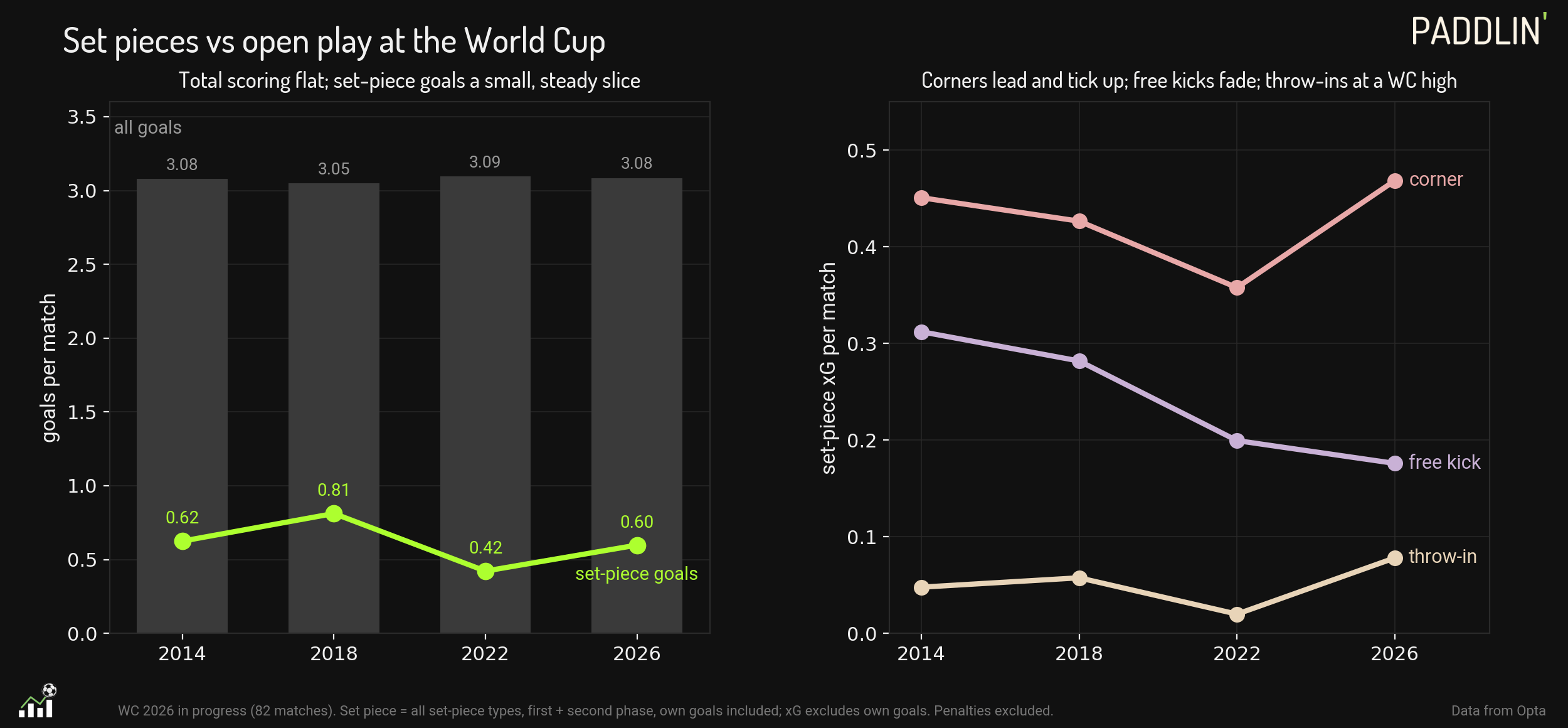
A deeper analysis of corner kick statistics suggests that teams have adapted to the changes to the rulebook implementation, and the insights behind the strategies that changed the game in the 25–26 Premier League may still be seen behind the numbers.
There has been an increase in corner kicks taken to the six-yard box, from 33 percent in the 2022 World Cup to 39 percent here, but that is a far cry from the absurd 59 percent of corner kicks crosses taken to the six-yard box in the Premier League last season.
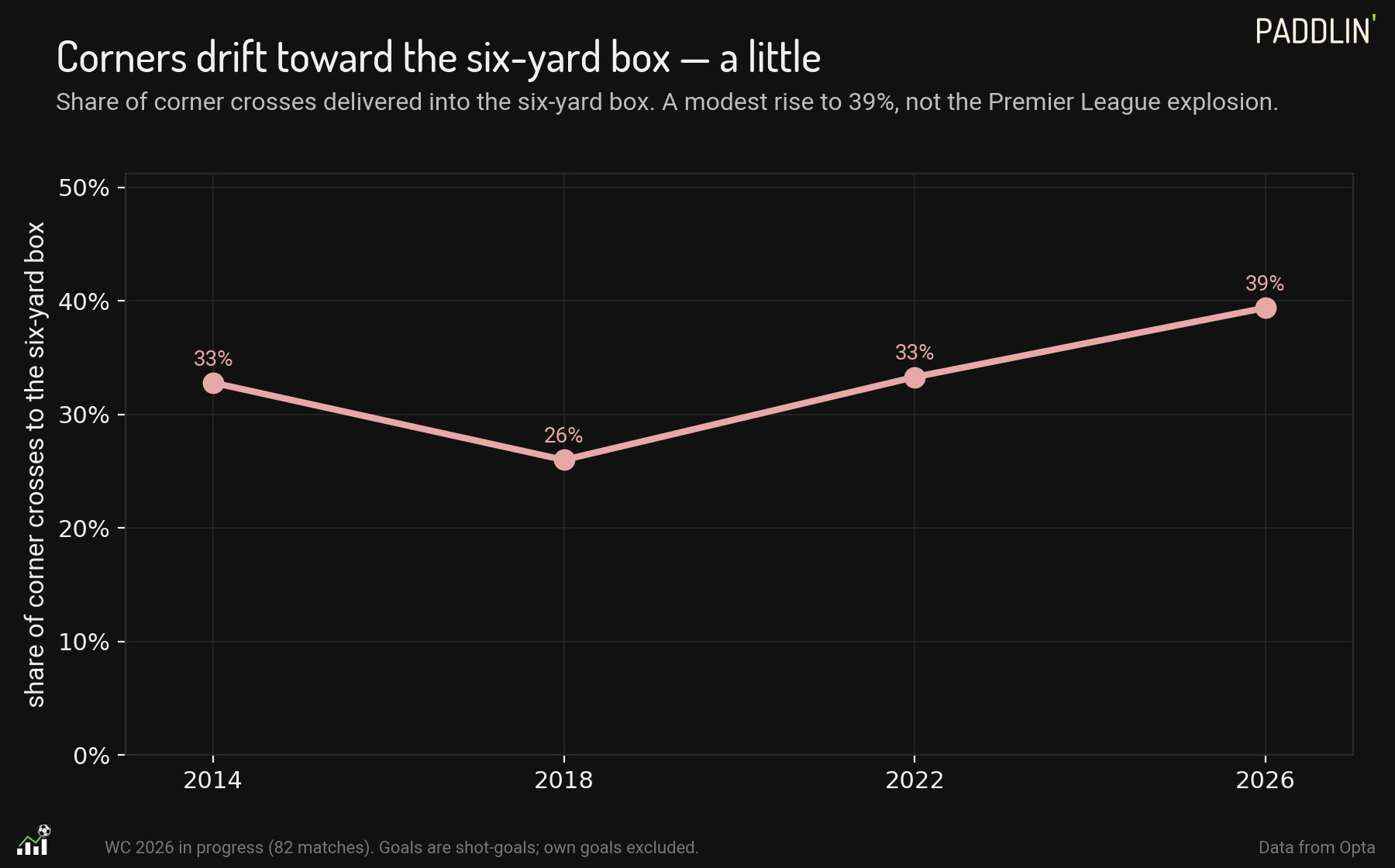
It makes sense that the new refereeing standards would have such an effect. Attacking players purposely taking up positions near the keeper are essential to the meat wall strategy. If they are at risk of being called for a foul for “even marginally” moving toward the keeper, and if referees have been instructed to pay particular attention “when the tactic aims to prevent the opposing goalkeeper from being able to defend the goal", teams will reasonably decide to back off from the approach. Even Germany’s very mild attempt to obstruct the keeper with one man in his space was identified and punished.
And when you look more closely at corner kick location, the story moves into tighter focus. Teams have learned from modern set piece tactics and are trying to play more corners to more dangerous locations, but the ultra close-range targets the meat wall tactic made possible are no longer available.
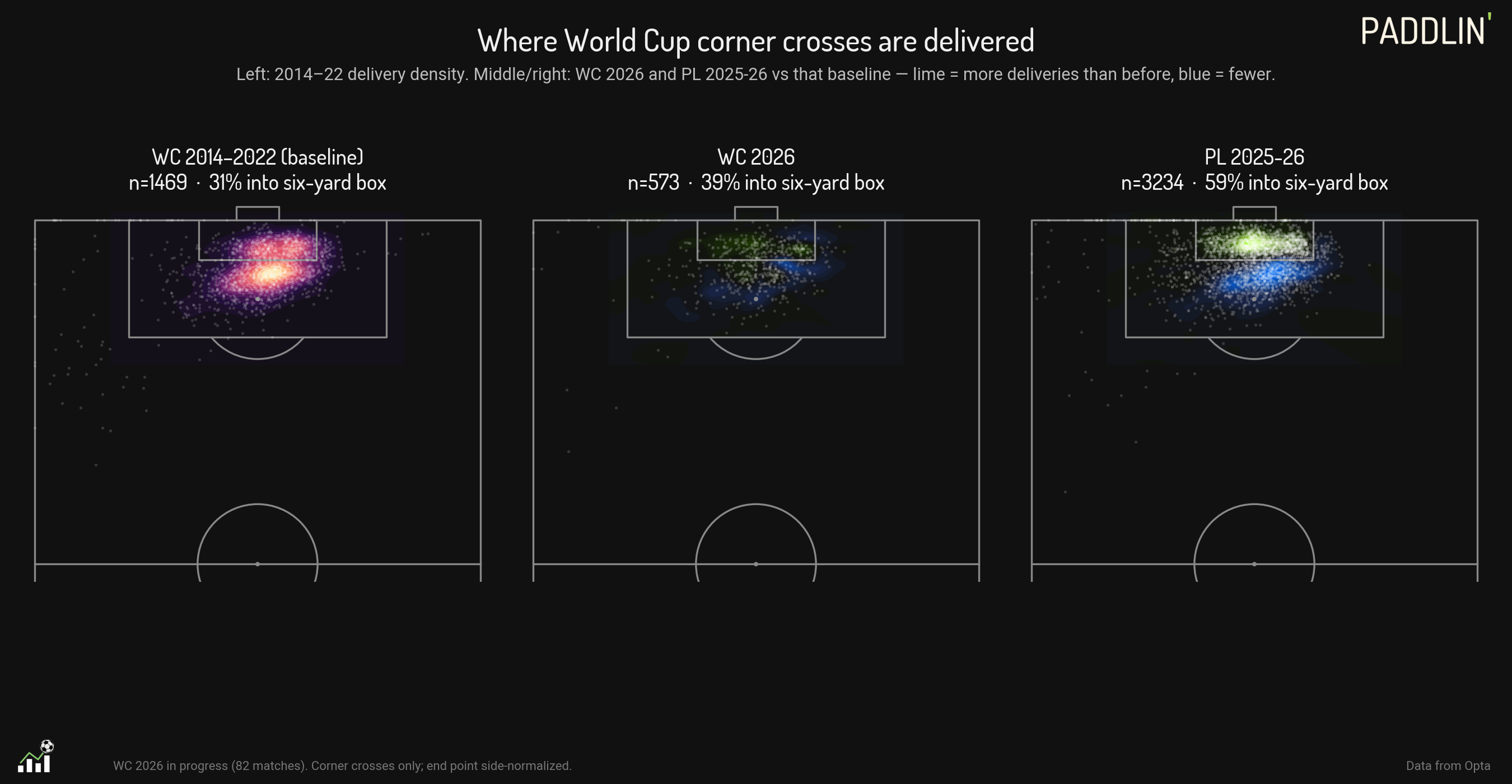
In past World Cups, a larger number of crosses were played to very poor areas, well outside of the six-yard box. The blue areas in the 2026 graphic show the corner kick deliveries that have become rarer this cycle. Fewer teams have played crosses to the penalty spot or the wide areas outside the six-yard box in 2026. But teams have not been able to concentrate corner kicks to the most dangerous areas just a few yards from goal, with more corners also being taken to the locations about seven to nine yards out as well as toward the edge of the six-yard box. Whereas in the Premier League in 2025–26, those corners also nearly disappeared in favor of a concentration of crosses hit to just a couple yards out.
I find these results even more compelling than if corner kick delivery had not changed. If the data were just the same as it was eight years ago, it might suggest that international coaches had simply failed to incorporate new insights about set pieces into their preparation. Instead, these charts display a tendency toward optimizing corner kicks, reflecting those new insights, but with the rules functioning effectively as a dampener and preventing the development of the radical strategies dominant in the Premier League.
The new directives on corner kicks seem to be working.
But what about the other new rules? FIFA introduced a set of new rules aimed at speeding up the pace of play and preventing long delays in the action. Several of these are somewhat harder to capture analytically, but the rules aimed of speeding up restarts of play should be easy to study.
Here’s how Dale Johnson at the BBC summarized the rule change:
Countdowns for goal-kicks and throw-ins (five seconds): If a player deliberately delays the restart of play, a goal-kick could become a corner or the throw given to the opposition.
The count will not begin when the ball goes out of play. A referee will choose to activate it if a player is taking too long.
The rule relies on the referee’s discretion. Referees at the World Cup have called for turnovers of possession in several matches, but the real question with the effectiveness of these rules is not whether punishments are handed down. Have there been fewer delays before restarts of play?
And this also raises a question about set pieces. Throw-in set pieces have caused an explosion in delays in the Premier League. Nearly half of all throw-ins taken from attacking areas in the 25–26 season required a delay over 20 seconds. That rate of delay was more than double the rate from previous Premier League seasons. If the “shot clock” for throw-ins is enforced, and if these frankly ridiculous new delays are nipped in the bud, will that also limit the effectiveness of the long throw strategy?
