


The set piece revolution remains the story of the season in the Premier League and shows no signs of slowing down. Goals from set pieces are still elevated. Corner kicks and long throws continue to account for more or less the entirety of this effect. Since the last Expecting Goals newsletter pinpointed these two tactics as the core of the new set piece vision, more discussions and analyses have focused on these situations.
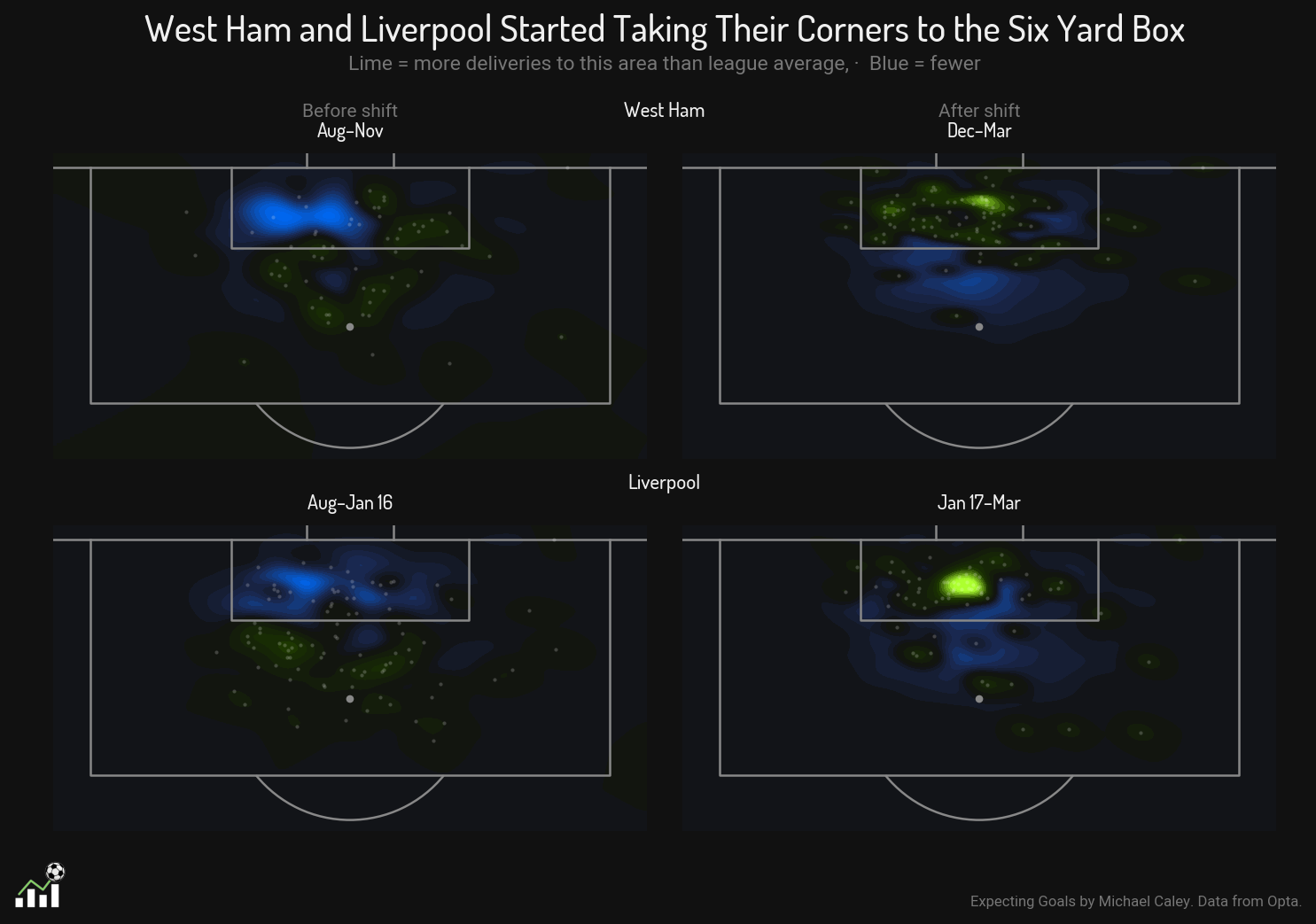
A recent analysis piece on Sky Sports looked at the “meat wall” corner kick tactic of placing attackers in the path of the keeper to prevent him from claiming the ball even when it is served into the center of the six yard box. David Reed found that the number of attackers in the six yard box on corners has increased by about 70 percent over just two seasons. In another study, Laura Hunter identified that as the season has gone on, teams have changed their tactics on corner kicks to prioritize inswingers to the goal mouth, with Liverpool having a particularly dramatic shift. This strategy is gaining new converts rather than slowing down.
On throw-ins, there are even proposed rules reforms. Setting up a long throw takes time, especially to move the defenders into position and bring the long throw specialist over to pick up the ball. A recent piece on Opta Analyst by Ali Tweedale found that the time spent with the ball out of play before throw-ins has increased by nearly 20 percent this season, from a little under 9 minutes per match to a little under 11 minutes per match. IFAB, the commission responsible for setting rules across football, has proposed to empower referees to begin a five-second count if a team seems to be taking too long to play a throw-in or a goal kick. It remains to be seen if this time limit will be enforced in a way that makes the long throw tactic less effective or simply speeds it up a little bit.
And on the pitch, the set piece goals keep coming. Set pieces account for just under 30 percent of goals scored this season, up from a little over 20 percent in recent seasons. And as the last newsletter shows, this sudden tactical shift in the Premier League has arisen not from a complex array of factors but from two clearly identifiable new ideas: the long throw and the “meat wall” corner kick.
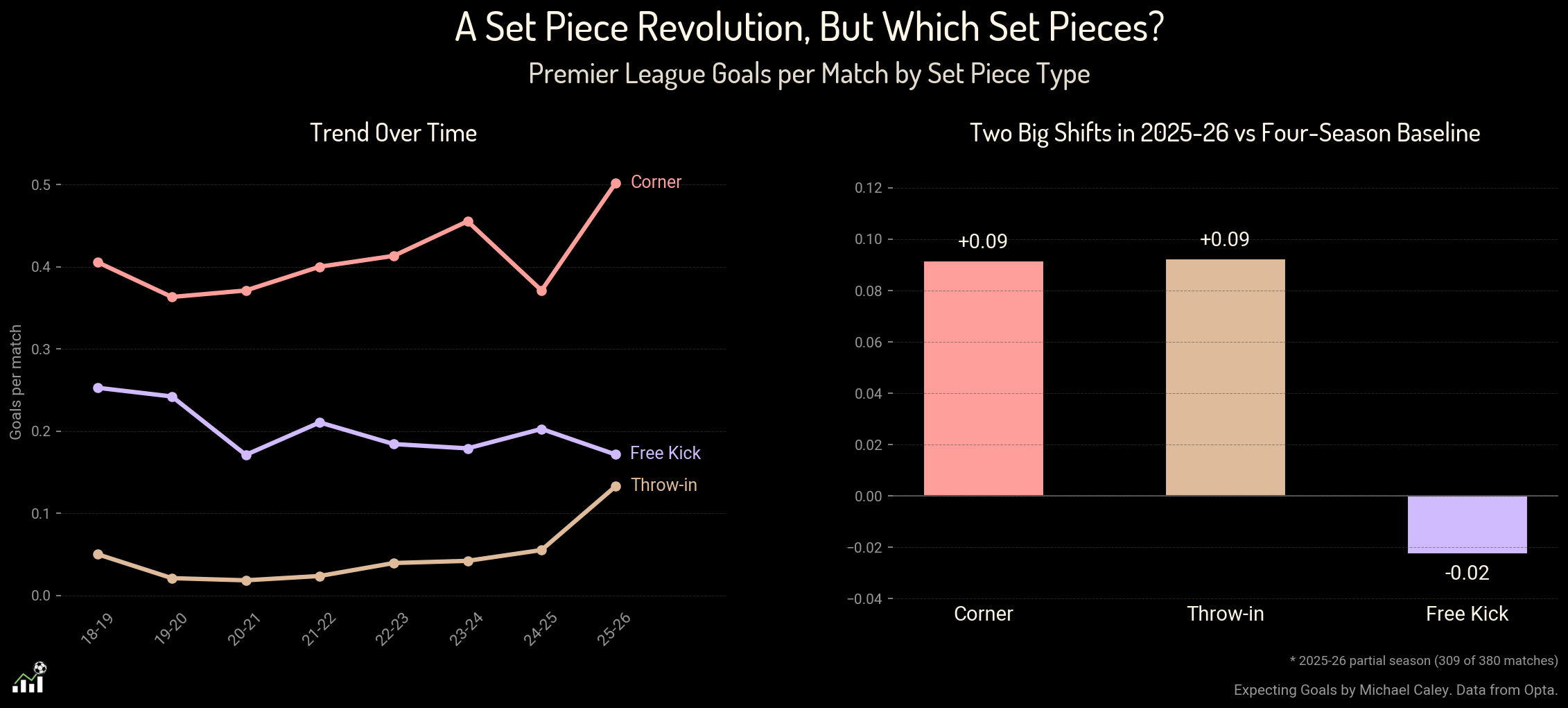
At the same time as these tactics have increased goal production from set pieces, open-play goal scoring remains depressed. As a result, corners and throw-in set pieces combined have accounted for about 23 percent of goals scored in the Premier League this season, compared to an average of about 15 percent in recent seasons. Nearly a quarter of goals now come from corners or long throws.
How did this happen? Who is responsible for this sudden tactical shift, and how did it take over the Premier League so quickly?
A Revolution, But Who Are the Revolutionaries?
This question has a short answer, and then it also has a long answer that digs back into an earlier era in the Premier League and offers a set of contrasts that can help us understand better what is going on today. That longer answer will take up much of the length of this newsletter. It will also introduce the paradox of the Rory Delap Trap.
Still, there is a short answer.
It was Brentford and Arsenal.
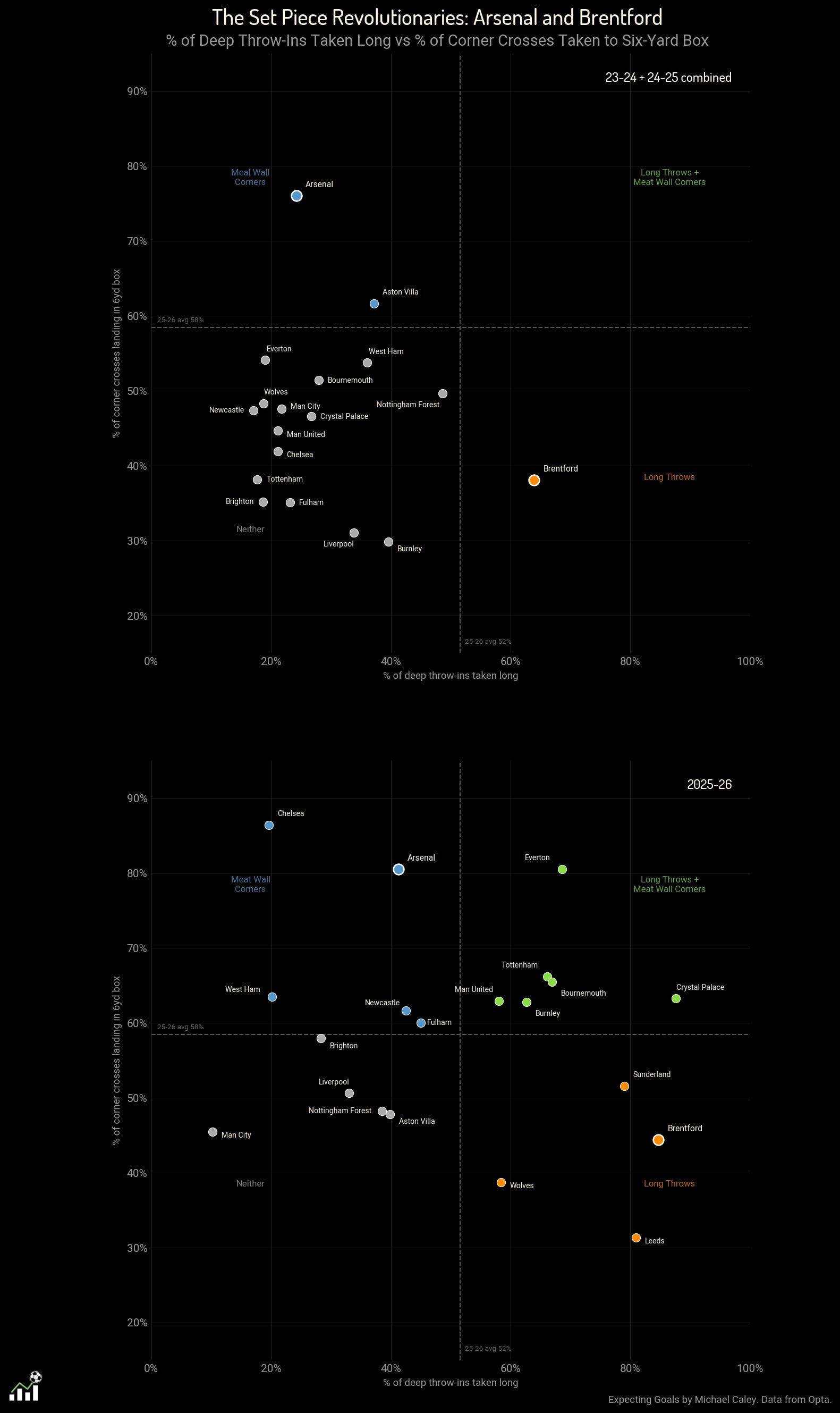
In the 2025–26 season, fully ten Premier League clubs have taken at least half of their deep throw-ins long into the penalty area. In the two preceding seasons, only Brentford at about 64 percent broke that barrier. Likewise Mikel Arteta’s Arsenal, with over 75 percent of their corner kicks played to the six-yard box, stand out as the clear innovators whose corner tactics are now being copied by the rest of the league. (Arsenal’s claims prevented numbers in 2024–25 also lapped the league before the “meat wall” was copied by many of their competitors.)
One striking finding here is that the two tactics have distinct innovators, and no club before this season was executing them both. Brentford has retained a strategy on corners that makes less use of crowding the keeper than most, while Arsenal still do not play the majority of their deep throw-ins long. Instead, new adopters like Everton, Crystal Palace, Spurs and Bournemouth have taken ideas from both Arsenal and Brentford to try to maximize all of their set pieces.
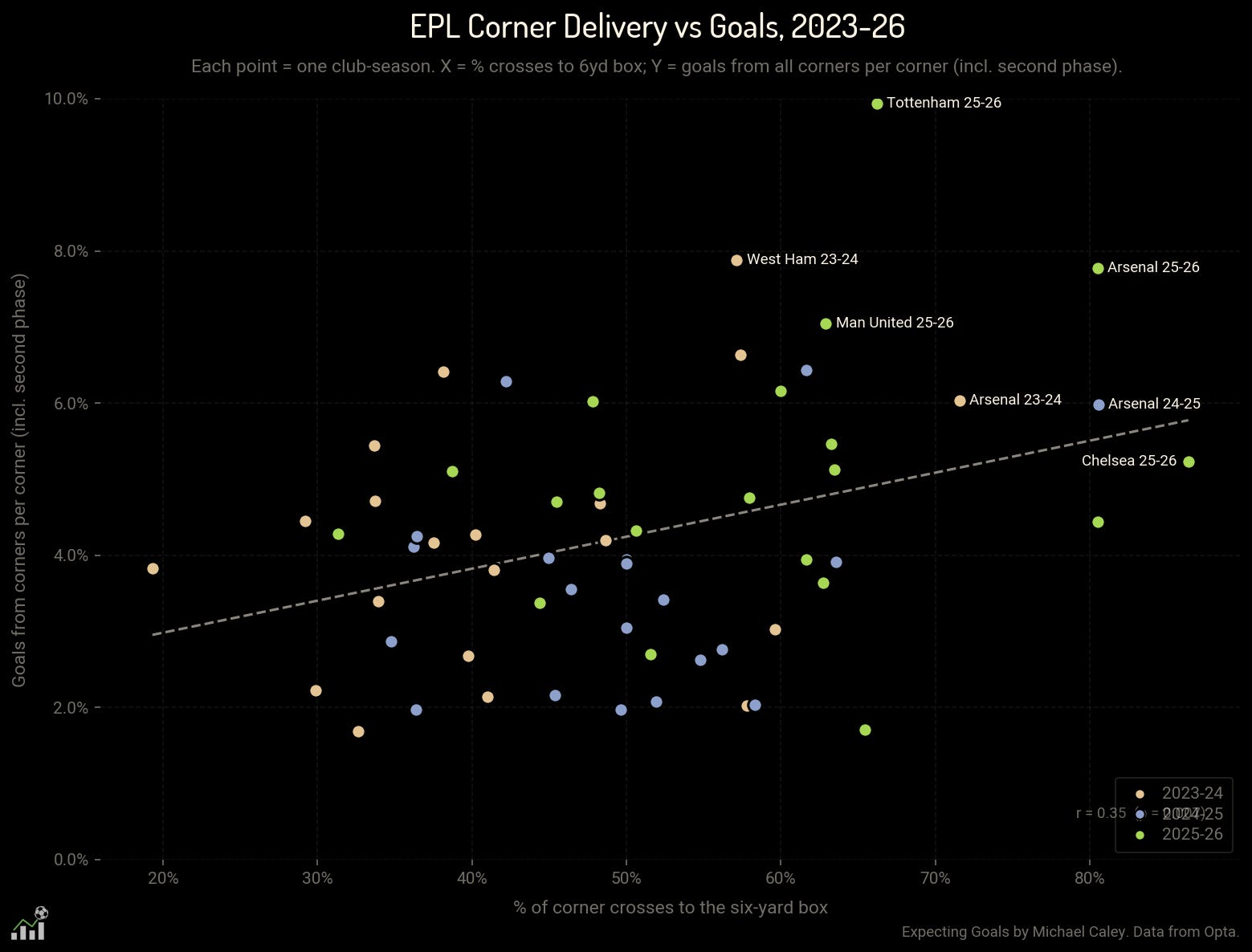
It is important to grasp why Premier League teams have so suddenly altered their approach to set pieces. Clubs and managers have adopted these tactics because they work. And this is true not merely at the level of individual plays, as the previous newsletter demonstrated, but also at the team level. Clubs that adopted these tactics have been rewarded with better set piece results.
The New Corner Kick Model Takes Over
These new corner kick tactics have clearly been effective over the last several seasons for clubs which have chosen to adopt them, first Arsenal and then a spate of copycats.
And just as many teams adapted their set piece strategies over the last summer to adopt Arsenal’s and Brentford’s innovations, this has also happened during the season. Along with Liverpool, as Laura Hunter had noted, West Ham likewise in the late fall began targeting the six-yard box at much higher rates.
The speed of the adoption of these corner kick tactics raises an obvious question. While it is not hard to understand why clubs have picked up strategies that help them score more goals from set pieces, why did it take until the last few seasons for teams to find these innovations? There was a longstanding tradition, in English football particularly, of focusing on set pieces as a way to even out the advantages of more skilled and technical possession sides. Were they unable to identify the right tactics?
The Pre-History of the Meat Wall
When looked at over a longer time horizon, the sudden development of a dominant corner strategy in the last two seasons appears as a spike following a long trough. Back in 2009–10 and 2010–11 in particular, there were more teams playing their corner kicks directly to the center of the penalty area, and even, if to a lesser degree, preventing opposition goalkeeper claims.
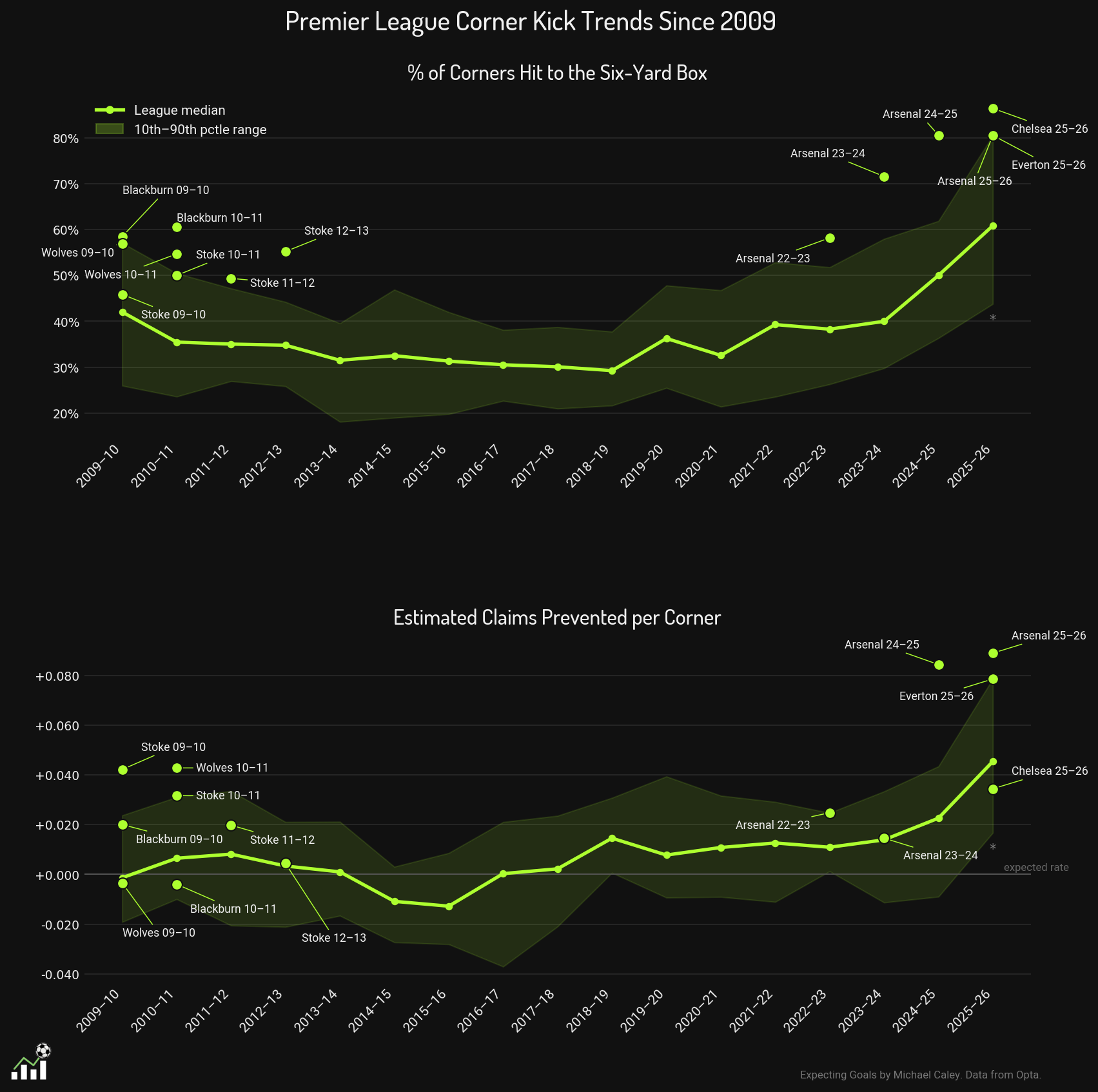
Sam Allardyce’s Blackburn Rovers, Tony Pulis’ Stoke City and Mick McCarthy’s Wolves all show up here with strategies that resemble Arteta’s contemporary version.
Why didn’t they catch on? The simple reason is that these clubs were not particularly effective in converting their corners. Blackburn, Stoke and Wolves ran only slightly above a league average of 0.04 goals per corner in this period.
And this relative inefficiency was probably not random, as a closer analysis of their approach shows crucial differences from the modern approach.
