


With Arsenal’s victory over West Ham on Sunday sealed following a lengthy VAR check of a typically physical corner kick routine, the question of the “meat wall” is back in the center of the football discussion. Few commentators have disputed that Arsenal goalkeeper David Raya was unlawfully impeded by West Ham forward Pablo. Pablo extended left arm prevented Raya from reaching the ball as he leapt to clear. However, this was hardly the only contact on the play. Just to Raya’s right, Arsenal midfielder Martin Ødegaard had West Ham’s Jean-Clair Todibo in a bear hug, while Todibo had grabbed hold of a piece of Raya’s shirt. A few yards away, Ødegaard’s teammate Declan Rice wrapped up Konstantinos Mavropanos from behind in classic rugby tackling form.
The videos and images have circulated widely as fans made claims and counter-claims over how the referees should have handled the call. But the question here is not so much about whether Pablo’s specific offense should have been reviewed. Rather, this controversy offers a crystallizing moment in the 2025–26 Premier League.
Clearly the traditional norms of allowed contact no longer applied here if players thought, correctly, they could get away with everything short of Pablo’s infraction. The grappling on this corner was no outlier. It exemplified the way the game is played in England now.
A further reason that this moment has captured the imagination of football fans is that Arsenal’s involvement is poignant. The Gunners, under manager Mikel Arteta and set piece coach Nicolas Jover, were the innovators in bringing the “meat wall” to the Premier League in the 2024–25 season. Arsenal began taking far more of their corner kicks to the six-yard box and impeding the keeper with a wall of bodies to prevent the keeper from claiming the cross, as demonstrated in the previous Expecting Goals newsletter. This tactic has spread throughout the league as many of Arsenal’s competitors quickly began copying this approach. Notably, West Ham started playing these inswinging corner kicks only midway through the 2025–26 season, after seeing how successful they were for opponents.
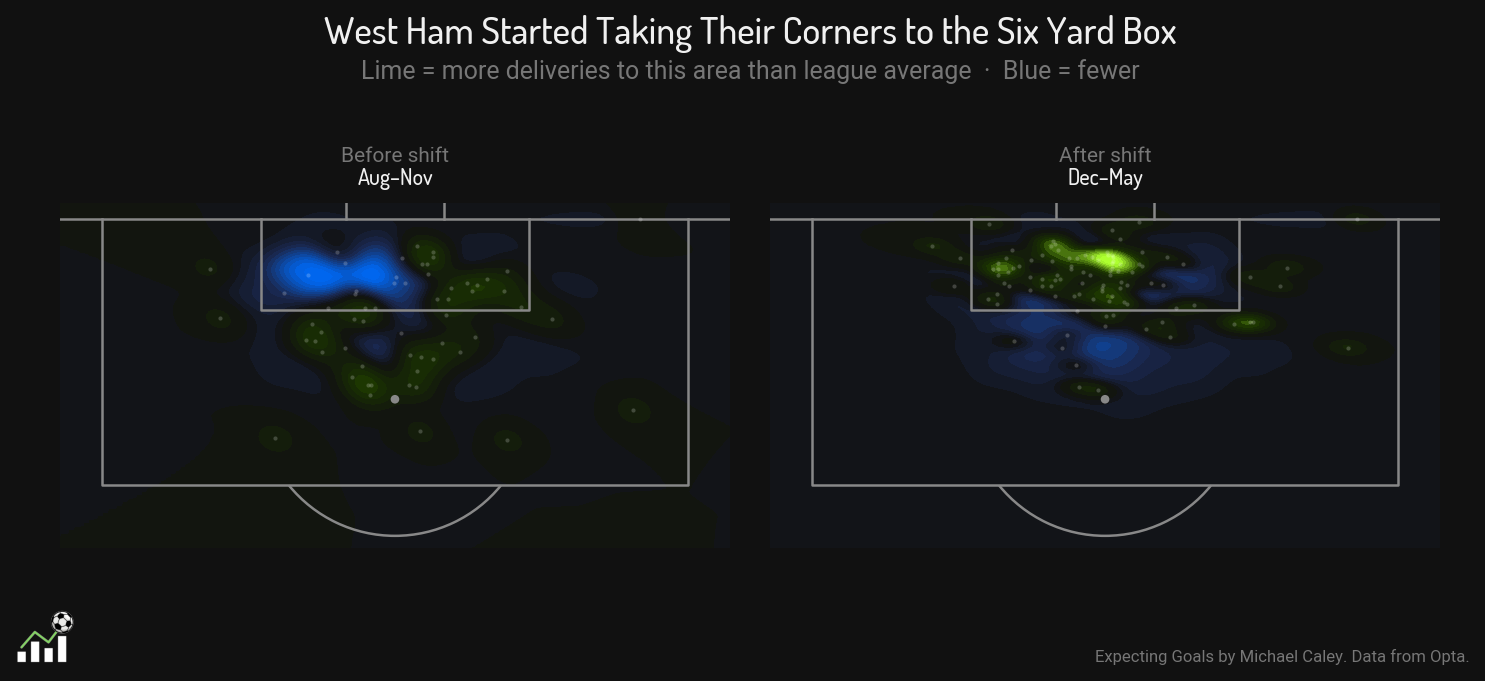
West Ham’s tactical change offers a perfect example of how innovations in set pieces have changed the game in the Premier League by forcing clubs to adapt or miss out on crucial goals. The meat wall tactic has two key components. The first is striking inswinging corners to the six yard box, closer to goal where goal-scoring rates are higher. But the second, without which the inswingers would reap little benefit, is placing bodies in the six-yard box to impede the keeper and prevent them from claiming high balls played into their traditional zone. David Reed showed on Sky Sports that the number of attackers in the six-yard box on corners has increased by about 70 percent over two seasons. As I discussed in the first Expecting Goals newsletter on set pieces, rates of keeper claims have actually decreased this season even as corner kicks are taken at historically high rates into the six-yard box.

None of this would be a major issue, and certainly clubs like West Ham would not have felt forced to adopt it themselves midseason, if it weren’t for the core fact about the new approach to corner kicks. This tactic works. Goal-scoring from corner kicks has increased from its traditional rate of three to four percent league-wide up to over five percent this season in the Premier League. That amounts to a nearly 40 percent increase in scoring from corner kicks because of these tactical changes.
The path from here to the absurd grappling on West Ham’s corner is straightforward. If attacking players are setting themselves in the way of the goalkeeper, the defenders will try to impede them from reaching their preferred positions just as Ødegaard has. And if all of that grabbing and holding is being allowed near the keeper, will the referees really stop players from doing so elsewhere in the penalty area? A further point made by former referee Graham Scott in The Athletic is that with so many players stacked on top of each other, it is impossible for one referee to have a sightline on every possible offense.
This problem is then exacerbated by a deep structural inequality in the rules of the game. If the referee calls a foul on Pablo, West Ham lose a corner kick opportunity which has been scored about five percent of the time in the Premier League this season. But if Rice’s foul on Mavropanos is called, that gives West Ham a penalty kick with a nearly eighty percent chance of being scored. If an attacking team fights and grapples on every corner and gets called for ten fouls while winning just one penalty, they have achieved a highly favorable outcome. The multiple different ways that West Ham players were attempting to harass Raya, without trying to play the ball themselves, have a real logic under the rules of the game. Attacking teams have every reason to take more and more risks committing fouls on corners unless their offenses are whistled at profoundly asymmetrical rates compared to defending teams.
What Is To Be Done?
Commentators have circulated a number of proposals to deal with this new corner kick tactic. If people agree that all this grappling is unpleasant to watch and the “meat wall” does not fit within the spirit of the game, then something needs to change either in the rules of soccer or their application. Here are a few of the live suggestions.
Returning to a standard of “protecting” the goalkeeper with a lower bar for fouls against the keeper on corner kicks.
Barring attackers from the six-yard box at the moment the corner kick is taken.
Copying an idea from field hockey and requiring defenders to start behind the end line while attackers must begin from further out.
I have previously suggested that perhaps ice hockey rules offer another option, with their category of “interference” by which any action which impedes a goalie within the “crease” around the goal is an infraction. This would explicitly write into the rules the lower bar for goalkeepers by establishing a new standard that impeding the keeper is simply no longer allowed. It also may be that a simple change in refereeing norms could suffice. While there are some worrying signs, especially in the Bundesliga, refereeing standards and norms of play have mostly prevented the same kinds of grappling and interference with the goalkeeper from becoming standard in continental European leagues.
But in this newsletter I want to offer something much simpler which I believe can address all of the problems with corner kicks at once.
What if corner kicks became free kicks and were no longer taken from the corner?
Here is my pitch. First, this rule change would not introduce a new kind of action within a match that is unfamiliar to fans, players, coaches or referees. It would not require a new set of refereeing or video replay standards. There would be offside review, but that review would be handled in the standard way that offside is adjudicated on all free kicks, and there would be no change to rules about fouls or allowed player positioning. It would not require stricter refereeing, which risks counterintuitively incentivizing more contact on corner kicks, not less, due to the imbalance in the value of attacking and defensive fouls.
Further, as I argued in the initial newsletter, it seems to be precisely the lack of offside on corner kicks and throw-ins that is being exploited by the new set piece revolutionaries. There has been no meaningful change in scoring from free kick set pieces even as goals from corners and throw-ins have increased at unprecedented rates.
Broadly, there are three types of dead balls which can be used to create set pieces. There are throw-ins, which can be launched into a crowded penalty area from the sideline, and corners likewise crossed in from the corner flag. And there are free kicks, a much more diverse set of opportunities spread all over the pitch which can be used for direct shot attempts, crosses, launches, or a variety of trick plays. The effects of the set piece revolution are seen entirely in the first two categories, while scoring from free kicks has actually decreased.
…
What do corners and throw-ins have in common that free kicks do not?
There is no offside rule on corners and throw-ins when they are taken.
In these two situations, unusually within the game of football, the defending team cannot determine by its shape the area within which the attacking team must play. The attacking team can then pack the penalty area with bodies in whatever formation they choose. It appears that this particular gap in the rules has been the primary opportunity identified and exploited in the Premier League this season.
Why are players grappling for position on every corner kick? Because at the moment the corner kick is taken, attackers are already allowed to stand in, or run into optimal attacking positions. Attackers will battle for those positions knowing that even if they get called for a foul, it is probably still worth the risk. Defenders and goalkeepers will have to physically protect those optimal attacking locations and prevent attackers from setting themselves up there. The competition for space created by the lack of offside on corners is effectively the same situation that obtains at the line of scrimmage in American football. Everyone is competing for access to the same valuable spaces and the contest will necessarily push the limits of allowed contact.
By allowing the defense to set a line beyond which attacking players may not stray, if they want to be available to receive the ball, this rule would immediately prevent most forms of goalkeeper obstruction. It would also significantly limit grappling as attackers would now be running toward optimal positions rather than camping out there already.
I do not see this as the only potential solution or necessarily the best one, but I want to explore the free kick solution because it can be approached analytically, and because it has a clean and simple logic for how it would remove a set of negative incentives to higher-quality play on set pieces.
From Where Should the New Free Kick Be Taken?
This is a simple question of analytics. It combines two objective questions. What was the rate of goal-scoring from corner kicks before the meat wall took over the Premier League? What is the rate of goal-scoring from free kick set pieces based on the location from which the free kick was taken? Then it just takes a quick cross-reference to determine which areas of the pitch see free kicks scored at the same rate as corner kicks used to be scored.
Here is the map of estimated likelihood for goal-scoring from free kick set pieces.
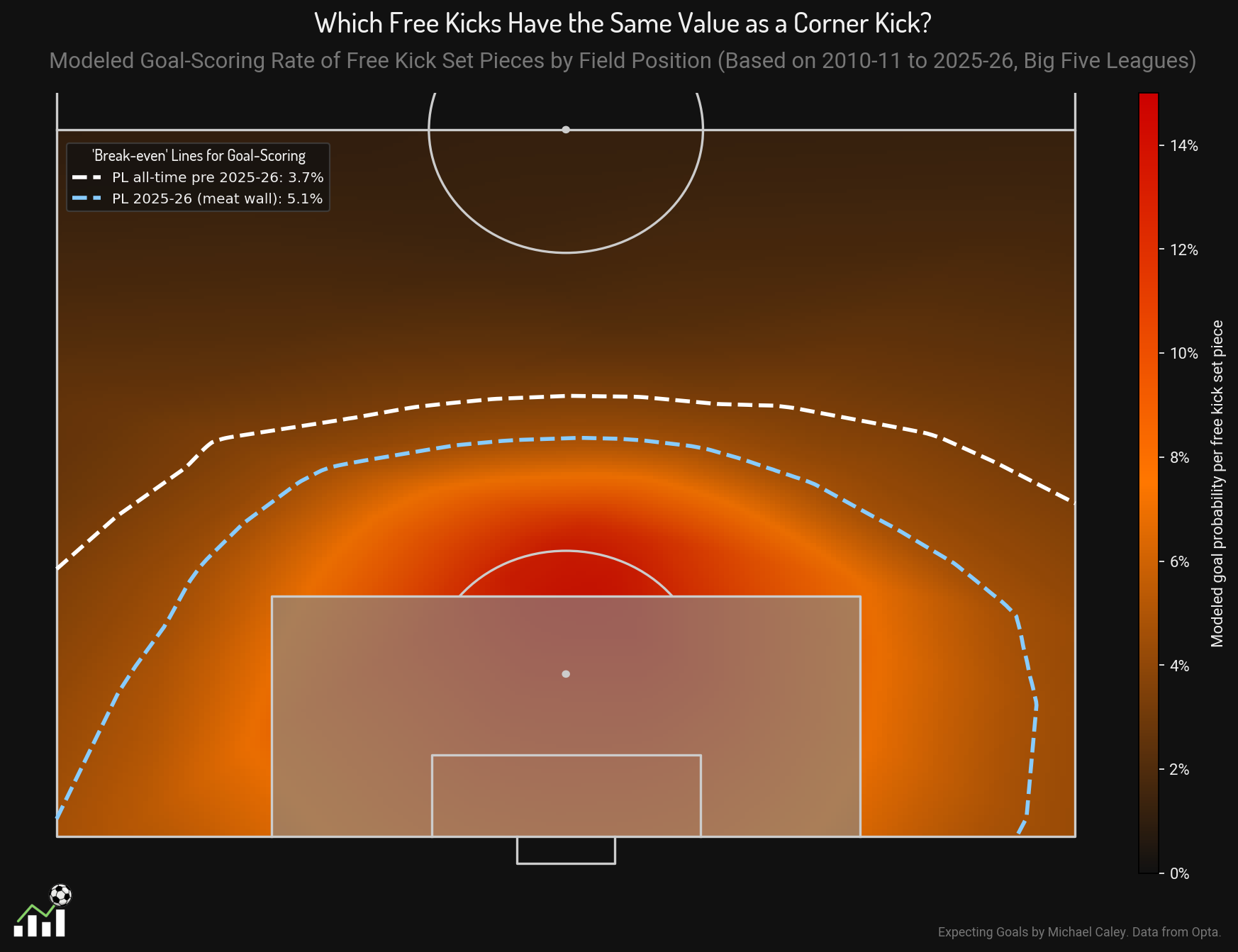
The dotted white line represents the “break-even point” where the likelihood of scoring from a free kick matches the traditional goal-scoring rate from corners in the Premier League. The dotted blue line represents a similar break-even point, but for the current goal-scoring rate from corners.
The white line shows that it used to be the case that winning a corner kick was never as good as winning a free kick on the wing around the edge of the penalty area extended. But the blue line shows that this season in the Premier League, every corner kick is the equivalent, on goal-scoring terms, of that free kick from 18 yards out on a wing.
Following the output of the model, a free kick taken from about 25 yards out from goal, on the sideline, would be roughly equivalent to a traditional corner kick in goal likelihood. If offside applied on these new free kicks, it would create a different competitive dynamic from what exists currently on corners, and I believe it would eliminate most of the issues that were so clearly evident on West Ham’s disallowed goal.
Now, it may be that these same problems can be more or less solved by keeping attackers out of the six-yard box. I am worried that attackers would still be subject to the same incentives to grapple and obstruct the keeper, as they would only need to cover a few yards while the ball was in the air. As with any rules change, it would need to be trialed and the results would have to be analyzed. This would be true of turning corner kicks into free kicks as well, and in particular the increased number of set pieces subject to offside video review might be unappealing to fans. And of course perhaps a simple change in refereeing instructions could be enough to make the difference.
I see the free kick proposal as the most conservative of the radical rule change proposals. If a reasonable equilibrium can be achieved without removing the “corner” from “corner kick,” that is preferable. But if such incremental changes do not work, and the league is looking at complex new rules of player positioning like field hockey-style corners, the free kick proposal offers a much simpler way to solve the problem of the meat wall.