


Last season, I wrote a series of newsletters on the “set piece revolution” in the Premier League. I found that there was a large spike in set-piece goal-scoring, driven entirely by two factors: new attacking tactics on corner kicks and a massive increase in long throws.1 It was the corner kicks that caught the attention of fans and media, with Jonathan Northcroft in The Times bringing my neologism of the “meat wall” to a wider football audience. This new tactic on corners was immediately recognizable and, to most viewers, both unattractive and unseemly: pack players in the vicinity of the goalkeeper to prevent the keeper from punching or claiming a delivery they would otherwise reach, then profit from the ensuing chaos.
One of the big questions coming into the 2026-27 season was whether this tactic would continue to dominate the game in the same way. This international break, ten matches into the season, offers a nice moment to start putting together some answers. I am not the first person to dig into these numbers. Both Ali Tweedale at Opta Analyst and Hamzah Khalique-Loonat at The Times put together perceptive columns on this data, and my analysis mostly confirms and extends theirs. The paradigmatic meat wall tactic seems to be in decline in the Premier League, but deeper investigations suggests it is far too early to celebrate its total demise.
What is new this season, and calls for these investigations, is that the refereeing standards have changed. At both the World Cup and in the lead-up to the 2026-27 season, there have been real interventions aimed at cleaning up the way teams approach attacking corners.
The new no-nos on corner kicks
Football’s refereeing and rule-making bodies introduced new directives at the World Cup designed to prevent the excesses of the meat wall. As explained by FIFA’s head of refereeing Pierluigi Collina, referees were instructed to pay closer attention to cynical obstruction, especially when targeting the keeper. These rules appear to have been successful at disrupting the new corner kick tactics, as anyone who watched Germany-Paraguay can attest.
The Premier League put together its own directives before the 2026-27 season, which align broadly with FIFA’s.
[T]here will be an increased emphasis on those ‘non-footballing holding actions that have no place on the football pitch’.
This includes where a player is:
Only focusing on the opponent (not looking at the ball)
Making no attempt to play or challenge for the ball
Holding an opponent with both arms
Committing sustained and/or impactful holding of an opponent or their clothing
The Premier League’s head of refereeing Howard Webb did call out the explicit goalkeeper protection in FIFA’s guidelines as something that the Premier League would not copy. But a crackdown on “non-footballing” actions should, in theory, make for a wide enough net to capture all the new tactics of keeper obstruction. We are now ten matches into the season and 948 corner kicks have been taken in the Premier League. Have the new directives worked?
There are two separable questions here. First is whether these directives have had any effect at all. Has the game been refereed differently and have clubs responded with changes in their approach to corners? Second, have goal-scoring and chance creation from corner kicks actually declined? Have these changes functioned to limit the importance of corner kicks, and to what degree?
More fouls, more claims, fewer goals…
To the first question, the answer seems clearly to be yes. Attackers have been called for 5.8 fouls for every 100 corners this season, up from 4.6 last season. Despite Webb’s statement that referees would not call every bump on the keeper, fouls committed specifically against the goalkeeper have risen the most compared to average past levels.
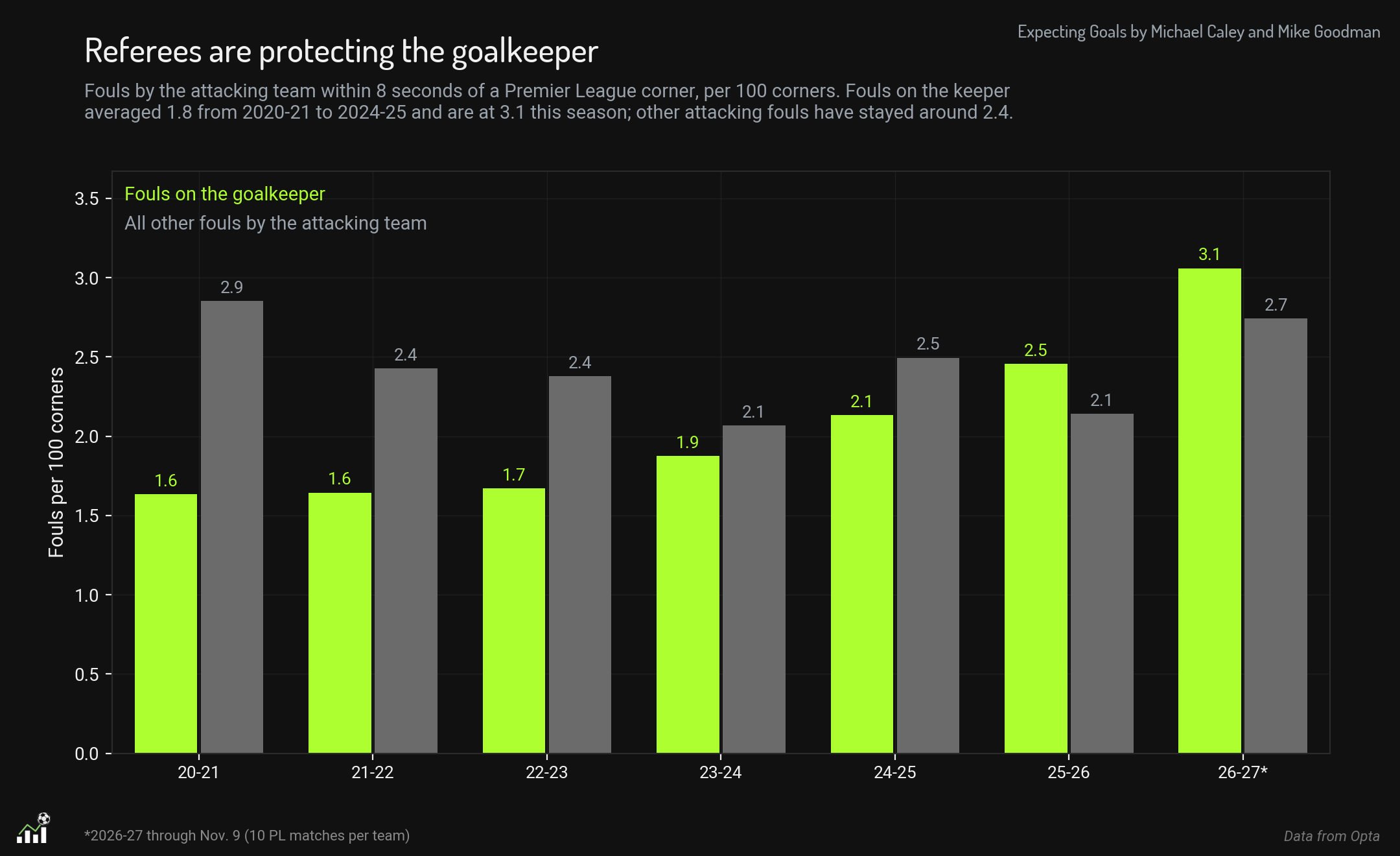
At the same time, fouls committed by the defending team have remained at a consistent and low level (about 0.7 per 100 corners).
Of course, the point of a rule change is not to call more fouls. It is to change player behavior. If referees now are noticing and whistling obstruction of the goalkeeper, attackers should respond by backing off the keeper and allowing them to control their penalty area. The early returns here are positive as well. Goalkeepers are punching and, in particular, claiming corners at significantly increased rates from 2025-26.
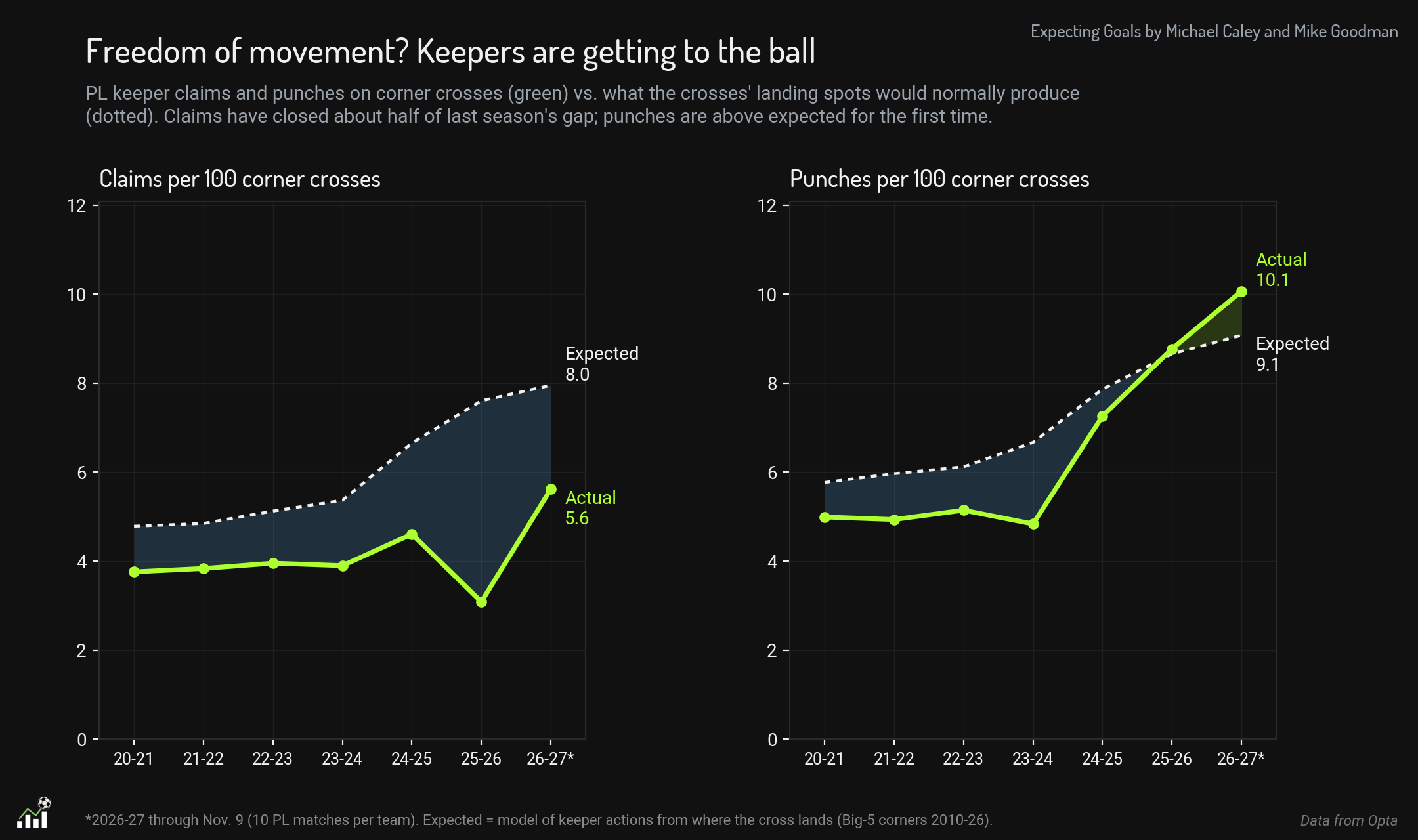
Goalkeeper claims fell to 3.1 per 100 corners taken as crosses last season. This happened even as corner deliveries increasingly targeted areas in the six-yard box where keepers are the most likely to be able to claim the ball. I created a model to predict claims based on where crosses landed, and this model predicted that goalkeepers would be able to catch far more they actually did, about 7.6 out of every 100 corner crosses. This season the number of claims has nearly doubled, up to 5.6. Punches have been rising, and even continued that trajectory in 2026-27 despite the increase in claims. All told, goalkeepers are now reaching over 15 percent of corner kick crosses.
The next step would be goal-scoring. If referees are now calling keeper obstruction fouls, and keepers are now able to claim or punch significantly more corner kicks, then there should be fewer corner kick goals.
There have been a lot fewer.
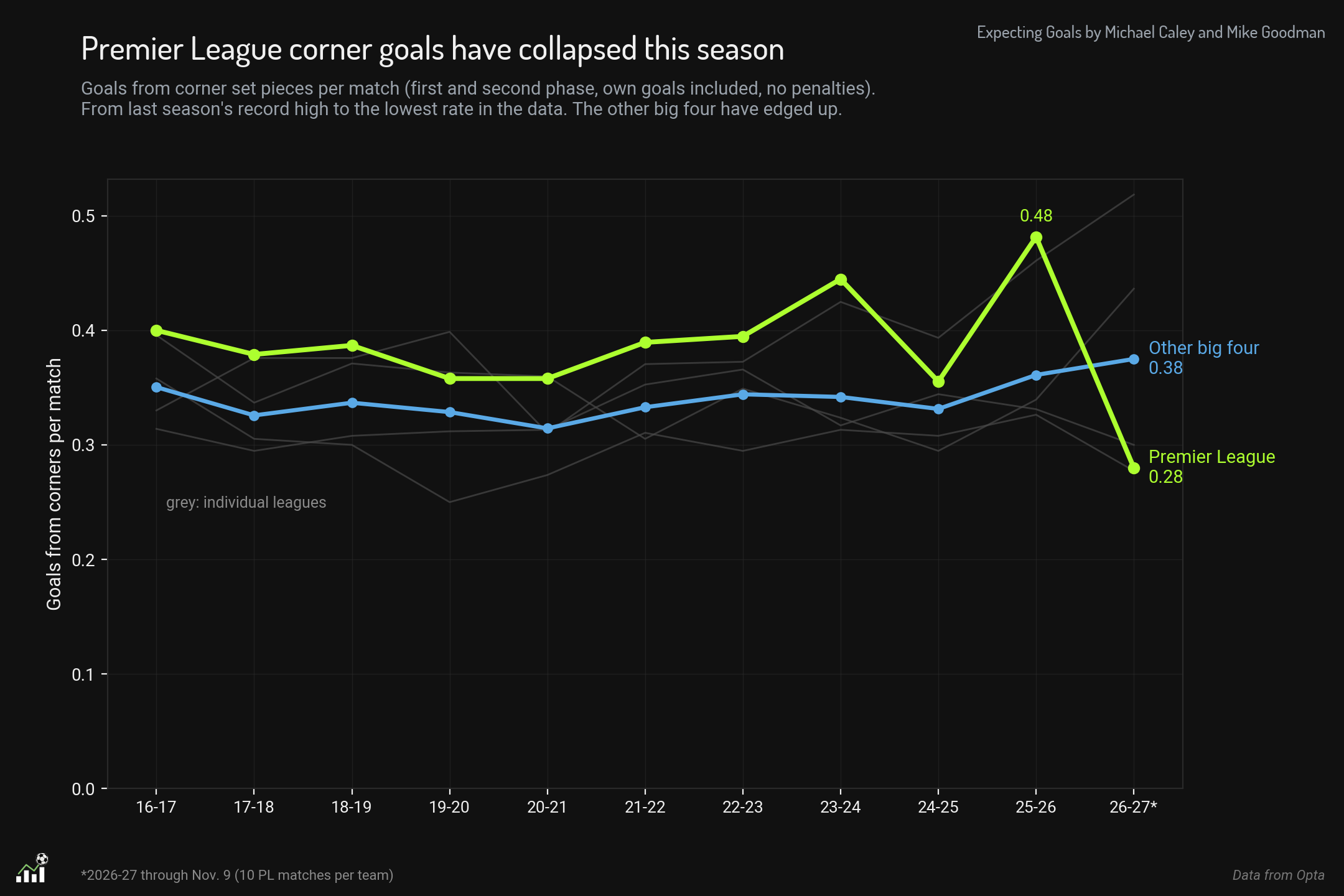
There have been so many fewer that it seems unlikely the rule changes could be the primary cause. Sure, there have been more fouls and more claims, but could that really cause a 40 percent drop in goal-scoring? Would a few more whistles really make Premier League teams significantly less likely to score from corner kicks than teams in the other big European leagues?
…but maybe it’s not over yet
A look at expected goals calls the easy narrative into question. While goals from corner kicks have fallen by about 40 percent, xG from corners has dropped by only about 10 percent.
