


In yesterday’s newsletter, I introduced the peak and career rankings for goals, assists, and shot creation. The goals statistics were based on data since 1987–88, assists from 1999–2000 (but since 1992–93 for the Premier League), and shot creation from 2009–10. Across all these numbers, there was little doubt as to the greatest player covered in that span of time. It was Lionel Messi. Only Ronaldo scored about as many goals—more if you include penalties, fewer if you don’t—and whether you are looking at peak performance or career accumulation, no one came close to matching Messi’s aggregate production.
As we head into the World Cup final and what could be Messi’s last match on the World Cup stage, it is a good time to continue the work of quantifying and then marveling at his greatness. I knew more or less what I would find when I began this project, and it is still incredible to see laid out specifically.
But this newsletter has a secondary purpose as well. By looking at the top-15 peak and career lists across a variety of statistics, it is possible to begin pulling out some of the other greats of the modern era and comparing or categorizing them. I see no particularly reasonable arguments for anyone but Messi at the top, it is just as clear that Ronaldo stands in second. Below that the discussion gets much more complex, but I see in the data particular cases for Luis Suárez, Mohamed Salah, and Eden Hazard, as well as the more obvious ones for Robert Lewandowski and Kylian Mbappé. And as we go through the different statistics, players with more specific cases as top passers, carriers and receivers also stand out.
I want to pull one chart out here, along with a question asked in the Double Pivot podcast Discord.
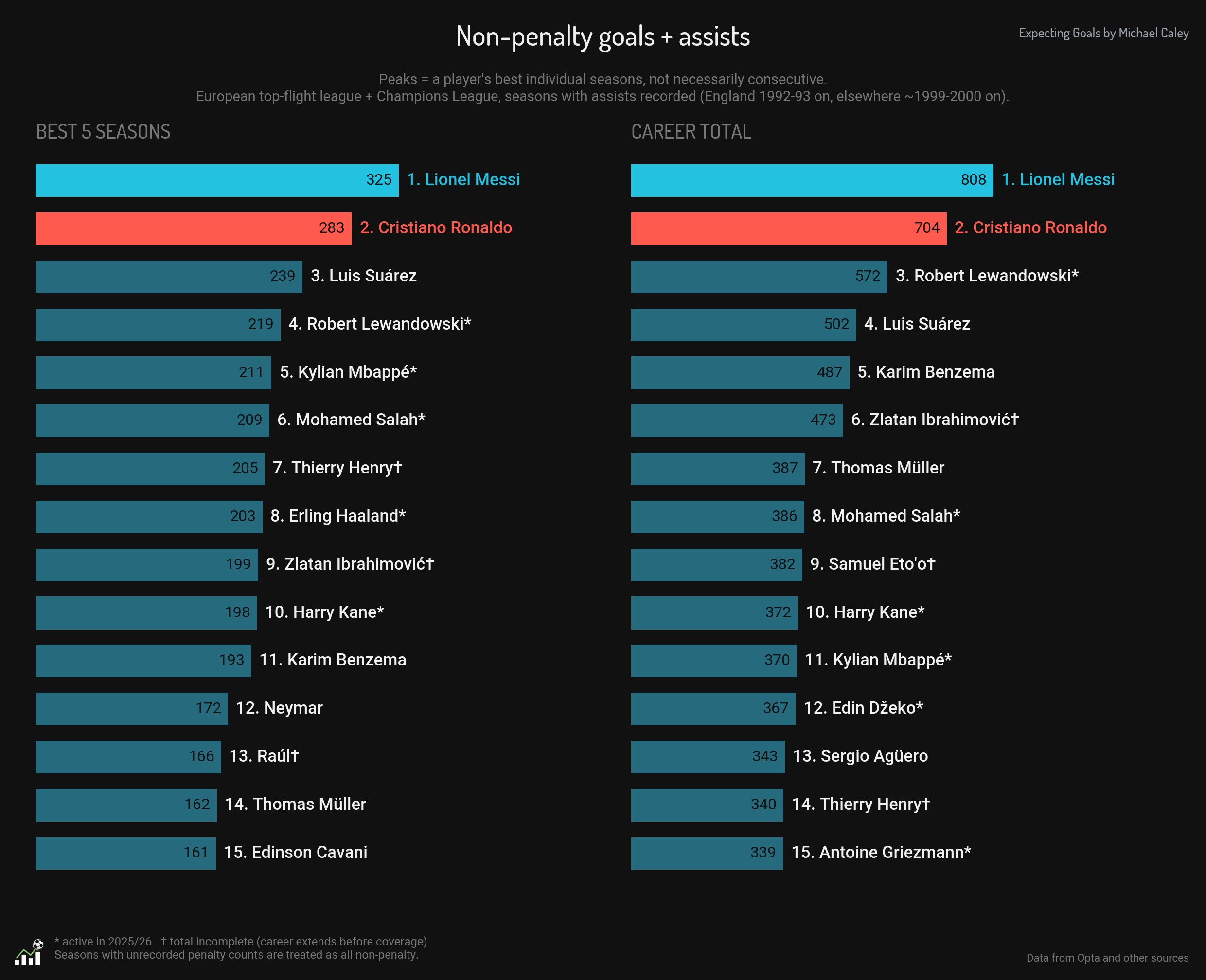
Mbappé is fifth here in non-penalty goals and assists in his five best seasons, across top-flight league and Champions League play. His peak already stands among the greatest of the modern era. And Messi scored or assisted about 23 more goals per season in his best seasons.
Who are some players, it was asked, who are about as far behind Mbappé in their peak seasons as Mbappé is behind Messi? These would be players who put up about 100 non-penalty goals and assists in their peak seasons.
Some notable examples: Iago Aspas (104), Lorenzo Insigne (104), Jamie Vardy (103), Philippe Coutinho (98), Papu Gómez (97), Mario Götze (95). All excellent players, of course, but obviously none of them comparable to Mbappé in their attacking production. And that’s the size of the gap between Mbappé and Messi.
The ball progression statistics only serve to further highlight this point. Messi is not the single greatest player of the last seventeen seasons by every one of these metrics individually—although he is for many of them—but in the aggregate no one else shows up as high, as often for either peak or career production, and it is not close. And these are all statistics at least one step removed from scoring or assisting goals.
These are the core statistics that will be covered, across passing, ball-carrying, combined progression, and ball-receiving.
Penalty area entries by pass or carry should be self-explanatory. The one thing worth noting here is that the standard definition of a “carry” requires the player to move the ball at least five yards, and so a player who simply happens to receive the ball just outside the penalty area and move it one step in will be excluded, but that is very rare.
For progressive actions, either pass or carry, I will use John Muller’s definition of actions that move the ball at least one-quarter of the distance to goal from when they began. For progressive passes, I am excluding all passes played into a contested aerial, and in all cases crosses are excluded. I will have more to say about these definitions in the passing section.
Expected threat added by pass or carry uses the definition established by Karun Singh, measuring the likelihood of a goal being scored from any position on the pitch and using the chaining of events to calculate a threat value from every other location on the pitch. Players receive value for moving the ball from a location with a lower xT value to a location with a higher xT value. I have excluded negative xT events, as a player retreating (or passing backwards) should not be penalized for that action more than a player who fails to move the ball at all.
Finally, before we get to the charts, I should repeat a point from the last newsletter about how to think about “peak” greatness:
For peak studies, I am using a similar process to the study of peak in baseball. Jay Jaffe’s JAWS system provides a first measure of greatness by combining a player’s career totals with their totals over their seven best seasons. There is of course nothing magical about the number seven, and Bill James often looked at three, five, and seven year peaks. I found in going over these numbers that all three selections told similar stories, and I preferred the five-year peak because soccer careers tend to be shorter and it gave players who may have a few seasons outside the data coverage window more room to make the lists.
I am looking at numbers by season here because the season is the proper focus for analysis at the team or player level. Trophies are handed out based on team performance over a season, and players consistently see their jobs as contributing toward these team achievements. A player’s peak should be the seasons in which they did the most to improve their team and move them closer to winning these trophies.
Peak and Career Ball-Carrying
I have used four statistics for ball-carrying, three of which are found above, and the fourth is a straightforward single number.
Successful take-ons are the one statistic with no comparison among passes. These are actions where a player matches up one-on-one with a defender and gets past them toward goal.
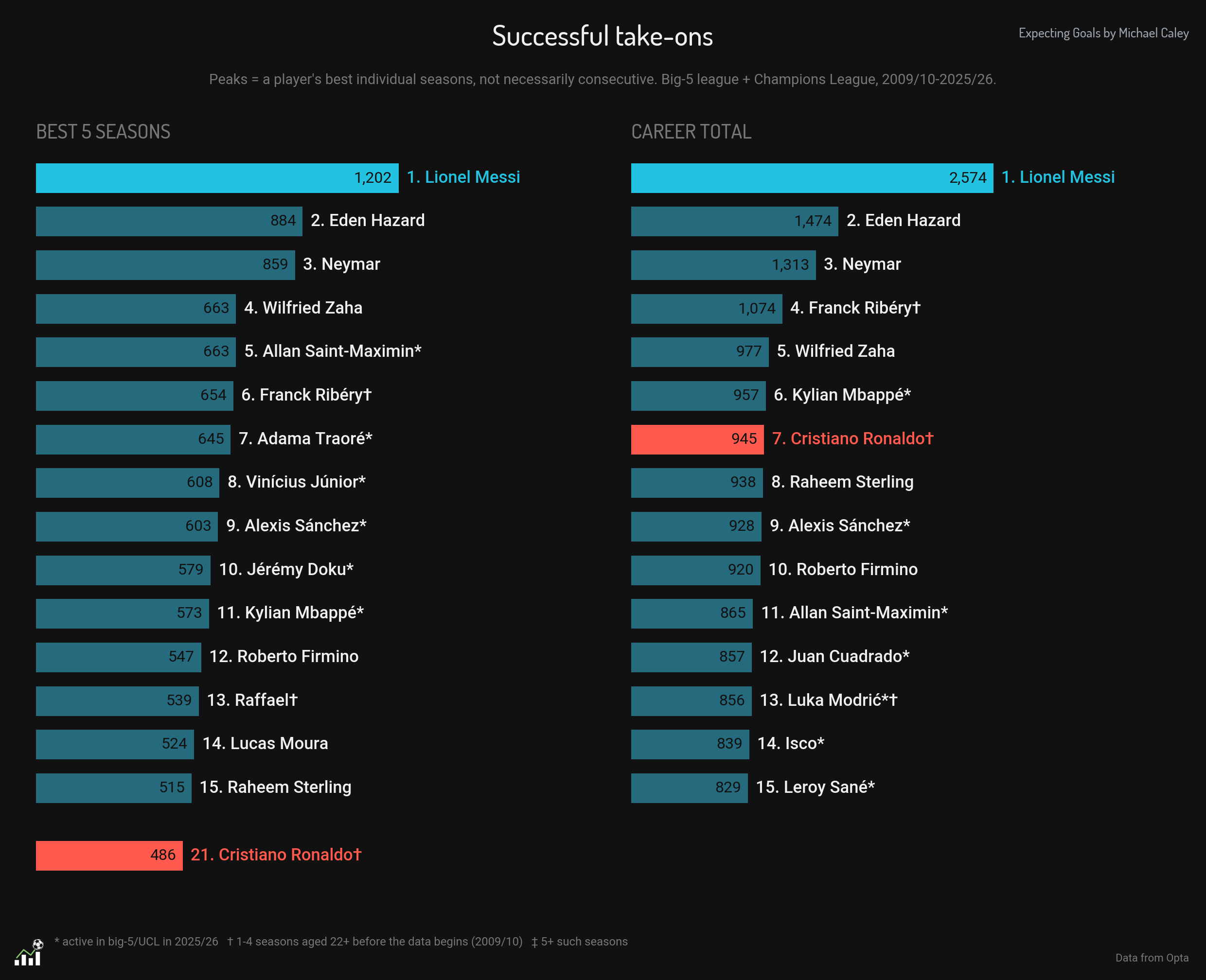
Messi is just absurd here.
Eden Hazard and Neymar clearly appear well beyond all other competitors as #2 and #3 in peak and career take-ons. It is possible a fuller database that captured Franck Ribéry’s early seasons at Bayern and Marseille would add him to that group.
A few pure specialists appear on this chart who will not show up anywhere else: Allan Saint-Maximin and Adama Traoré among the Premier League specialists, as well as Raffael from the Bundesliga.
Roberto Firmino, clearly underrated as a one-on-one specialist.
It should be noted that the definition of the take-on appears to have been tightened in recent seasons, as total successful take-ons across all leagues have dropped notably. This is an issue that fortunately will not arise with any of the other stats here but is worth noting. Jeremy Doku, under the older definition, might well be near the top of the leaderboard.
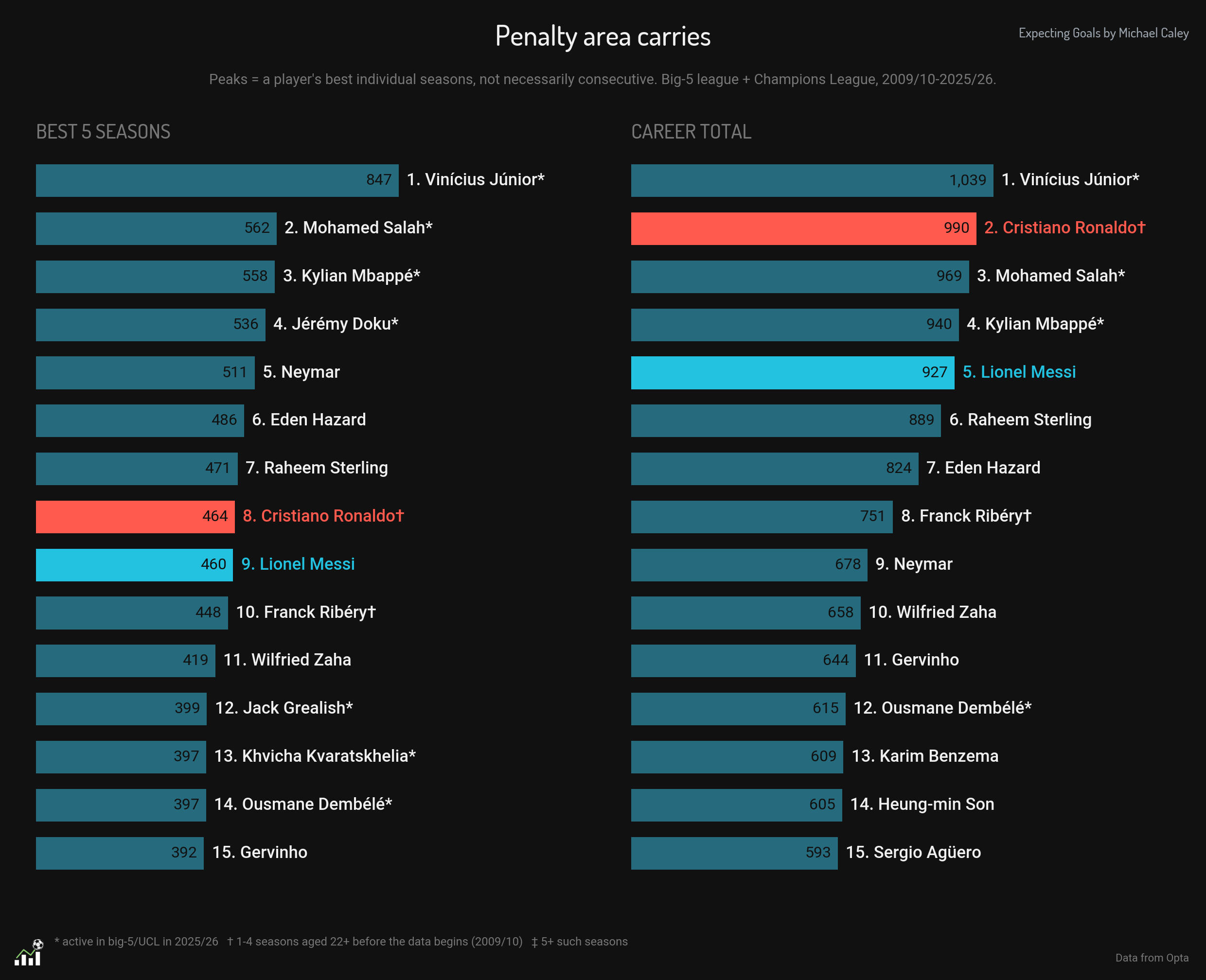
There may never have been a penalty area carry specialist like Vinicius Junior. He is still only 26 years old and he is already at the top of the career chart. His peak dominance is something that only Messi achieves on any of the other charts.
This appears to be an overlapping skill with take-ons, which makes sense. Both in that it will often require beating a defender to get into the penalty area, and because defenders may be more likely to sit off and allow entry to the penalty area to a player they are scared might blow by them if they square up. Wilfried Zaha notably shows up here, despite playing mostly for much less ball-dominant teams, although he will not again. Gervinho too.
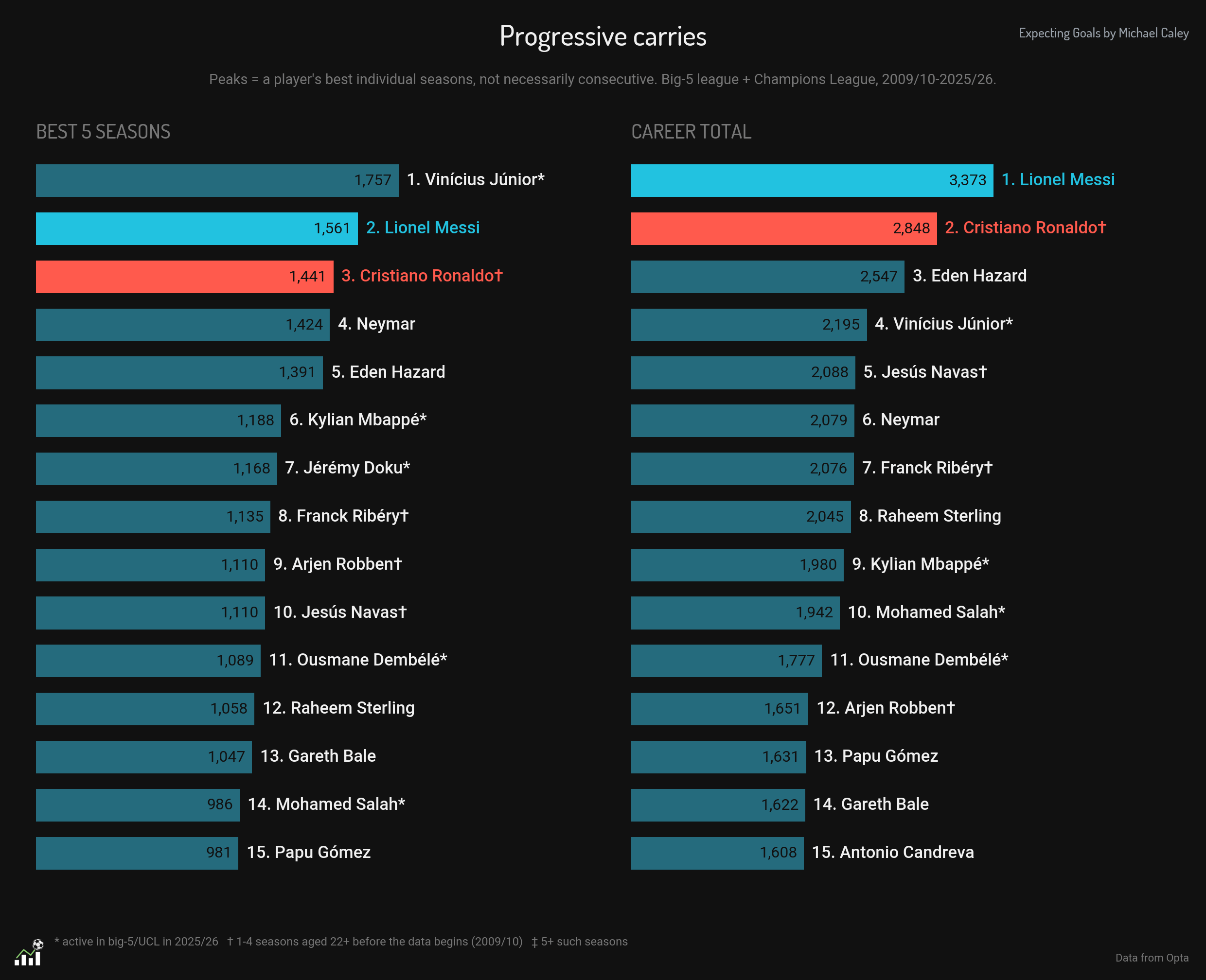
As we step back a little bit further from the penalty area, Messi and Ronaldo shoot up the charts. Both did a lot of long carrying for their teams to move the ball from midfield into the attacking area, which appears here under progressive carries.
Vini Jr seems likely to surpass them over his career if he can avoid injury.
Arjen Robben joins Franck Ribéry here from the great Bayern sides of the 2010s. I have always been slightly annoyed by the “all Robben does is cut inside and shoot” meme. Robben in fact was a highly varied and effective ball-carrier, who drove to the endline more or less as often as he cut inside, and his appearance here helps demonstrate that fact.
Jesús Navas and Papu Gómez, two otherwise extremely dissimilar players, appear here. Navas was an elite long-carrier from more defensive wide positions, while Gómez had a free, inside-forward style role for Atalanta where he could receive the ball all over the pitch to drive forward or play around the penalty area to create shots.
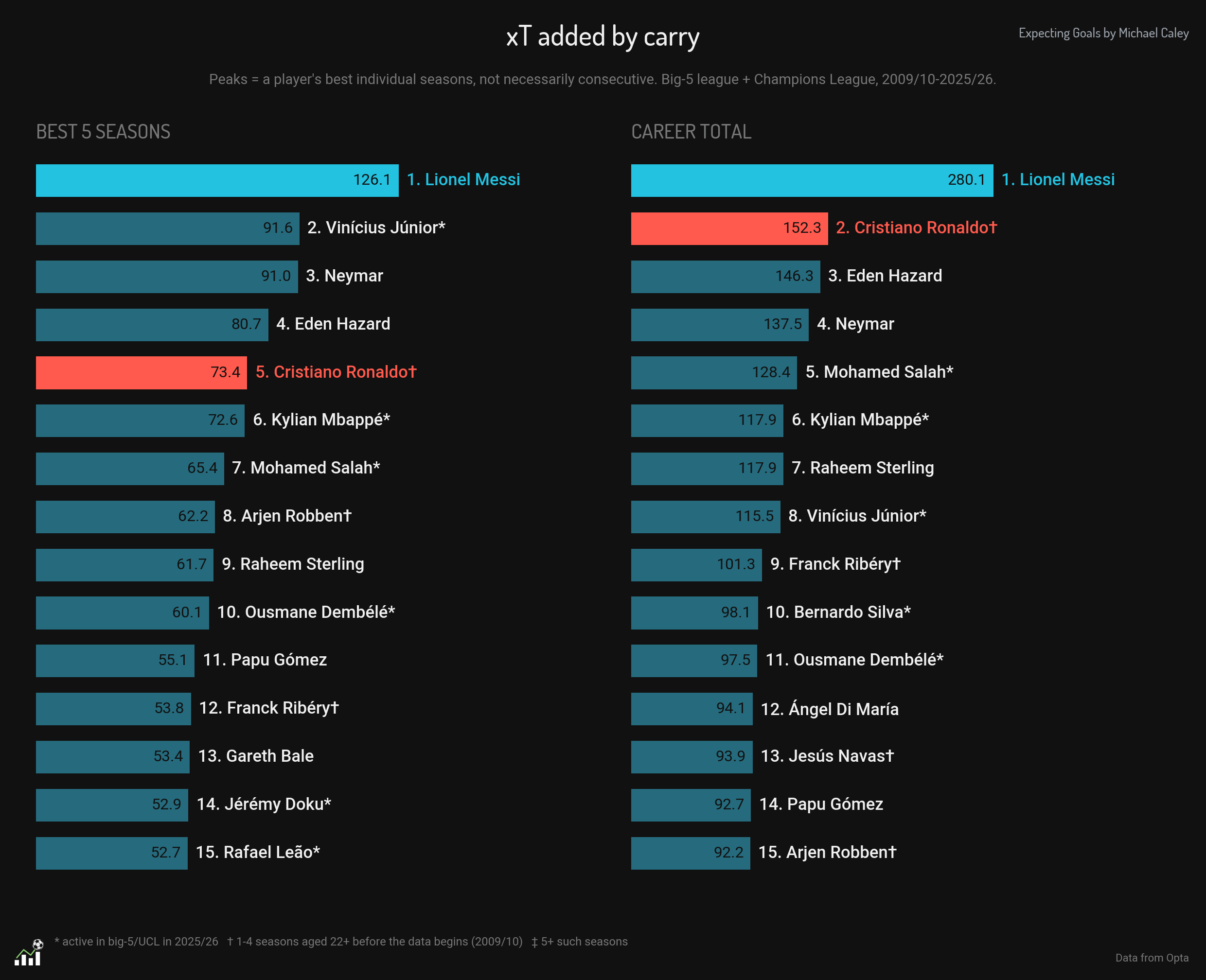
It is interesting to think about the extent of Messi’s advantage here and what it tells us about expected threat in comparison to the other statistics. What xT does most notably is focus on actions very close to the penalty area and give them outsized rewards. There is a “goals funnel” on the pitch according to xT, and being able to move the ball into the central zone near the goal will provide more xT than half a dozen penalty area carries. These specific actions, where Messi managed to weave through penalty area traffic for a clear shot on goal or a pass to a teammate for a tap-in, make up an outsized number of Messi highlight-reel clips. No one comes remotely close to Messi in these actions, and that comes through in expected threat.
I am confident that with full career coverage, Ronaldo would establish himself as #2 here in peak as well as and career.
Raheem Sterling has probably become somewhat underrated over time as his early decline has masked the memory of his peak. At his best he appears here as comparable to Robben and Ribéry, Mbappé and Salah, in ball carrying by xT.
Creative Passing: Different Systems and Different Results, and Always Messi
Obviously one way to measure creative passing is simply in terms of assisting shots, as laid out in the previous newsletter. But I can add to that passing into the penalty area, progressive passing, and xT added by pass. These highlight notably different sets of players including a large array of names that haven’t appeared previously on these charts, perhaps they highlight some inadequacies of each stat as a single metric, and also they highlight Lionel Messi.
