


One of the truisms of soccer analytics is that, early in the season, the table is lying to you. A team can shoot into the top four on the back of some fortunately timed goals or a hot run of finishing, but those results do not demonstrate that team is actually a Champions League contender. Goal difference, expected goals difference, and measures of pitch control like expected threat difference all predict future performance better than points or table position.
But the table does unerringly share one important piece of information: how many points each team has. They don’t take away your wins just because you were a little fortunate to bank the points.
Of course, one can easily point to situations where the early season table did not matter. Aston Villa started last season with three points from five matches, while Tottenham Hotspur rushed out to 10 points and a third-place spot early on. But by the end of the season, Villa had claimed fourth place and a guaranteed spot in the Champions League while Spurs needed a victory on the final day to avoid relegation. Comebacks are common. Managers will never claim an early lead means anything, whether their team is protecting an advantage in the table or chasing down an opponent.
But surely it is worth something. Surely Enzo Maresca would not happily trade his Manchester City’s 15 points for Arsenal’s 12.1 So that is what this newsletter will be about. What is the value of a point early in the season? What is the table actually telling you?
Do Points Really Stay Banked?
One possibility, given the frequency of comebacks, might be that teams have a tendency to get reeled in by their competitors. Maybe a team that starts hot will give those points back later, perhaps because they expended more energy to win those early points and could not keep up that intensity over the season. A simple study of past results suggests that is not the case.
What I did here was to take a few very simple methods of projection—past season points, points from the past three seasons, squad value estimated by Transfermarkt.com, and an extrapolation from the betting odds—and use them to project results in the big five leagues since the 1997-98 season. I looked at teams that took more points than projected over the first five matches. So if a team is projected, based on their estimated quality and the difficulty of their schedule, to take 7 points from those matches but they take 10 instead, that is considered playing 3 points ahead of projection. Over the course of the season, how far will that team finish above their preseason projection?
What I found is that teams do not give back early season points. Instead, they tend, very slightly, to add a few points more over the rest of the season. The study estimates the effect at between 0.1 and 0.15 points per match added compared to expectation, for every point per match banked against expectation.
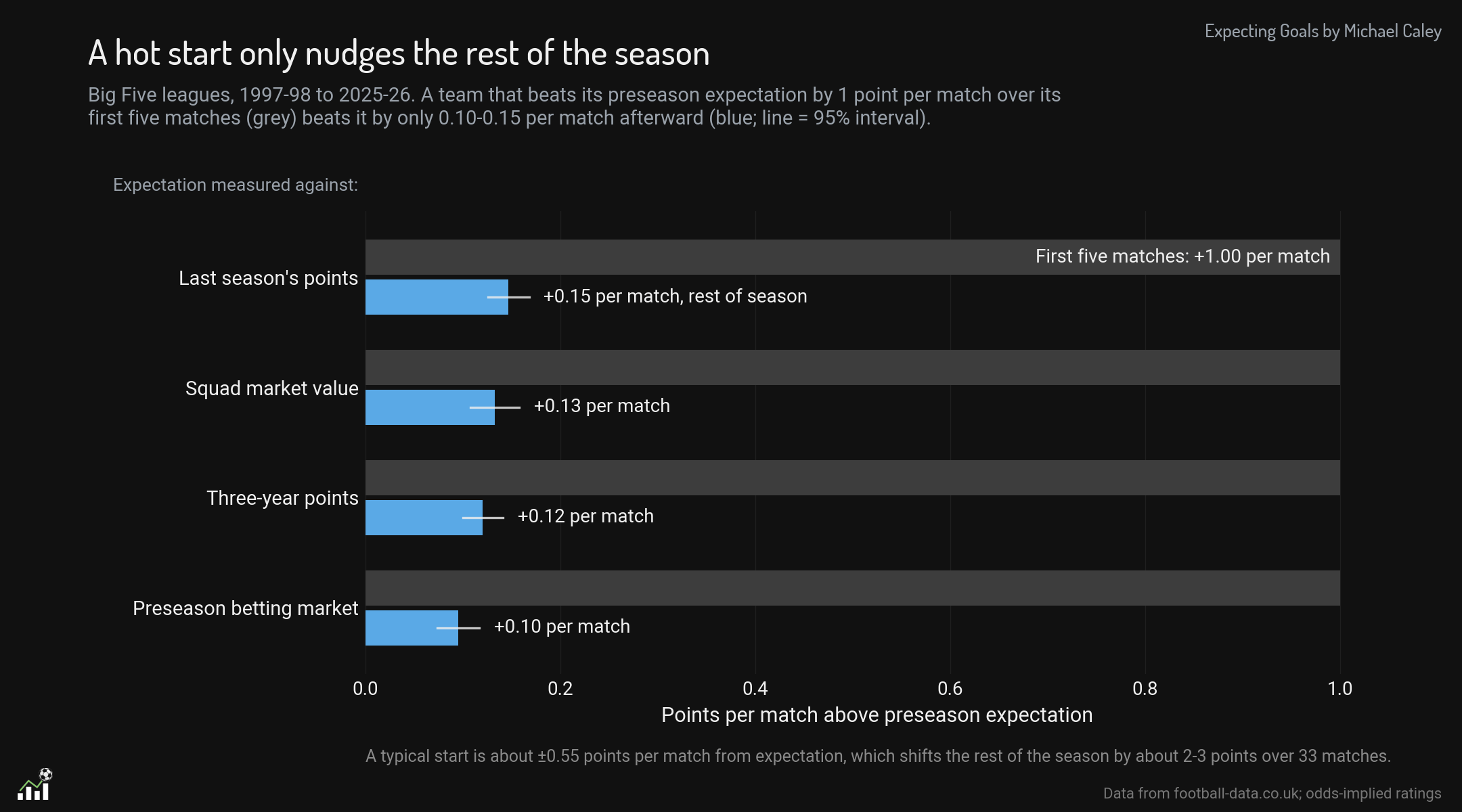
So take that team that was projected to take 7 points but took 10 from their opening fixtures. If they have 33 matches go, they would be projected to add another 2-3 points above expectation over the remainder of the season. To put this in more concrete terms, this team was projected for about 53 points before the season. Those added three points, from their hot start, would give them a 56-point projection. The added 2-3 points above expectation beyond that would push the projection to 58 or 59 points. A team that projects in the upper midtable preseason can jump into the range of European qualifying with a hot start. That’s a significant effect.
But that’s not really what the points are worth. On average, the teams that do better than projected really are a little better than they were projected to be. Some of that effect, then, is just the preseason projections being wrong. What I am interested in here is the value of the points themselves, separate from what the points indicate about the quality of the team.
Points are Points
My next study design made two upgrades to the earlier format. First, because the market odds were the best indicator of team quality, I created an estimate of team quality based on the market odds up to kickoff on week six, incorporating changes in the estimates of team quality over the early season. Then, I looked for matched pairs. In the same league-season, if two teams had about the same market-based team quality projection, but one of them had more points than the other through five matches, what would the difference between these two teams be at the end of the season?
I found about 2,400 matched pairs for this study, in the big five leagues since 2000-01. On average, I found that clubs in these matched pairs were just about equally likely to take more points than the other over the remainder of the season. Once the study accounts for team quality, there is no particular tendency for teams to relinquish early season leads over equally matched opponents, nor to extend them.
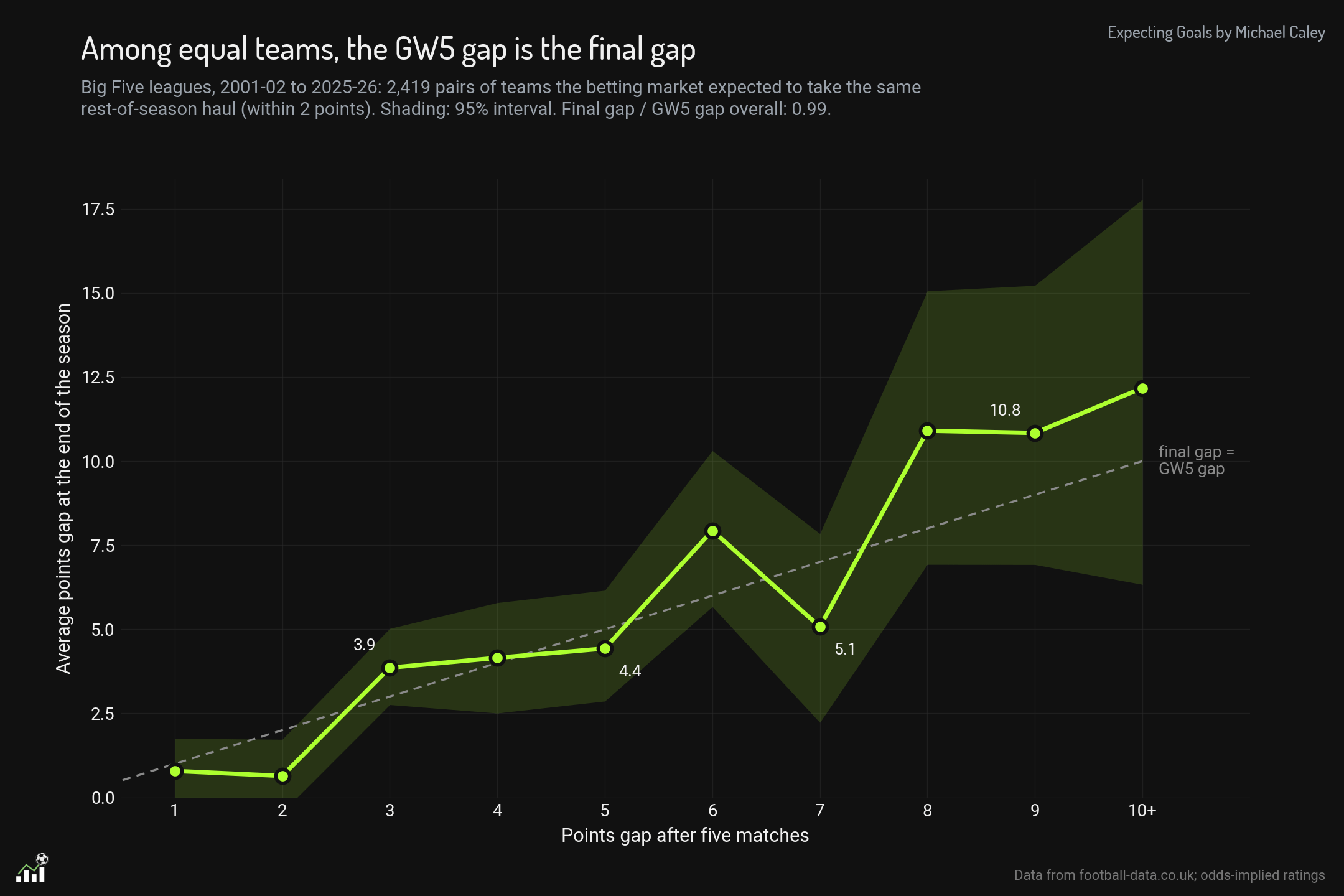
This suggests that, simply, points are points. There is variance, as teams with three-point leads over equally-rated opponents have on average ended up 3.9 points ahead at the end of the season, while teams with five-point leads have ended up 4.4 points ahead. Because each slice cuts the sample down to several hundred pairs, it is likely this is just randomness. On average the early lead is maintained as is.
But for any individual team staring at a three-point deficit, the question is not what happens to the average team in this situation, but how often someone beats the odds and makes a comeback.
How often do clubs hold their early leads, and how much does it matter?
For this analysis, I took a subset of the teams from the above study, just the 575 pairs of teams with the closest ratings.2 Across this sample, most paired clubs had very similar records over the course of the rest of the season, and so in general, the team that had banked a lead stayed ahead. But that only applies in about two-thirds of cases, with over 30 percent of leading teams seeing their advantage disappear.
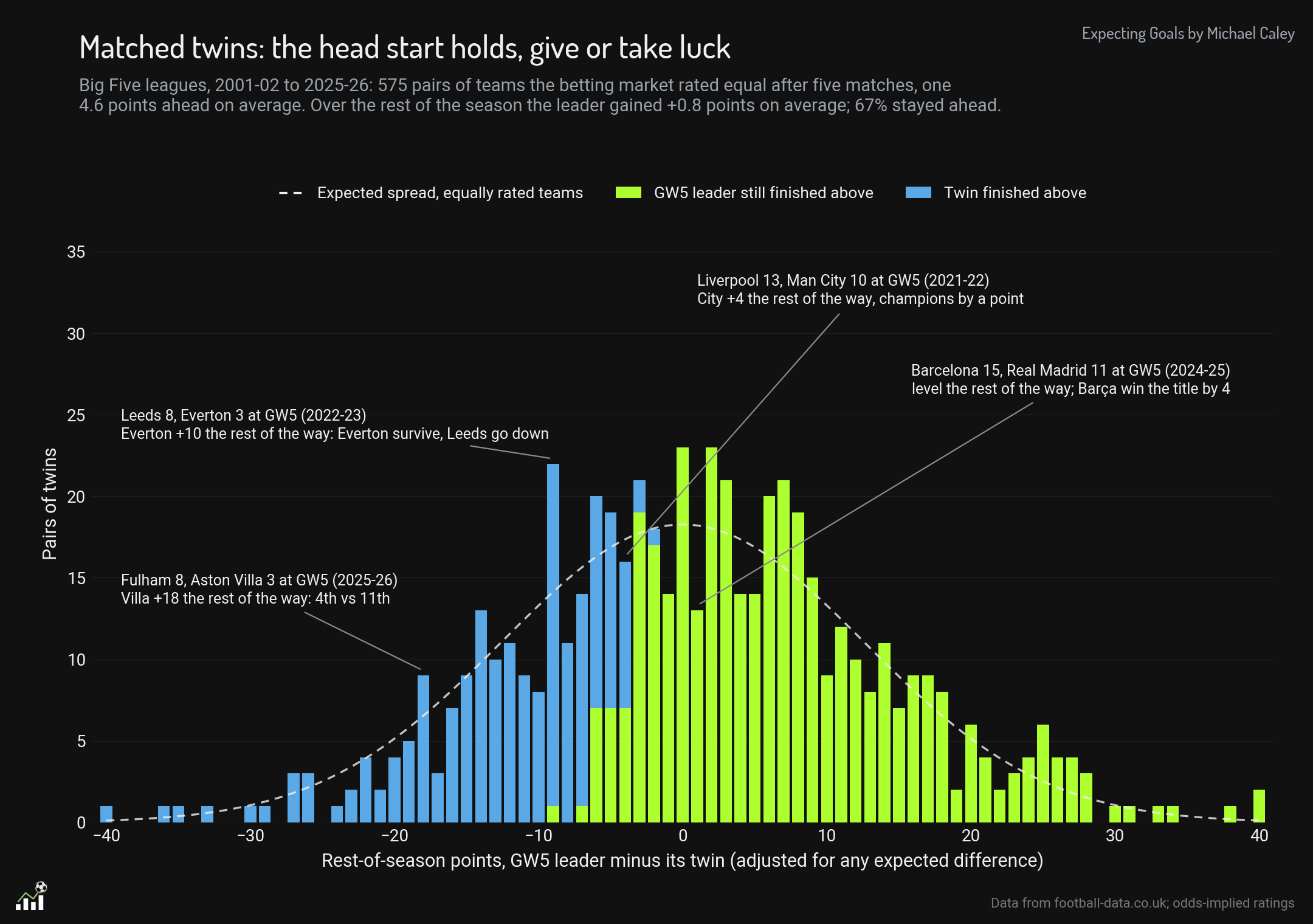
In the La Liga title race in 2024-25, Barcelona’s four-point lead after five matches ended up being the difference in the table at the end of the season. But in the Premier League in 2020-21, Liverpool’s three-point advantage over Manchester City was just barely not enough to hold. And the example of Aston Villa in 25-26 offers a different kind of point. Sometimes teams play much better, or much worse, than you’d expect based on their first five matches. Villa were rated by the markets about even with Fulham after their slow start, but Villa were 18 points better than the Cottagers the rest of the way and qualified for the Champions League.
So answering one question just raises another. This study establishes that points are points: teams that bank points early in the season tend, on average, to stay exactly that many points ahead of equally-matched teams. But what is that actually worth in the real world to a real, individual team rather than to an abstract “average” team? What is Manchester City’s current three-point lead on Arsenal worth in title probability? What have Aston Villa and Spurs relinquished in Champions League odds from their slow starts? How much has Hull City gained against the other promoted teams?
