


The rewards for a successful season in European football are odd, competitively. Winning the league gets you a title, of course, and finishing in the bottom positions gets you relegated to a lower division. And table position does provide some further prize money. But table position also feeds into the European qualification process, as the top teams in the league gain entrance into UEFA competitions: the Champions League, the Europa League and the Europa Conference League. Each of these gives the team a further chance at glory and cash in the next season, but each also significantly adds to the team’s fixture list.
With qualification, eight and maybe more high-stakes matches have been added to a schedule that already pushes the boundaries of what athletes can manage. Clubs typically need to adjust their squad-building over the preceding summer to prepare for Europe, with new transfer and wage spending going to added depth instead of improving the team’s first XI. During the season, that same first XI either takes on added injury and fatigue risk by playing through the added matches, or gets rotated for rest in matches they otherwise would likely have played.
It is a commonplace to ask if teams that qualified for the Europa League or the Conference League might regret their qualification, as it will bring costs in the next season. The Champions League, with its much larger payouts and greater perceived glory, rarely gets lumped in with the other UEFA competitions, but the same principles apply. What are the costs of European qualification?
The preseason projection method
When I previously looked at this question, I considered it only during the season. When a team that had a week of rest faced an opponent coming off a Thursday match in the Europa League, how much did that shorter rest make a difference? And this is a highly complex issue requiring a rich database of fixtures, lineups and travel distances, as well as a projection system for estimating team quality and a statistical model for rest time. As I was preparing for this year’s Double Pivot Podcast Premier League preview draft, I realized a much simpler option could be used before the season. If I included whether a team has qualified for Europe as a variable in a simple projection model, what effects would it have? Would it show that teams take fewer points in seasons where they have UEFA competition on top of their league schedules?
I found that an extremely naive model—considering only previous season points and European qualification—actually identified playing in Europe as a positive factor.
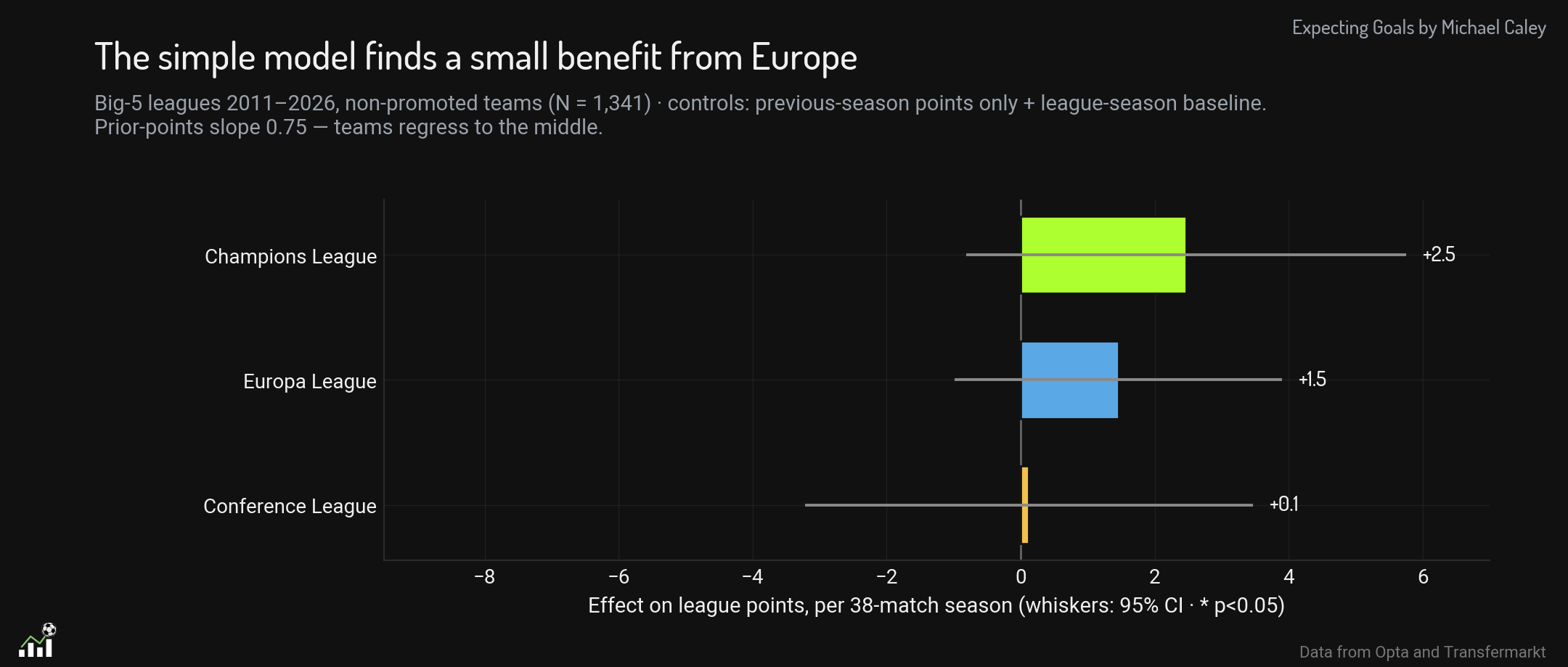
This finding has some real value, even if it is clearly not correct. What the model found was that previous season points need to be regressed to the mean, and most teams end up closer to 10th place in the next season than they were in the season before. But this is not as true for the very best teams in the league. And I have to assume this is because those teams are rich. The teams with the most money will be less likely to regress to the league mean because they can continually refresh their squads with improved talent. This is one of the major issues with projection systems in football broadly: because of economic stratification, the means to which clubs and players should regress are not all the same.
But this is broadly a manageable issue in this instance. I built a slightly more complex model incorporating goal difference and expected goals difference to handle some of the regression components, as well as Transfermarkt squad value to handle some of the economic component. This model found that while there is a cost to being in Europe, it is primarily concentrated in the Champions League.
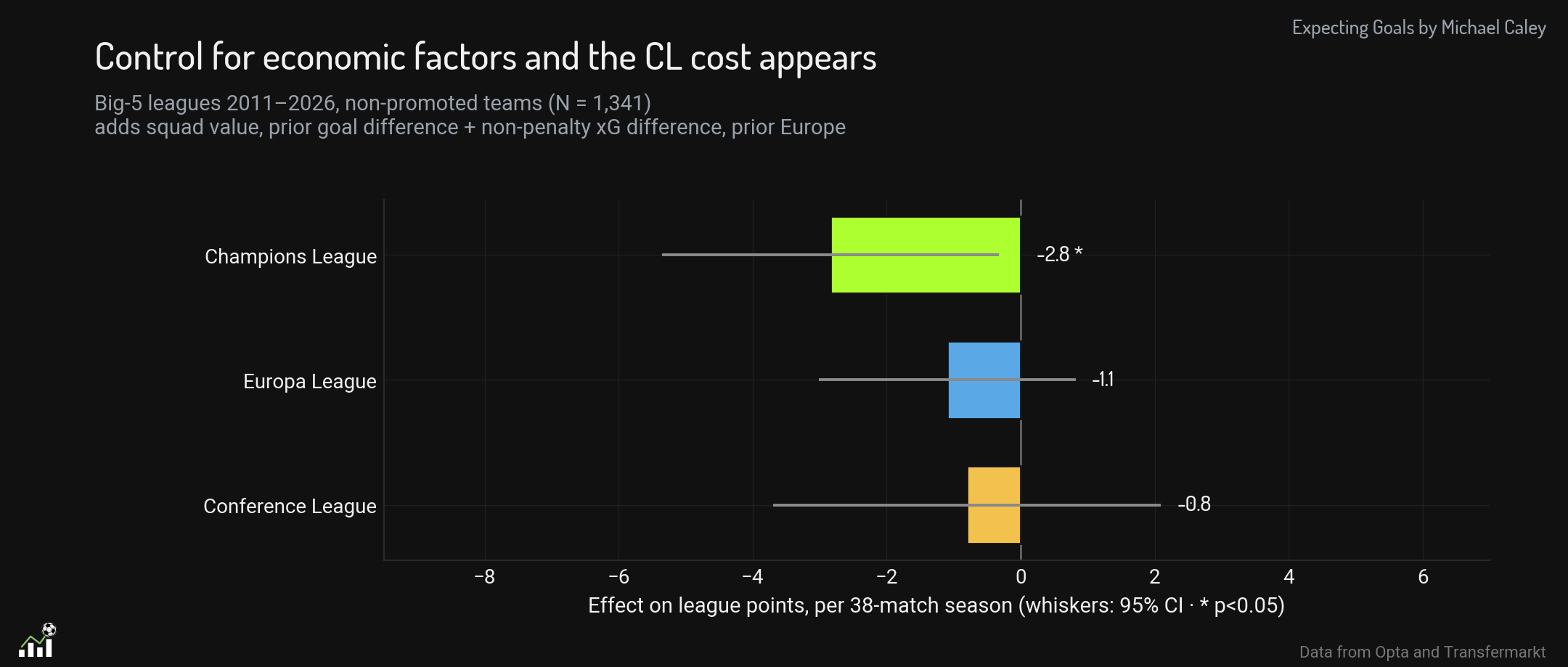
The commonplace that teams will regret qualification to Europa or the Conference League seems like it might be backwards. Rather, it is playing in the most prestigious UEFA competition that most drags teams down in the next season.
Now, the teams which play in the Champions League are not all alike. Some have been qualified every season in recent memory, while others make a single appearance after a historic season, and still others bounce between the different European competitions. This season in the Premier League, Manchester City will be playing in the Champions League for the 16th consecutive season, while Manchester United will be returning for the first time since 2024. And from the other side, Newcastle, Chelsea and Tottenham all finished further down the table last season and will not be playing in the Europe at all. Do they gain the same benefit as all the other teams that do not have to play midweek matches?
And these questions can help pinpoint the larger issue. Why does playing in the Champions League hurt a team’s projection more than playing in other European competitions?
Stratifying the costs of Europe
Breaking down European qualifiers into smaller groups helps identify both which teams will be hurt most by the extra matches and why. This method also suggests that Manchester United may struggle this season more than expected.
