I have a few more player profile transfer blogs to come. I was actually drafting one about Yan Diomande when I started worrying about league translation. It is clear that Diomande has been putting up elite attacking numbers in the Bundesliga, especially for a 19-year-old. But what does it mean to put up elite numbers in the Bundesliga specifically, in 2025-26? As the value of television contracts across Europe’s leagues has increasingly diverged, so have the finances of teams in the different European leagues. And in particular the Premier League has become the dominant economic force in European football, thanks to television revenues more than double those of La Liga and more than three times what Serie A or the Bundesliga earns.
One would expect this to show up on the pitch as well. At a surface level, Premier League teams have won back-to-back Europa League and Conference League trophies, while Arsenal only lost the Champions League final on penalties. But nailing down the precise effects and their timelines is a harder task.
Premier League dominance in the 2020s
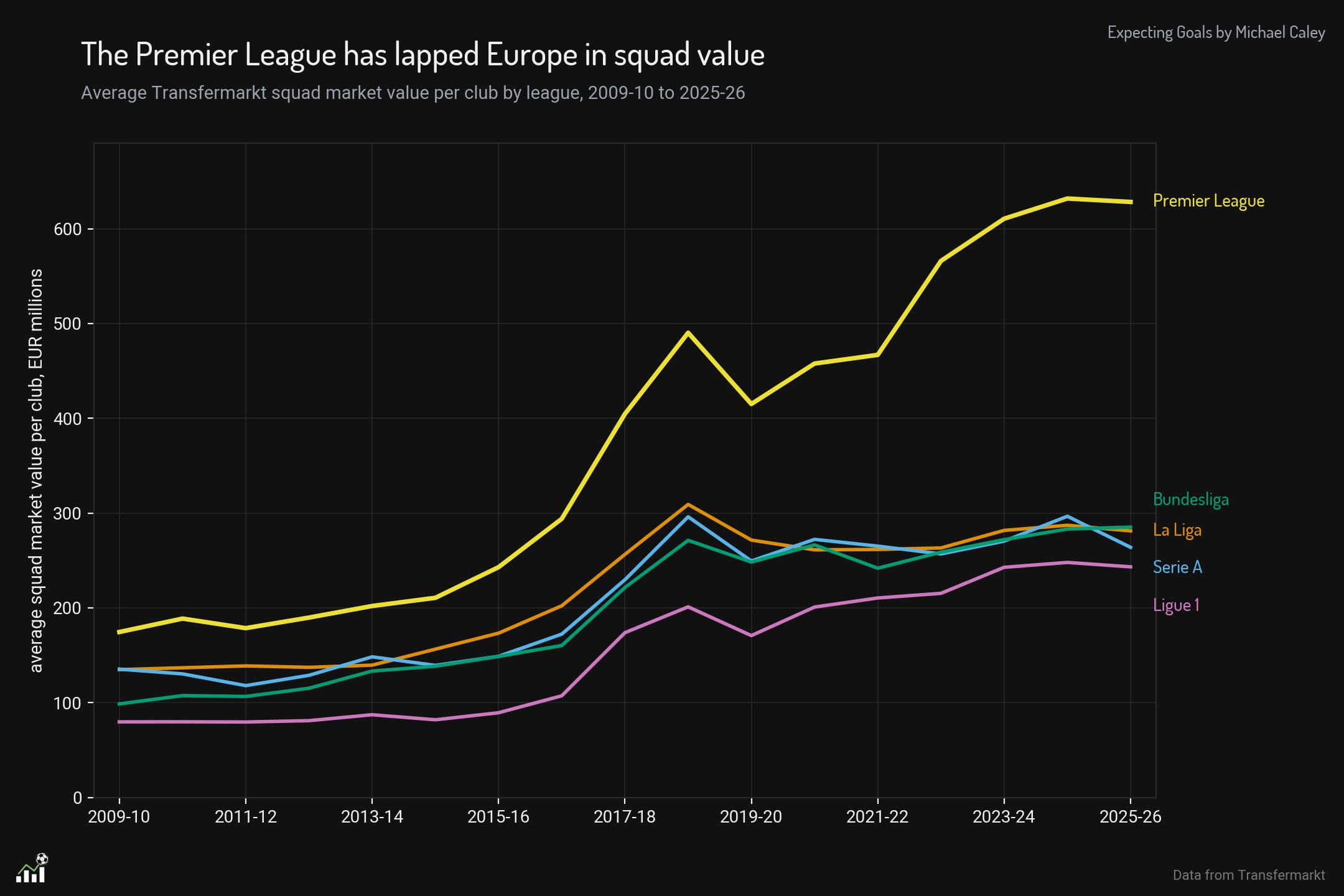
I found two methods that broadly agreed on results. By Transfermarkt valuations, the average Premier League club went from roughly 50 percent more valuable than its big-four counterparts to well over twice as valuable.
Obviously these ratings are not a perfect proxy for team quality. To estimate how much these differences translate into expected football results, I built a simple model to estimate the quality of the different European leagues based on pre-match gambling odds. I found that during the middle of the 2010s there was real parity between the top leagues, with the Premier League falling below the Bundesliga and La Liga despite somewhat higher aggregate team values. It was primarily in the aftermath of the 2020 pandemic that the Premier League began to pull away, but there is now a large gap between the leagues.
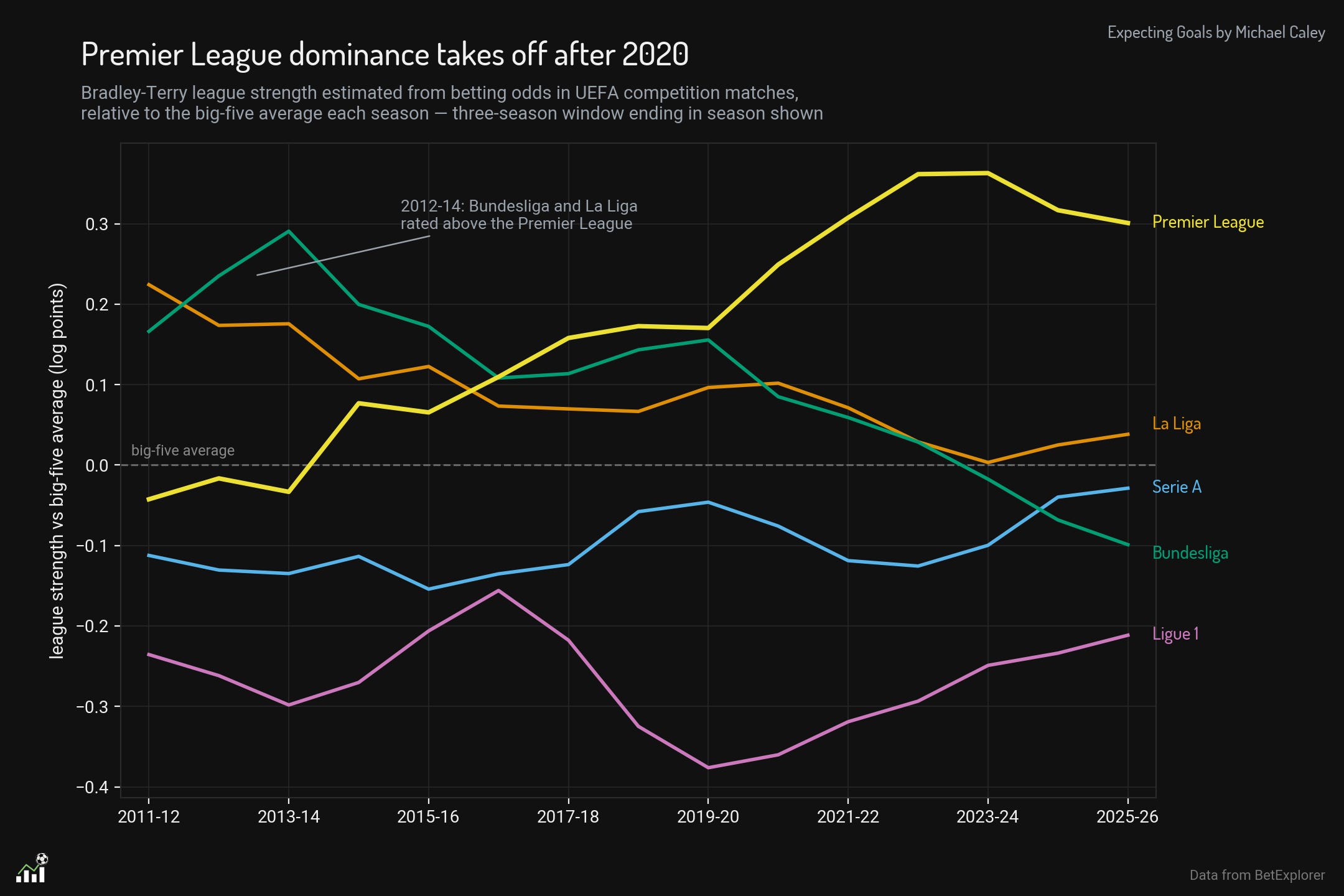
This finding obviously raises major questions about what player statistics mean. The 2010s in retrospect look like a golden age for analysts, when performance levels in the different leagues were close enough to suggest players would translate reasonably well between the major leagues. But today, these results indicate that players in the Premier League are facing tougher competition week in and week out than those in the Bundesliga or La Liga, and the gaps between the leagues are increasing.
So, this raises obvious questions about statistical adjustments. Should the statistics of players who have been playing in the Bundesliga be adjusted down relative to those who have been playing in the Premier League? And by how much?
League Translations: Goals are down for imports
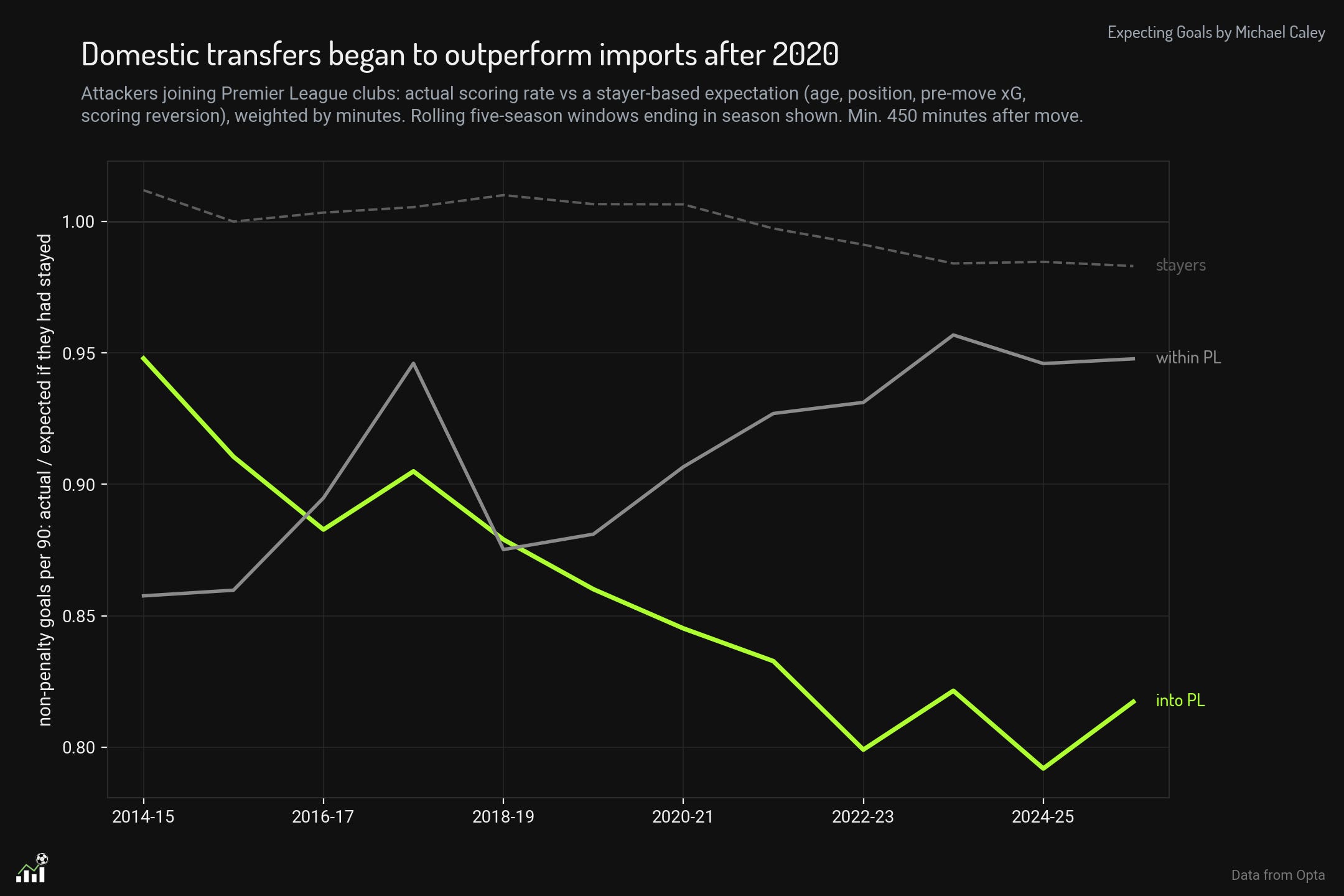
What I found is that there has been a real shift in how player statistics have translated to the Premier League that tracks these economic changes. For simplicity, I looked at non-penalty goals.1 Ultimately, when teams sign attackers, they want goals, and it’s an easily available statistic. Early in the 2010s, there was actually a premium for goal-scoring from outside the Premier League, with players moving into the league commonly putting up better numbers compared to players moving within the league. Over the decade this began to shift, and it has fully reversed by the 2020s, with Premier League players now retaining far more of their goal-scoring when they transfer within the league.