


There were more delays and less football during the 2025–26 season in the Premier League and across Europe. The percentage of time with the ball in play in Premier League matches fell to 55 percent, its lowest level in years, while across the big five leagues it was only marginally higher. Teams were letting the clock run before throw-ins as they sought to create set piece opportunities, and restarts on free kicks, goal kicks and corners were all slower.
The governing bodies of the sport reacted impressively quickly. The IFAB rolled out a set of rule changes before the 2026 World Cup, which have remained in effect for the 2026–27 league season, targeting different kinds of delays with specific sanctions.
Goal kicks and throw-ins: The referee has discretion to begin a five-second count when they consider the team to be delaying a restart. If a team does not put the ball in play this will result in a turnover. A throw-in would be given the other way for a delayed throw, while a corner kick would be given on a delayed goal kick.
Substitutions: The referee may begin a ten-second count on a player leaving the field of play. If they do not get off the pitch in time, the new substitute will not be allowed on the pitch until the next stoppage in play, after a minute has passed.
Injury delays: If a player receives treatment on the pitch, they must remain off the pitch for 60 seconds after the restart of play. (There are exceptions for goalkeepers and for injuries following yellow or red card offenses.)
The rule changes seem to have been effective. Even though the average overall match length is slightly down this season, ball in play time is up. The percentage of match time spent with the ball in play is reaching new heights.
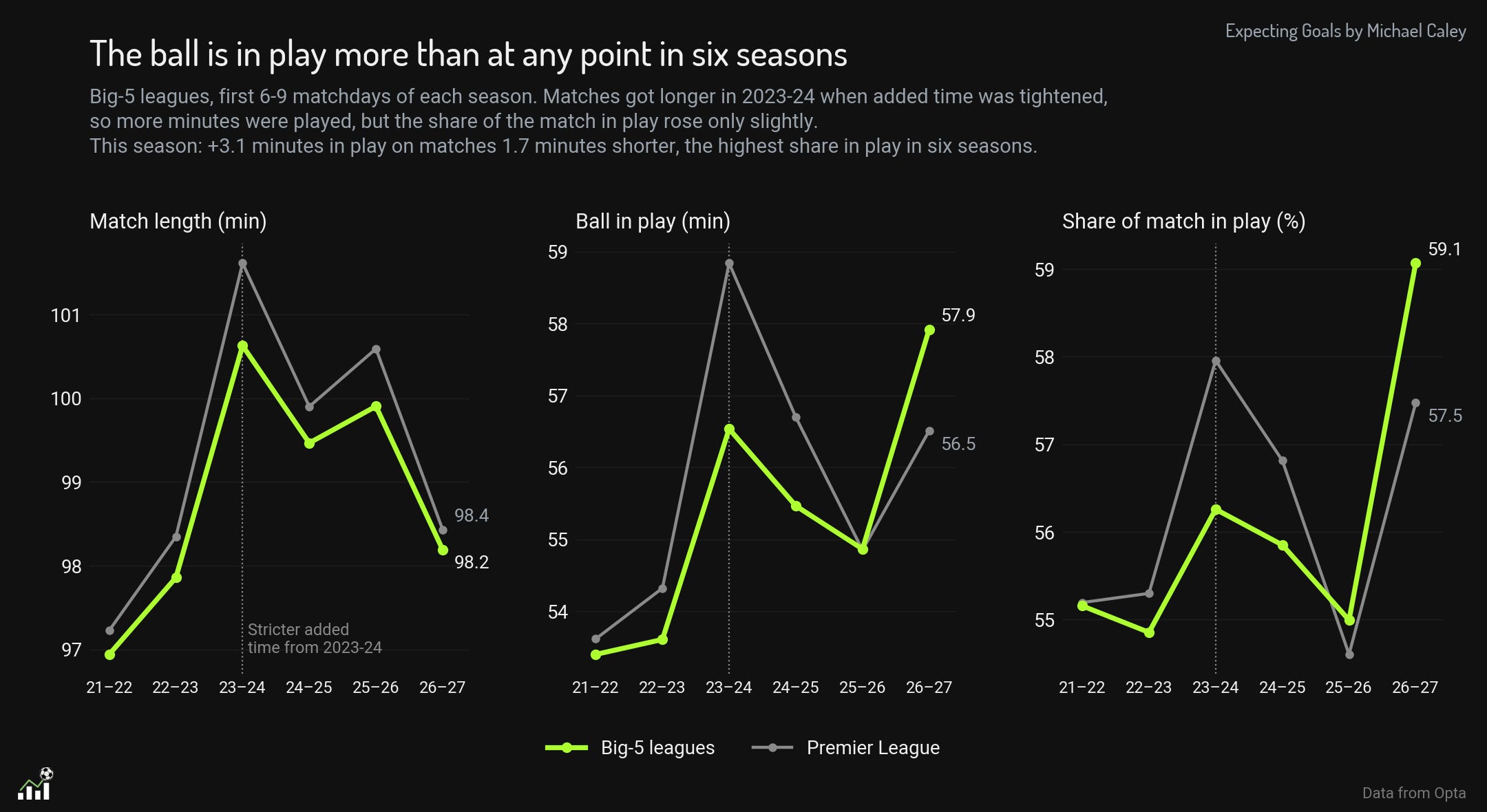
Match length and thus total time in play spiked in 2023–24 with guidance to referees to count stoppage time more aggressively, but this change did little overall to impact delays, and the pace of play continued to slow. So far in the 2026–27 season, the results are clear. Ball in play time is up while the amount of time spent on delays is down nearly five minutes per match.
Where did these five minutes come from? Mostly the new rules.
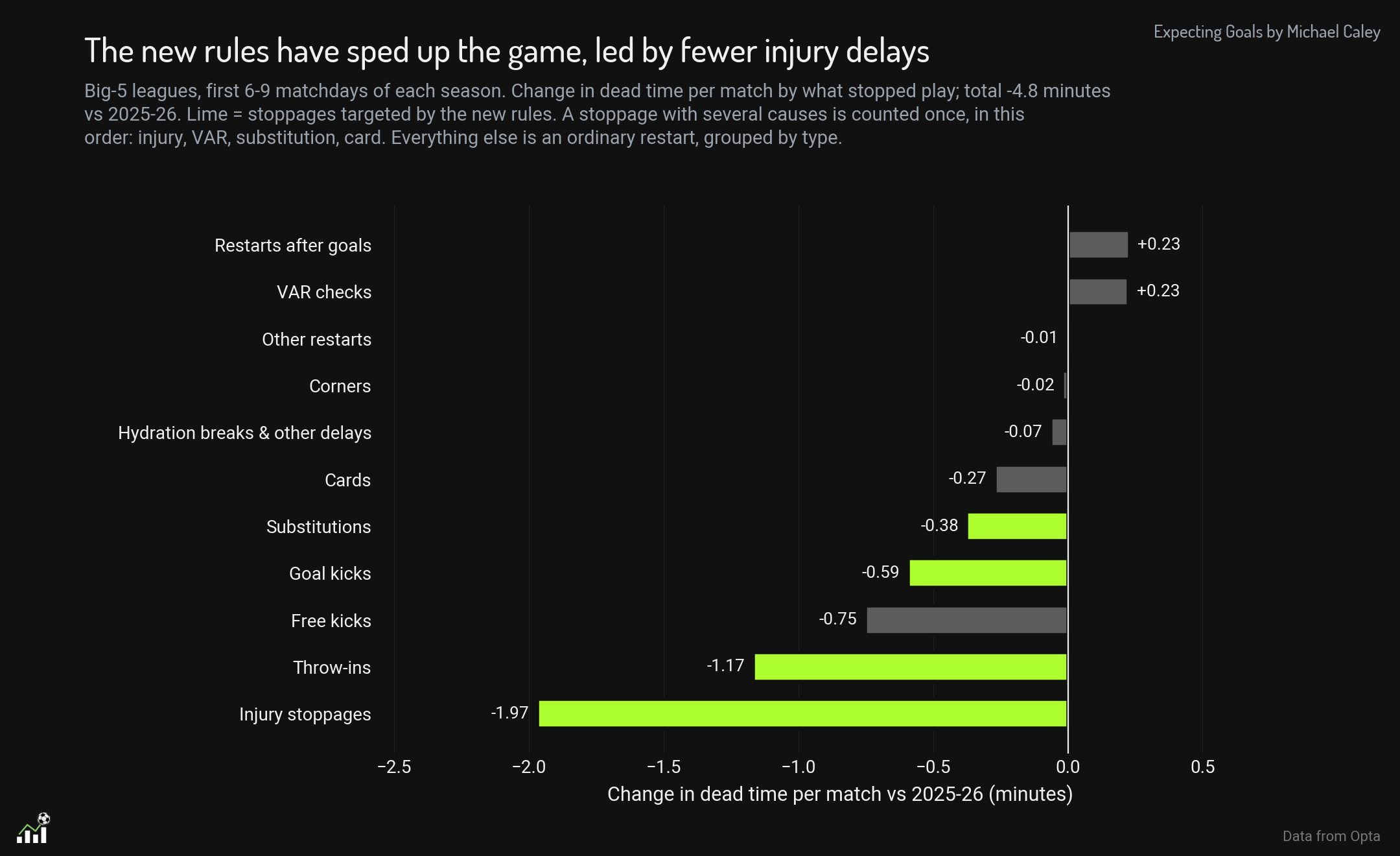
There were nearly two more minutes of injury stoppage per match in the big five leagues last season, compared to this season so far. Throw-in delays are down by a little over a minute per match, and goal kicks and substitutions account for about another minute. Notably corner kicks, which are not under any new pace-of-play restrictions, have not seen any change in the time taken in preparation.1
The number of throw-ins and goal kicks per match has barely changed, but teams are delaying about two seconds less on throw-ins and about three seconds less per goal kick. By contrast the average injury stoppage has gotten somewhat longer, but the number of injury delays has roughly halved, from 2.6 to 1.3 per match. This is exactly what the new rules were designed to do: crack down on slow restarts and eliminate unnecessary treatment delays.
But I think it is perhaps unexpected that the single largest driver of the change is the new rule on injuries. And when you dig into the numbers you can see why this rule has been so effective. During the minute when sides are playing with 10 men and waiting for their teammate to return to the pitch, they are under relentless pressure and concede chances at a rate that would be equivalent to losing a full match by two goals. It is a significant advantage that players are quite reasonably doing everything they can to avoid giving to their opponents.
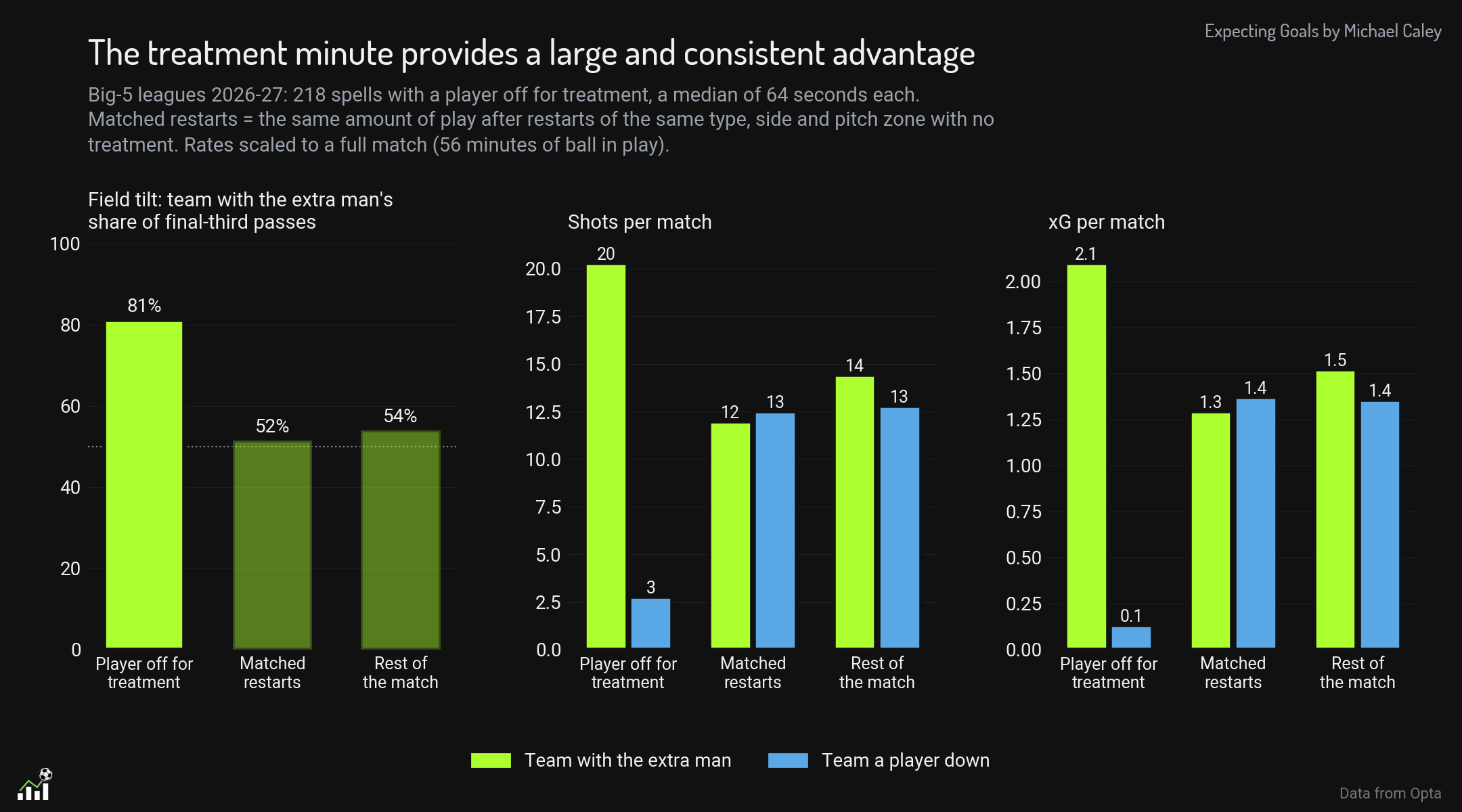
So what is going on here? And why does it seem no one has noticed?
