


Cavan Sullivan has been the next great American hope for a while. When Sullivan was just 14 years old, his MLS club, the Philadelphia Union, agreed with Manchester City on transfer terms to send him to the Premier League when he turns 18. Then he became the youngest-ever player in MLS when he debuted at age 14 in 2024. This season for the Union, Sullivan spent most of the spring as a rotation player, with six starts out of 13 appearances for about 650 minutes. His contributions were good, especially for a 16-year-old, but unspectacular. The potential was obvious, but it remained potential, a story about how well-regarded he was in the game.
Over the World Cup summer break, this story changed. Sullivan was added to the Union’s starting XI on July 23 and has started every match since. He has been one of the best players in MLS since joining the lineup, with five goals and four assists in a little under 900 minutes. Now these performances have earned Sullivan his first call-up to the United States Men’s National Team for a set of friendlies during the upcoming international break.
It is always exciting for fans when a hyped prospect starts to deliver on his potential. And it is even more exciting for statistical analysts who write newsletters when a player finally gets enough minutes in a senior league to develop an objective statistical profile.
And it’s a good profile.
What kind of player is Cavan Sullivan?
Sullivan has now played over 1,500 minutes for the Philadelphia Union, and what stands out immediately in his numbers is that he does everything well. In my xG system he is averaging nearly 0.7 expected goals plus expected goals assisted per 90 minutes, split about evenly between xG and xG assisted. He is averaging a little under three shots attempted and two shots assisted per 90. And he is also carrying a heavy ball progression load for the Union, averaging nearly five progressive passes and four progressive carries per 90 as well. Each of these numbers individually stands in the top 10 to top 30 in MLS this season among attackers, but very few players have managed to contribute in so many ways at once.
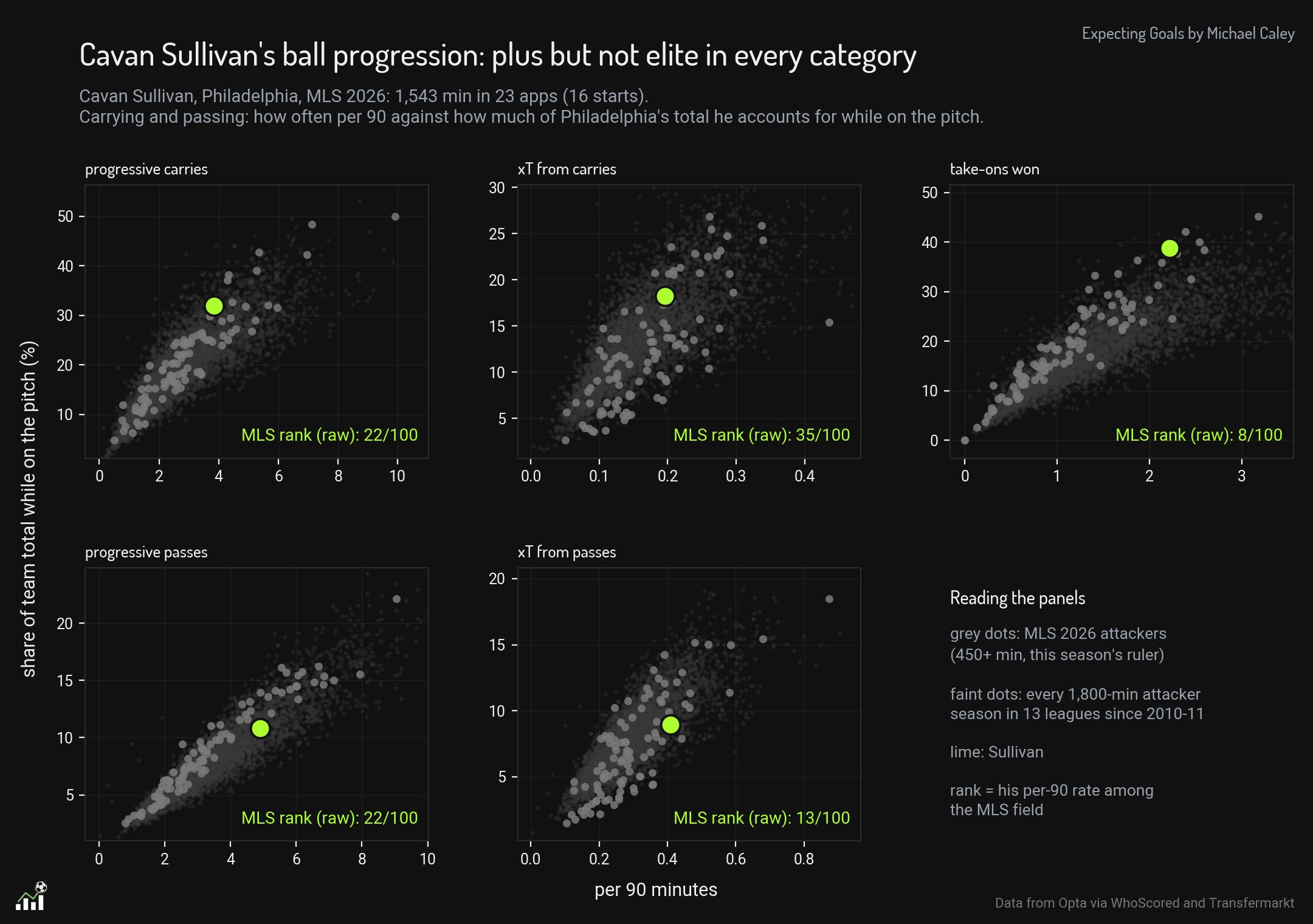
Sullivan’s take-ons are his clearest standout statistic, but demonstrating roughly equal skills moving the ball forward by carry or by pass stands out. And that’s without getting into the goals and the shot creation.

Once again, he is filling up the box score, getting good shots for himself, finishing them at a reasonable rate, and creating for his teammates.
Sullivan’s numbers also raise one point about how the Expecting Goals “Remember Some Guys” Comps System works. The charts above show Sullivan’s numbers on scatter plots. The y-axis (the height of the dot) shows his raw production. The x-axis (how far to your right the dot is) shows his production as a share of his team’s production while on the pitch. The comps system uses a blend of raw and team share, to capture how player production in soccer is a function of both the player’s own abilities and the quality of their teammates and tendencies of the tactical system in which they play. For Sullivan, his Philadelphia Union teammates have been putting up elite passing and xG numbers while he’s been on the pitch. So in the “team share” portion, his end product and passing progression are downgraded. But he is the only player on the Union doing lots of ball-carrying, which in turn bumps up his ratings on that metric. Opposition defenses should know to key on Sullivan as the team’s top ball-carrier and 1v1 attacker, and he still puts up numbers.

Sullivan’s xG per 90 is 19th among MLS attackers but his xG share is just 57th. That is the most extreme case, but in general, the Union have not depended particularly on Sullivan to finish their chances. What the team share adjustment does is take an already-balanced statistical profile and make it even more balanced by scaling up the ball carrying and slightly scaling down the passing and end product.
In broad strokes, this is a recognizable kind of player. I ran the comps system for every league I have coded in and found a large number of similar seasons. Obviously these player-seasons are comparable to one another only in relation to their leagues. A player who can put up the same numbers against Premier League opposition has done something more impressive than someone putting up that record in the Eredivisie. But as a type of player, this captures what Sullivan has shown.
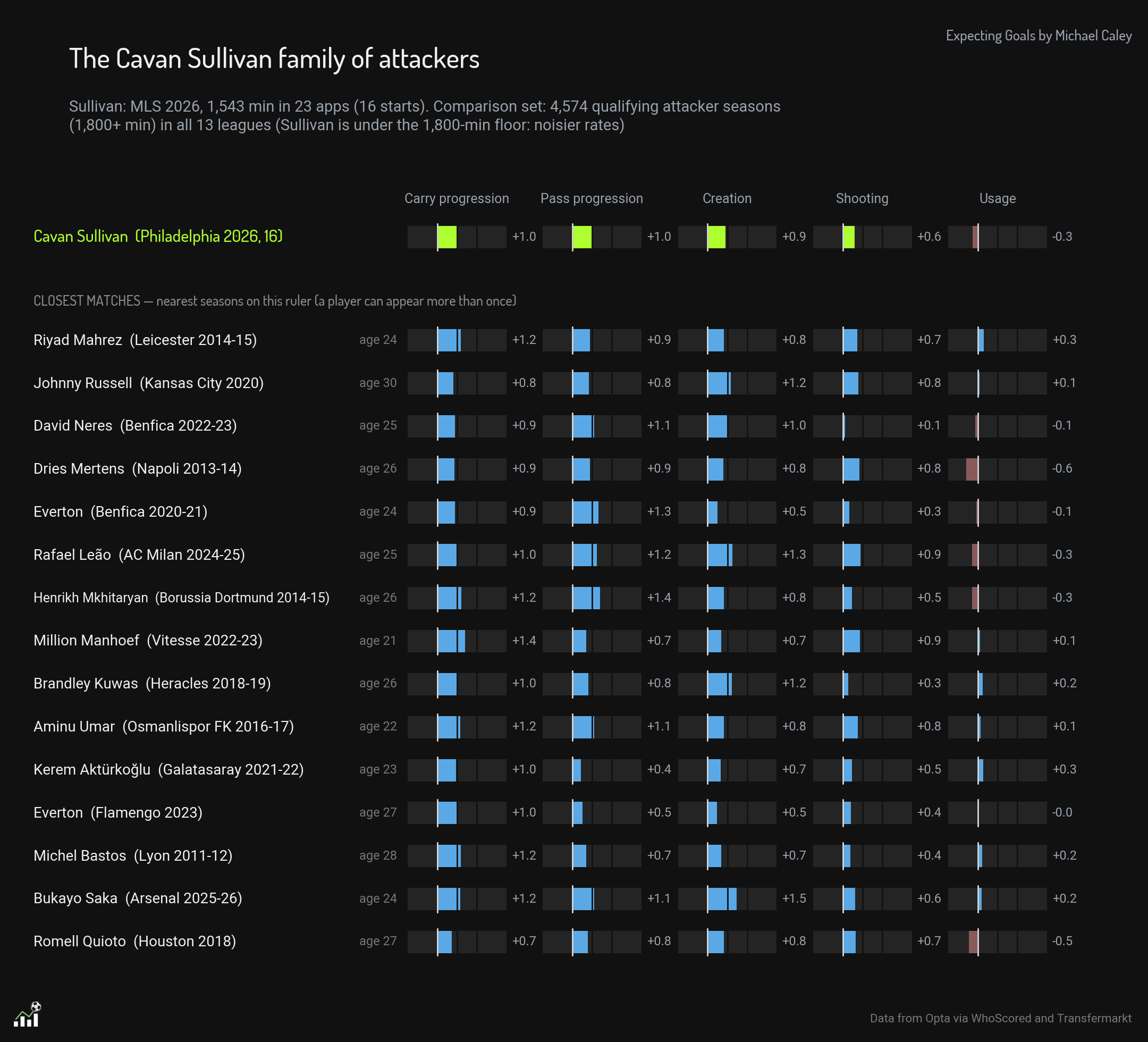
For fans of top-level European soccer, the type here is exemplified by Riyad Mahrez, Dries Mertens and Henrikh Mkhitaryan. These are players who played off the wing, but tended to come inside and often attacked more from the 10 space than the wing. Sullivan, despite playing on the wing, has only about 57 percent of his touches in wide areas. Pure wingers tend to be at 75 percent, and inverted wingers in the 60s. This balanced positional profile then tends to go along with a balanced statistical profile, mixing passing and carries and shot production.1
For fans of MLS, Johnny Russell of Sporting KC offers one of the best comps—Russell has two other seasons in the top 50 for Sullivan as well. He was another wide attacker who didn’t have the pure pace of a traditional winger, but depended on a varied mix of skills and an ability to play in the center of the pitch and the penalty area.
What this captures, I think, is that players who are above average in every aspect of attacking play are rare and valuable. They are not superstars, but they are among the top players at their positions in the league. And they typically have a similar positional profile to Sullivan, as wing-10 hybrids. They are usually not the most elite athletes but use a mix of skills to elevate their games.
This analysis raises a number of questions. We can describe Cavan Sullivan’s current player type. We can say Cavan Sullivan is putting up numbers that rate among the best in MLS. But what does that mean? He’s 16 after all. Will he become a superstar from here? The comps chart did not include anyone under the age of 21 and most of the players were in their mid-20s or later? What happens to young players who show these types of skills at a very young age?
Further, there are league and opposition quality questions. How tough is it to play against MLS defenders? How good is Major League Soccer in 2026? What would we expect to happen if Sullivan joined Manchester City in a year and a half, or what if he was loaned out to the Championship or the Eredivisie? How does MLS stack up with those leagues?
Cavan Sullivan is not particularly similar to any other young players
I need to start with that header because otherwise the top comps chart is an absurd headline of its own.
Yes, that’s Lamine Yamal.
